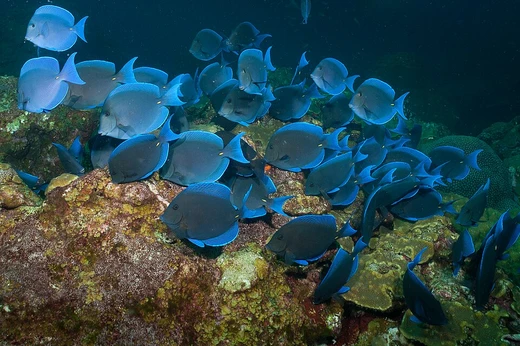
Grey unicornfish
A bluish-grey unicornfish found in Indo-Pacific reef habitats.

The grey unicornfish (Naso caesius), also called the silverblotched unicornfish, is a marine ray-finned fish in the family Acanthuridae, which includes surgeonfishes, unicornfishes, and tangs. It lives in the Indo-Pacific region. Its name comes from the Latin word *caesius*, meaning "bluish grey," which describes its overall color. The fish can reach a maximum standard length of 45.6 cm (18.0 in). Its body is bluish-grey or greyish-brown, sometimes showing irregular blotches or bars along the sides that may be lighter or darker than the background. The dorsal fin has 6 or 7 spines and 27 to 30 soft rays, while the anal fin has 2 spines and 28 to 31 soft rays. The pectoral fin has 16 to 18 rays, with the upper two being simple and unbranched. On the caudal peduncle, there are oval-shaped keels with spines that project outward but are not sharp. This species was first formally described in 1992 by American ichthyologist John Ernest Randall and marine biologist Lori Jane Bell Colin, based on a type specimen from the northern side of the East Channel of Eniwetak Atoll in the Marshall Islands. It belongs to the nominate subgenus of the genus *Naso*, which is the only genus in the subfamily Nasinae. The grey unicornfish is found mainly in the western Central Pacific, including Palau, the Mariana Islands, the northern Marshall Islands, the Hawaiian Islands, the Great Barrier Reef, Osprey Reef, the Chesterfield Islands, New Caledonia, Fiji, Tuvalu, the Society Islands, and the Pitcairn Islands. In Australian waters outside the Great Barrier Reef, it occurs at Lord Howe Island, reefs in the Coral Sea as far south as the Kurnell Peninsula in New South Wales, reefs off Western Australia, Ashmore Reef, and the Indian Ocean islands of Christmas Island and the Cocos (Keeling) Islands. It is a benthopelagic fish that lives over rock and coral substrates, either alone or in schools, in clear waters of lagoon reefs, reef channels, or seaward reefs at depths between 15 and 50 m (49 to 164 ft), where it feeds on zooplankton.
Quick Facts
- Parent
- Naso (Naso)
- Taxon
- Naso caesius
Facts from the source article.
Lore & Background
Naso caesius was first formally described in 1992 by American ichthyologist John Ernest Randall and marine biologist Lori Jane Bell Colin, with the type locality given as the northern side of the East Channel of Eniwetak Atoll in the Marshall Islands. It is classified within the nominate subgenus of the genus Naso, which is the only genus in the subfamily Nasinae within the family Acanthuridae. The specific name caesius is Latin for 'bluish grey', referring to the overall colour of this fish.
The grey unicornfish has a dorsal fin supported by 6 or 7 spines and between 27 and 30 soft rays, while the anal fin has 2 spines and between 28 and 31 soft rays. The pectoral fin contains 16 to 18 fin rays, with the upper two being simple and unbranched. The keels on the caudal peduncle are oval shaped with spines that project outward but are not acute. The overall colour is bluish-grey or greyish-brown, and the fish can create a series of irregular blotches or bars along the flanks, which may be lighter or darker than the background colour. The maximum published standard length is 45.6 cm.
This species is found mainly in the western Central Pacific, including Palau, Mariana Islands, northern Marshall Islands, Hawaiian Islands, Great Barrier Reef, Osprey Reef, Chesterfield Islands, New Caledonia, Fiji, Tuvalu, Society Islands, and Pitcairn Islands. In Australian waters, it occurs at Lord Howe Island, reefs in the Coral Sea as far south as the Kurnell Peninsula in New South Wales, off Western Australia, and at Ashmore Reef, Christmas Island, and the Cocos (Keeling) Islands. It is a benthopelagic species found over rock and coral substrates, occurring solitarily or in schools in clear waters of lagoon reefs, reef channels, or seaward reefs at depths between 15 and 50 m, where it feeds on zooplankton.
Reader's Guide
The grey unicornfish is a member of the family Acanthuridae, which includes surgeonfishes, unicornfishes, and tangs. Its description in 1992 by Randall and Colin added to the known diversity of the genus Naso, the only genus in the subfamily Nasinae. The species is distinguished by its bluish-grey colour and the oval, non-acute keels on its caudal peduncle. Its distribution across the Indo-Pacific, from the Marshall Islands to the Great Barrier Reef and as far as the Pitcairn Islands, highlights its adaptability to clear-water reef environments. The fish occupies benthopelagic habitats over rock and coral substrates at depths of 15 to 50 m, where it feeds on zooplankton, either alone or in schools. Its presence in both lagoon and seaward reefs underscores its ecological role in these ecosystems. The species' maximum standard length of 45.6 cm indicates a moderately sized unicornfish. The specific name caesius, meaning 'bluish grey', directly references its coloration, which can include irregular blotches or bars. This fish contributes to the understanding of reef fish diversity and distribution in the Indo-Pacific region.
Did You Know?
- The grey unicornfish was first formally described in 1992 by John Ernest Randall and Lori Jane Bell Colin.
- It feeds on zooplankton and occurs at depths between 15 and 50 m.
Frequently Asked Questions
What is the Grey unicornfish?
The Grey unicornfish (Naso caesius), sometimes called the silverblotched unicornfish, is a marine ray-finned fish belonging to the Acanthuridae family alongside other surgeonfishes and tangs. It is native to reef environments across the Indo-Pacific region.
How big does a Grey unicornfish get?
Adults can reach a maximum standard length of about 45.6 cm (roughly 18 inches), making it a moderately sized member of the unicornfish group.
What does the Grey unicornfish look like?
Its body is typically bluish-grey or greyish-brown, and individuals may display irregular lighter or darker blotches and bars running along the flanks. The dorsal fin carries six or seven spines followed by 27 to 30 soft rays, while the anal fin has two spines and 28 to 31 soft rays.
Where does the Grey unicornfish live?
It inhabits coral-reef habitats throughout the Indo-Pacific, where it is commonly encountered among the mixed assemblages of tangs and surgeonfishes.
Why is it called 'caesius'?
The species epithet comes from the Latin word *caesius*, meaning 'bluish grey,' a direct reference to the fish's characteristic overall coloration.
More in Tangs and Surgeonfish 1-24
Spotted an error? Know more?
Reader corrections go straight into our review queue. Suggest an edit · How this site is sourced