Wayland the Smith
Legendary smith of Norse and Germanic myth.

Wayland the Smith (Old English: Wēland; Old Norse: Vǫlundr) is a figure from Norse and Germanic legend, known as a master smith whose skill, cleverness, and story of enslavement and vengeance define his myth. The most detailed accounts come from the Old Norse *Völundarkviða* (a poem in the Poetic Edda) and *Þiðreks saga*. In these, a king enslaves Wayland, who retaliates by murdering the king’s sons, then fashions a feathered cloak to fly away to freedom. Other sources, including the Old English poem *Deor* and the Franks Casket, allude to similar events. Wayland also appears in passing as a maker of weapons and armor in texts such as *Waldere* and *Beowulf*.
The name “Wayland” comes from Proto-Germanic *Wēlandaz*, itself from *Wilą-ndz* (“crafting one”). It takes forms like Old Norse “Vǫlundr” or “Velent,” Old Frisian “Wela(n)du,” Old High German “Wiolant” (compare modern German Wieland Der Schmied), and Old French “Galans” or “Galant.”
The earliest possible reference is a gold solidus from around 575–625 AD, found near Schweindorf in Ostfriesland, Germany, bearing the Frisian runic inscription ᚹᛖᛚᚪᛞᚢ (*wela[n]du*). It is unclear whether this coin depicts the legendary smith or simply names a moneyer who used the name (perhaps as an epithet).
In Scandinavia, Wayland’s story appears visually on Ardre image stone VIII and possibly on a tenth-century copper mount from Uppåkra, found in 2011. Other early medieval Scandinavian images are harder to confirm, as they lack enough distinctive details matching the textual accounts.
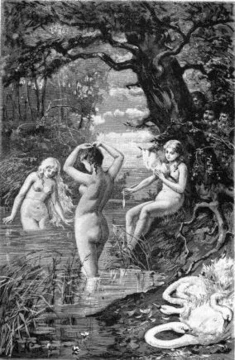
According to *Völundarkviða*, the king of the Finns (a term for Finnish, Baltic Finnic, and Sámi peoples) had three sons: Völundr and his brothers Egil and Slagfiðr. In one version, the three brothers lived with three Valkyries—Ölrún, Hervör alvitr, and Hlaðguðr svanhvít—who left after nine years; Egil and Slagfiðr followed them and never returned. In another version, Völundr married the swan maiden Hervör, had a son named Heime, but she later left him. In both versions, his love left him a ring, and in the former myth he forged seven hundred copies of it.
Later, King Niðhad captured Völundr while he slept in Nerike, had him hamstrung, and imprisoned him on the island of Sævarstöð, forcing him to make items for the court. The king gave Völundr’s wife’s ring to his daughter Böðvildr, and Niðhad himself took Völundr’s sword.
- Name
- Wayland the Smith
- Also known as
- Vǫlundr, Velent, Wieland
- Field
- Legendary master blacksmith
- Mythology
- Norse and Germanic
- Known for
- Craftsmanship, revenge against King Niðhad, escape via a winged cloak
- Earliest evidence
- Gold solidus with Frisian runic inscription, c. AD 575–625
Lore & Background
According to Völundarkviða, Wayland was one of three sons of the king of the Finns. He lived with Valkyries, but after they left, he was captured by King Niðhad, hamstrung, and imprisoned on an island, forced to forge items for the king. In revenge, Wayland killed the king's sons, fashioned goblets from their skulls, jewels from their eyes, and a brooch from their teeth, then seduced the king's daughter Böðvildr before flying away in a winged cloak.
Reader's Guide
Wayland the Smith is a central figure in Norse and Germanic mythology, embodying the archetype of the cunning artisan who turns captivity into revenge. His story, preserved in Völundarkviða and Þiðreks saga, influenced Old English poetry and visual art, such as the Franks Casket and stone carvings in northern England. The name 'Wayland' originates from Proto-Germanic *Wēlandaz, meaning 'crafting one,' and his legend was so pervasive that a Neolithic long barrow in Oxfordshire became known as Wayland's Smithy, where folk belief held he would repair tools left with a sixpenny piece. His association with Daedalus in Icelandic manuscripts further underscores his status as a master craftsman of myth.
Did You Know?
- The oldest known reference to Wayland is a gold solidus with a Frisian runic inscription, dated AD 575–625.
- In Þiðreks saga, Wayland's flying contraption was called a 'flygil,' suggesting wings, but conceived as a feather cloak by saga-writers.
- Wayland is associated with Wayland's Smithy, a Neolithic long barrow in Oxfordshire where folk belief held he would repair tools.
- In Icelandic manuscripts, the terms Labyrinth and Domus Daedali are rendered Vǫlundarhús, equating Wayland with the classical hero Daedalus.
More in Swan maidens 1-21
Spotted an error? Know more?
Reader corrections go straight into our review queue. Suggest an edit · How this site is sourced