The King of Ireland's Son
A children's novel based on Irish folklore, published in 1916.

National Library of Ireland on The Commons · No restrictions
Padraic Colum’s *The King of Ireland’s Son*, a children’s novel released in Ireland in 1916, came with illustrations by Willy Pogany. The story follows the eldest son of the King of Ireland as he wins Fedelma, the Enchanter’s Daughter, only to have her kidnapped by the King of the Land of Mist. He then sets out to find her again. The book draws on Irish folklore and has been called “his great synthesis of fireside tales” and “a marvellous compendium of Irish folktales re-told.” The 1916 edition from Henry Holt includes full-colour plates interspersed throughout.
The work is regarded as a classic of Irish children’s literature, weaving together a series of magical tales into one long, intricate plot. It opens with the King of Ireland’s son—careless, with his hound, hawk, and horse—meeting an odd old man who challenges him to a game of chess, with the winner naming the stakes. Along the way, characters like Flann (also called Gilly the Goat-Boy), the proud Lasarfhiona (Flame-of-Wine), a magical Spae-Woman, and a harsh farmer who employs Flann add depth and memorability.
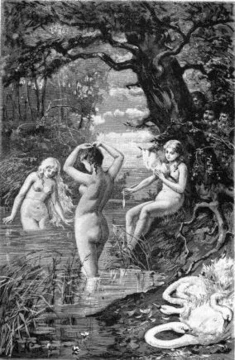
In the first part, “Fedelma, the Enchanter’s Daughter,” the prince loses a wager to his father’s enemy and must find him within a year and a day. A talking eagle advises him to watch for three swan maidens on a lake—the daughters of the Enchanter of the Black Back-Lands, the wizard he seeks. The prince hides the swanskin of the swan with a green ribbon, who turns out to be Fedelma, the Enchanter’s youngest daughter. At the Enchanter’s kingdom, he promises to marry Fedelma, resists the advances of her sisters Aefa and Gilveen, and must complete three difficult tasks for her father.
In “The Unique Tale,” the Spae-Woman tells the heroes a story: a queen wishes for a blue-eyed, blonde-haired daughter and carelessly wishes her sons to “go with the wild geese.” As soon as the daughter, named Sheen (“Storm”), is born, the seven princes turn into grey wild geese and fly away. Later, Sheen changes her name to Caintigern and becomes queen by marrying the King of Ireland, who is father to both the King of Ireland’s Son and Gilly of the Goatskin (Gilla Na Chreck An Gour). The seven wild geese are therefore their uncles.
Though written in America before 1916, Colum was a close friend and colleague of some who led the Easter Rising.
Quick Facts
- Author
- Padraic Colum
- Illustrator
- Willy Pogany
- Country
- Ireland
- Language
- English
- Genre
- Children's novel
- Release Date
- 1916
- Media Type
- Print (Hardcover)
Facts from the source article.
Lore & Background
The King of Ireland's Son is the story of the eldest of the King of Ireland's sons, and his adventures winning and then finding Fedelma, the Enchanter's Daughter, who after being won is kidnapped from him by the King of the Land of Mist. The work is described as 'his great synthesis of fireside tales' and 'a marvellous compendium of Irish folktales re-told'. The 1916 edition published by Henry Holt is interleaved with plates of illustrations in full colour.
In the first segment, Fedelma, the Enchanter's Daughter, the oldest son of the King of Ireland loses a wager against his father's enemy and should find him in a year and a day's time. He is advised by a talking eagle to spy on three swan maidens that will descend on a lake. They are the daughters of the Enchanter of the Black Back-Lands, the wizard the prince is looking for. The prince is instructed to hide the swanskin of the swan with a green ribbon, who is Fedelma, the Enchanter's youngest daughter. After arriving at the Enchanter's kingdom, he promises marriage to Fedelma, resisting her sisters' advances, and is forced to fulfill three difficult tasks to the Enchanter.
In the chapter The Unique Tale, the Spae-Woman tells the heroes a story of a queen who wishes for a blue-eyed, blonde-haired daughter, and carelessly wishes her sons to 'go with the wild geese'. As soon as the daughter (named Sheen, 'Storm') is born, the seven princes change into gray wild geese and fly away. It is later revealed that Sheen changed her name to Caintigern and became Queen when she married the King of Ireland, who is the father of two main characters: the King of Ireland's Son and Gilly of the Goatskin. The seven wild geese are, thus, their uncles.
Reader's Guide
The King of Ireland's Son is significant as a classic of Irish children's literature, drawing on Irish folklore to create a lengthy and complex narrative of interwoven magical stories. Although the book was written in America in the years before 1916, Colum was a close friend and colleague of some of those who led the Easter Rising. The work was described as 'the ultimate calling-up of Irish mythology and legend', and paired with James Stephens' Irish Fairy Tales, it made many happy hours for children curled up before glowing turf fires to read by the light of Tilley lamps in the long winter evenings of the new Ireland. An adaptation from the original folktale was later written by Brendan Behan, published in Brendan Behan's Island, 1962.
Did You Know?
- The novel was published in Ireland in 1916 and illustrated by Willy Pogany.
- The story includes characters such as Flann (Gilly the Goat-Boy), Lasarfhiona (Flame-of-Wine), and the Spae-Woman.
- In the chapter The Unique Tale, a queen's careless wish causes her seven sons to turn into gray wild geese.
- An adaptation of the original folktale was written by Brendan Behan and published in 1962.
Gallery




Frequently Asked Questions
Who is The King of Ireland's Son?
He is the title character, the eldest son of the Irish king, who serves as the protagonist of Padraic Colum's 1916 children's novel. His central quest involves winning the hand of Fedelma, the Enchanter's Daughter, and then tracking her down after she is taken by the King of the Land of Mist.
What are The King of Ireland's Son's powers or role in the story?
He functions as the heroic quester, a young prince who must journey through a world of enchantment and mist to rescue the woman he has won. His role mirrors classic Irish folklore heroes who test their worth through trials of courage and determination rather than raw magical power.
Who wrote and illustrated The King of Ireland's Son?
The novel was written by Irish author Padraic Colum and brought to life with full-colour plates by the Hungarian-born illustrator Willy Pogany. The 1916 Henry Holt edition intersperses these vivid illustrations throughout the text.
Why is The King of Ireland's Son important in folklore circles?
It is widely regarded as a classic synthesis of Irish fireside tales, weaving together multiple folkloric threads into a single adventure for young readers. Critics have praised it as a marvellous compendium of traditional Irish stories reimagined for a new generation.
More in Swan maidens 1-21
Spotted an error? Know more?
Reader corrections go straight into our review queue. Suggest an edit · How this site is sourced