Graelent
A Breton lai of a knight, a fairy mistress, and a secret love.

Graelent is an Old French Breton lai, named after its protagonist. It is one of the so-called anonymous lais.
- Type
- Old French Breton lai
- Protagonist
- Graelent, a knight of Brittany
- Related texts
- Lanval (Marie de France), Guingamor
- Manuscript era
- 13th century (based on editions)
- Notable adaptations
- Old Norse Grelent, Middle English Sir Launfal
Lore & Background
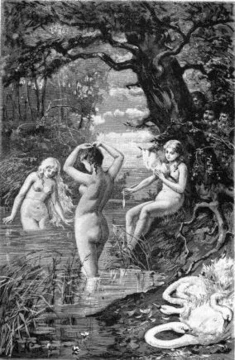
The plot is similar to that of Marie de France's lai of Lanval. Graelent, a knight of Brittany, rebuffs amorous advances from the queen, who retaliates by manipulating the king against him. Graelent's wages are suspended, reducing him to poverty. Graelent dejectedly rides into the forest, and while tracking a white hind, he stumbles upon a beautiful lady bathing in the fountain, attended by two maidens. Graelent sneaks up and clutches the articles of clothing she has disrobed upon a bush. The lady cries out his name, demanding their return. Graelent does not comply, and bargains for her to emerge from the fountain, and asks for her love. She is at first scornful at the suggestion, but Graelent rapes her, and she then decides to help him. She would appear to him whenever he wills it, but the relationship must be kept a strict secret, and the couple are to abide in the country for one year while avoiding detection from comrades. Graelent receives from the lady a magnificent war horse, and large sums of gold and silver. He repays his debt to the burgess's hostel where he stayed, and begins entertaining many knights, regaling them with food and harpers' music. He spends other hours of the day and nights with his lady. Graelent is now extricated from financial difficulties, but another ordeal is awaiting. A year goes by, and at the king's annual Pentecost feast, all present are expected to praise the beauty of the queen as being greater than any other that they know. Graelent refuses, blurting out that he knows a woman thirty times as beautiful. The enraged queen dares him to produce this woman on pain of punishment, and the king orders him thrown in prison. The lady does not appear at his whim as she has always done before, and Graelent is struck by remorse, but gains no reprieve until the next Pentecostal feast, when he is given a last chance to ride out and find his lady. Graelent returns empty-handed, and resigns himself to trial, but just then beautiful damsels arrive in court, with the message that the lady will soon be present to acquit Graelent of his veracity. Unlike Lanval, the 'fairy mistress' here does not immediately take him back, and sets off on the journey back to her world beyond the river. Graelent follows mounted on the white horse she has given him, and ignoring her warning, begins to ford the river but is unhorsed and begins to drown.
Reader's Guide
Graelent closely resembles the plotline to Lanval by Marie de France, and the texts are considered interrelated. There has been considerable disagreement over the years among commentators regarding their authorship, the chronological order, and mutual relationship. Graelent was initially published as a work by Marie de France by Jean-Baptiste-Bonaventure de Roquefort in 1820, and subsequently translated as one of her works by Eugene Mason (1911), but this attribution is considered erroneous. Although some early scholars such as Gaston Paris (1889) considered Graelent to antedate Lanval, and later William C. Stokoe, Jr. (1948) continued to argue it as the source of Lanval, many have voiced dissent, and the contrary opinion is the recent consensus, according to Glynn S. Burgess. The definitive view of these three lays (the third being Guingamor), chronologically and thematically, is that of R. N. Illingworth, who concluded that they were composed in the order Lanval, Graelent, and Guingamor, with Graelent and Guingamor (both anonymous) drawing on Lanval, but Guingamor also drawing on Graelent. Moreover, although the narratives were taken largely from Marie, the two anonymous lays integrated into their stories, independently of Marie, material stemming from 'a nucleus of genuine Celtic tradition'. The protagonist robbing the bathing lady's garment is a common swan maiden folklore motif, and William Henry Schofield felt this was borrowed specifically from the story of Wayland the Smith, which survive in the Middle High German Friedrich von Schwaben and the Eddic poem Völundarkviða. Schofield also discerned borrowings from the Irish narrative Noinden Ulad ('Debility of the Ulstermen'). Graelent was translated into Old Norse as Grelent, one of the Strengleikar; this text has value for tracing the textual history of the French lai. In its turn, this translation seems to have influenced the Icelandic romance-saga Samsonar saga fagra and the rímur Skíðaríma, both of which include characters called Grelent. The Middle English Sir Launfal by Thomas Chestre is considered a composite, based on Lanval with elements added from Graelent.
Frequently Asked Questions
What is Graelent?
Graelent is an anonymous Old French Breton lai from roughly the 13th century in which a penniless Breton knight encounters a fairy lady bathing at a forest fountain. Its plot closely mirrors Marie de France's Lanval, and it sits within the broader cycle of anonymous Breton lais.
Who is the swan maiden in Graelent?
The fairy lady is a supernatural being who bathes at a fountain accompanied by two attendants; the moment Graelent snatches her garments from a bush, she calls him by name, revealing that she already knows his identity. Her otherworldly nature is underscored by that uncanny recognition and by the white hind that leads him to her.
How does Graelent's story begin?
The knight first turns down the queen's romantic overtures, and in revenge she turns the king against him and has his wages cut off. Left destitute, he rides mournfully into the forest, chases a white hind, and stumbles upon the fairy lady at her fountain.
What adaptations and related texts exist for Graelent?
The tale was adapted into Old Norse as Grelent and into Middle English as Sir Launfal, and it is closely linked to Marie de France's Lanval and the lai Guingamor. All of these versions share the core motif of a knight binding a fairy lady by taking her garments.
More in Swan maidens 1-21
Spotted an error? Know more?
Reader corrections go straight into our review queue. Suggest an edit · How this site is sourced