Egil, brother of Volund
Legendary archer and brother of the smith Völund.

Jarvin - Jarle Vines · CC BY-SA 3.0
Egil is a legendary hero known from the *Völundarkviða* and the *Thidreks saga*, where he appears as a masterful archer and the brother of the smith Völund. His name comes from the Proto-Germanic *Agilaz*, and the same story shows up in Old English as Ægil on the Franks Casket and in Alamannic as Aigil on the Pforzen buckle.
The original Proto-Germanic version of the tale can only be guessed at, but it likely portrayed Egil as a famous archer who defended a stronghold alongside his wife Alruna against many attackers. The Pforzen buckle is uncertain beyond naming Aigil and Ailrun, possibly adding that they fought a battle at the Ilz river. The Franks Casket depicts Ægil and his wife enclosed in a keep, with Ægil shooting arrows at attacking troops.
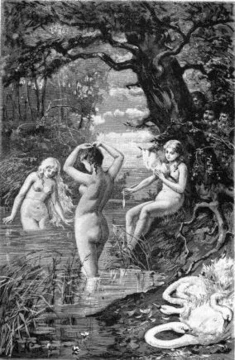
In the *Völundarkviða*, Egil is a son of a Finn king, with an older brother named Slagfiðr and a younger brother, Völund. The three brothers marry valkyries they meet in swan form: Slagfiðr marries Hlaðguðr svanhvít, Völund marries Hervör alvitr (both daughters of King Hlödver), and Egil marries Ölrún, who is called 'dóttir Kiárs af Vallandi' (Kiár of Valland).
In the *Thidreks saga*, Egil acts as a peerless archer. King Nidung forces him to shoot a nut (or small object) off his own son’s head. Egil prepares two arrows but succeeds with the first. When the king asks what the second arrow was for, Egil replies that if he had killed his son, he would have used it to shoot the king. Unlike the similar tales of William Tell or Palnatoke, Nidung does not punish Egil for his honesty but instead praises him (chapter 128). Later, Völund is crippled by Nidung and held captive. To help his brother, Egil shoots birds and collects their feathers, which Völund uses to make a pair of wings. Völund ties a bladder filled with blood around his waist and flies away. Nidung orders Egil to shoot his fleeing brother; Egil hits the bladder, tricking Nidung, and Völund escapes (chapter 135).
- Field
- Legendary hero, archer
- Known for
- Master archer, brother of Völund, nut-shot legend
- Nationality
- Son of a Finn king (Völundarkviða); associated with Kiár of Valland (Ölrún)
Lore & Background
In the Völundarkviða, Egil is a son of a Finn king, with elder brother Slagfiðr and younger brother Völund. The three brothers marry valkyries they encounter in swans' form: Egil marries Ölrún, who is called 'dóttir Kiárs af Vallandi' (Kiár of Valland).
In the Thidreks saga, Egil acts as a masterly archer. He is forced by king Nidung to shoot a nut (or small object) from the head of his son. He readies two arrows, but succeeds with the first. Asked by the king what the second arrow was for, he said that had he killed his son with his first arrow, he would have shot the king with the second. The king commends him for his openness. Later, to help his crippled brother Völund, Egil shoots birds and collects their feathers, from which Völund makes wings. Völund ties a bladder filled with blood around his waist and flies away. Nidung commands Egil to shoot his fleeing brother, who hits the bladder, deceiving Nidung, and so Völund escapes.
Reader's Guide
Egil's significance lies in his role as a legendary archer whose story parallels later figures such as William Tell and Palnatoke. The apple-shot episode in the Thidreks saga is directly comparable to those legends, though in Egil's case the king commends rather than punishes him for his threat. Egil also appears in the Franks Casket, where he is shown enclosed in a keep with his wife, shooting arrows against attacking troops. The Pforzen buckle may name Aigil and Ailrun and possibly mention a battle at the Ilz river, though its testimony is uncertain. Egil's legend, reflected across Germanic traditions, provides insight into shared heroic motifs and the transmission of oral tales. His assistance to Völund's escape further cements his role as a loyal brother and skilled archer, contributing to the broader narrative of the Völund legend.
Did You Know?
- Egil's name derives from Proto-Germanic *Agilaz.
- In the Thidreks saga, Egil shoots a nut (or small object) from his son's head, comparable to William Tell.
- Egil helps his brother Völund escape by shooting a bladder filled with blood.
Cross-Cultural Echoes and Material Testimony
The name Egil traces back to Proto-Germanic *Agilaz, and the legend bearing his name surfaces across multiple Germanic traditions and surviving physical artifacts. In Old English the figure appears as Ægil, depicted on the celebrated Franks Casket, while the Alamannic form Aigil is inscribed on the Pforzen buckle. The Pforzen buckle's testimony is modest—it names Aigil and Ailrun and possibly alludes to a battle fought at the Ilz river—but the Franks Casket offers a far more vivid tableau: Aegil and his wife sealed within a keep, with Aegil loosing arrows at waves of besieging troops. Scholars can only conjecture at the Proto-Germanic shape of the original tale, yet the broad outline seems recoverable: a renowned archer defending a stronghold alongside his wife against numerous attackers. The survival of this motif in both insular and continental Germanic contexts suggests the story circulated widely across the Germanic world long before it was crystallized in the Old Norse poetic and saga traditions.
The Swan-Maiden Court and Royal Lineage
In the Völundarkviða, Egil occupies a specific place within a triad of brothers, all sons of a Finn king. His elder brother is Slagfiðr and his younger is Völund, the famed smith. The three men each encounter valkyries disguised as swans and take them as wives. Slagfiðr claims Hlaðguðr svanhvít and Völund takes Hervör alvitr—both daughters of king Hlödver—while Egil's bride is Ölrún, identified as a daughter of the Roman Emperor, Kiár of Valland. This marriage alliance is striking in its geopolitical reach, linking the Finn royal house to the Roman imperial court. The swan-maiden motif binds the three brothers' narratives together, yet Egil's particular union with a figure of Roman imperial blood sets his story apart from his brothers'. He is thus positioned at the intersection of Norse, Germanic, and Roman mythological spheres, a bridge between the world of the Finn kings and the classical Mediterranean.
The Apple on the Head
In the Thidreks saga, Egil is tested as an archer of extraordinary skill when king Nidung compels him to shoot an apple balanced on his own son's head. Egil draws two arrows before releasing the first, which strikes true and fells the fruit. When Nidung demands to know the purpose of the second arrow, Egil answers without hesitation: had the first arrow killed his son, the second would have been aimed at the king himself. This episode is directly parallel to the Swiss legend of William Tell and the Danish tale of Palnatoke, all three involving a forced shot at a child's head and a defiant second arrow. However, the outcome diverges sharply from Tell's story. Rather than punishing Egil for his frankness, Nidung commends him for his boldness (chapter 128). The scene cements Egil's reputation as not merely a skilled marksman but a man of unflinching courage and absolute loyalty to his family.
The Flight of Völund
Egil's most heroic act in the Thidreks saga comes when his brother Völund, crippled and held captive at Nidung's court, needs to escape. Egil takes to the forest, shooting birds and gathering their feathers. Völund fashions these into a pair of wings and ties a bladder filled with blood around his waist. He then takes flight, and Nidung, watching in fury, orders Egil to shoot his fleeing brother. Egil looses an arrow that strikes the blood bladder, which bursts and spills crimson across the sky, convincing Nidung that Völund has been hit. The king is deceived, and Völund vanishes beyond his reach (chapter 135). This episode showcases Egil's archery not as a weapon of aggression but as an instrument of brotherly rescue. His precision and his willingness to deceive the very king who holds his family in thrall mark him as a figure of cunning loyalty, standing in deliberate contrast to Nidung's cruelty.
Gallery
Frequently Asked Questions
Who is Egil, brother of Volund?
Egil is a legendary archer hero from the Germanic heroic tradition, appearing in the Völundarkviða and the Thidreks saga as the brother of the famed smith Völund. His name derives from the Proto-Germanic root *Agilaz, and he is also known in Old English sources as Ægil.
What are Egil's powers or role in the legends?
Egil is celebrated as a masterful archer whose defining feat involves an apple-shot legend. In the reconstructed Proto-Germanic narrative, he defends a stronghold together with his wife Alruna against a large force of attackers.
Why is Egil important to fans of Germanic legend?
Egil demonstrates how a single heroic archetype traveled across multiple Germanic cultures, surfacing in Old English (Franks Casket), Alamannic (Pforzen buckle), and Norse (Völundarkviða) traditions. He anchors the broader Völund cycle that links smithing, archery, and royal intrigue.
In which sources can fans find Egil?
The primary literary sources are the Völundarkviða and the Thidreks saga, while material-culture evidence appears on the Franks Casket (Old English Ægil) and the Pforzen buckle (Alamannic Aigil). Together these attest a widespread Proto-Germanic story cycle centered on the archer and his smith-brother.
More in Swan maidens 1-21
Spotted an error? Know more?
Reader corrections go straight into our review queue. Suggest an edit · How this site is sourced