Maid Lena
A Danish swan maiden tale of quest and magical objects.

Maid Lena (Danish: Jomfru Lene af Søndervand) is a Danish folktale collected by Svend Grundtvig. It belongs to the swan maiden tradition, classified as Aarne-Thompson-Uther type ATU 400, "The Man on a Quest for the Lost Wife," a narrative form found in Scandinavia and the Baltic Sea region.
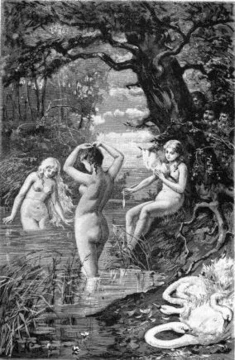
In the story, a farmer has three sons: Poul, Peder, and Esben, the youngest considered a fool for spending his days playing in the ashes by the fireplace, earning him the name Esben Ashenfiest or Askefis. The family plants wheat in a meadow, but on St. John's Night, the fields are found completely trampled. The same happens the next year, so they plant flax and set a three-night watch. Poul and Peder fail, but Esben Askefis keeps watch on the third night. He sees three white swans arrive, shed their feather cloaks, wings, and gossamer veils to become human maidens, and dance in the meadow. While they dance, Esben steals their clothes. The maidens beg for their garments back, but Esben asks each to marry him. The first two refuse, but the third, Lene, agrees and gives him her ring as a token. She explains that she and her sisters are princesses cursed by a witch, and their castle once stood where the field now lies. For their wedding, Esben must build a castle on that spot. Lene teaches him a spell to use on a rock. After she departs, Esben knocks on a rock with a twig, chants the spell, and finds money, gold, and ornaments beneath it. He hires carpenters and masons, and the castle is finished by Walpurgis Night.
Esben invites the whole village to the wedding, but the king invites himself. On the eve of the summer solstice, Esben waits at the castle doors and sees the swans flying toward him, followed by a magnificent carriage carrying Lene. As he greets her, she notices the king and warns Esben that the king desires her. She tells him to find her in her own castle, located "south of the sun, west of the moon and in the middle of the world," and departs. Esben begins his journey. On the road, he meets three pairs of goblins fighting over magical objects: a hat of invisibility, seven-league boots, and a Swiss knife that can revive the dead or kill. Esben steals them. Later, he finds the huts of three old women: the first rules the forest animals, the second the fish of the sea, and the third the birds of the air. The first two summon their subjects to ask for the castle’s location, but none know. At the third woman’s home on Vogelberg (Bird Mountain), an old eagle arrives late, saying it has come from that very place, and offers to take Esben there. After a long journey, Esben reaches Lene’s castle. He asks a maidservant for a cup of wine, places Lene’s ring inside it, and the servant brings the cup to her mistress. Lene recognizes the ring and rushes to embrace him, but fears for his safety because a witch in the castle can turn people to stone with a glare. Esben puts on the invisibility hat, enters the witch’s quarters, and kills her with the Swiss knife. Freed at last, Lene and Esben marry.
The tale is classified as ATU 400, where the hero finds a supernatural maiden or rescues an enchanted princess, marries her, and then loses her to another place. He undertakes a long quest, often aided by the elements or rulers of animals. The episode of acquiring magic objects from quarreling men is classified as ATU 518, though folklorists Stith Thompson and Hans-Jörg Uther argue it rarely appears independently and usually combines with ATU 400. Romanian folklorist Marcu Beza noted an alternate opening to swan maiden tales—seven white birds stealing golden apples or trampling fields—while researcher Barbara Fass Leavy observed a Scandinavian variation where a man’s third son guards the fields and sees three dancing maidens. Swedish scholars have described the field-watch motif as typical of Swedish, Nordic, and Baltic Sea variants of the swan maiden story. Danish historian Christian Molbech collected another Danish variant, *Den nedtraadte Ager*, in which a farmer’s youngest son, Esben, guards a field destroyed each Saint John’s Eve.
- Tale type
- ATU 400 (The Man on a Quest for the Lost Wife)
- Collector
- Svend Grundtvig
- Language
- Danish
- Region
- Scandinavia and Baltic Sea
- Also known as
- The Lass of Söndervand (English translation)
Lore & Background
The story follows a farmer's three sons: Poul, Peder, and Esben, considered a fool for sitting by the fireplace. Their family's fields are trampled on St. John's Night; the elder sons fail to keep watch, but Esben succeeds on the third night. He sees three white swans become maidens, steals their clothes, and the third maiden, Lene, agrees to marry him, giving him a ring. She reveals they are cursed princesses and teaches him a spell to build a castle. Esben builds the castle, but at the wedding the king's presence causes Lene to flee to a castle 'south of the sun, west of the moon and in the middle of the world.' Esben begins a quest, acquiring a hat of invisibility, seven-league boots, and a Swiss knife from fighting goblins. He then meets three old women who rule animals, fish, and birds; an eagle takes him to Lene's castle. He uses the ring to identify himself, dons the invisibility hat, and kills the witch with the knife, freeing Lene.
Reader's Guide
Maid Lena exemplifies the international tale type ATU 400, with a distinctive Northern European opening where swan maidens trample fields. The narrative combines the quest for a lost wife with the acquisition of magic objects (ATU 518), a combination scholars note is typical rather than independent. The tale's motifs—the watch over fields, the swan maiden transformation, and the helpers (rulers of animals)—are recognized as characteristic of Scandinavian and Baltic variants. Its collection by Svend Grundtvig preserves a regional form of a widespread mythic pattern, contributing to the study of folk narrative structure and cultural transmission.
Did You Know?
- The tale is classified as ATU 400, 'The Man on a Quest for the Lost Wife,' and also incorporates episode ATU 518, 'Men Fight Over Magic Objects.'
- Esben is called Esben Ashenfiest or Askefis, meaning 'Ash-rake,' because he spends his days playing in ashes.
Frequently Asked Questions
Who is Maid Lena?
Maid Lena (Danish: Jomfru Lene af Søndervand) is the swan maiden at the center of a Danish folktale collected by Svend Grundtvig. In English-language editions she is also referred to as 'The Lass of Söndervand.'
What is Maid Lena's role in the tale?
She is the magical wife whose disappearance triggers the husband's long search, a structure classified under Aarne-Thompson-Uther type 400. Her story is intertwined with magical objects that guide and aid the quest to find her.
Why is Maid Lena significant in folklore?
She is a key Scandinavian embodiment of the swan maiden motif that circulates across the Baltic Sea region. Her tale anchors the Danish branch of the 'Man on a Quest for the Lost Wife' tradition and helps scholars trace how the motif adapted to local settings.
Where does the Maid Lena tale come from?
The story was recorded in Danish by collector Svend Grundtvig and belongs to the broader Scandinavian and Baltic Sea folk tradition. It stands as one regional variant among several tellings of the same swan-maiden narrative type.
More in Swan maidens 1-21
Spotted an error? Know more?
Reader corrections go straight into our review queue. Suggest an edit · How this site is sourced