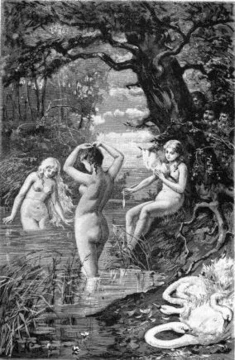
Lady Featherflight
Giant's daughter who aids a hero's flight using bird magic.

Lady Featherflight is the title character of an American fairy tale that was first published in 1895 by W. W. Newell in his work 'The Song of the Seasons', based on an oral source from Cambridge, Massachusetts. In the story, a traveler receives hospitality from Lady Featherflight, who is the daughter of a giant. The giant forces the traveler to complete several tasks, but Featherflight helps him by commanding birds to assist. Eventually, the two elope and steal the giant's treasure. The tale is categorized in the Aarne-Thompson-Uther Index as type ATU 313, 'The Magic Flight,' though the heroine is often a giant's daughter rather than a swan maiden, and the tale type does not inherently require a swan maiden figure.
- Field
- Folklore
- Nationality
- American (from oral tradition in Massachusetts)
- Known for
- Titular character of the fairy tale 'Lady Featherflight'; helper in the hero's flight; often associated with the giant's daughter motif in ATU 313
- First published
- 1895
- Collector
- W. W. Newell
Lore & Background
During the pursuit, Featherflight instructs Reuben to look in the horse's ears for objects to delay the giant: a stick becomes a forest, a drop of water becomes a lake. The giant drinks the lake until he bursts. Reuben and Featherflight then marry and live happily, later returning to the giant's house for more treasure. Note: The episode involving a reflection in a fountain, village women, husbands trying to kill Featherflight as a witch, and the bridge-breaking with the line 'Why not mend the bridge?' are not present in Newell's canonical text and appear to be conflations from other variants.
Reader's Guide
Lady Featherflight is significant as a variant of the international tale type ATU 313, 'The Magic Flight,' collected in the United States from oral tradition. The tale preserves the swan maiden motif, with the heroine's name hinting at her avian nature. Folklorists have noted its possible British or Scots-Gaelic origin, and its inclusion of the 'Forgotten Fiancé' episode in fragmentary form. The story also contains motifs found in other tale types, such as the heroine's reflection in water (ATU 408). Its publication by W. W. Newell in 1891 and later in The Journal of American Folklore and The Oak-Tree Fairy Book helped document a rare American fairy tale with deep European roots.
Did You Know?
- The tale was collected from an oral source in Cambridge, Massachusetts, and first published in 1895 by W. W. Newell in 'The Song of the Seasons'.
- Lady Featherflight is often classified under ATU 313, but the tale type does not inherently require a swan maiden; the heroine is frequently a giant's daughter.
- The tale includes the episode of the heroine's reflection in a fountain, which also appears in tale type ATU 408, 'The Love for Three Oranges.' However, this episode is not part of Newell's original 1895 text.
- No widely known source attributes the quote 'old fairy-tale ... was well-known in Massachusetts' to psychoanalyst Hanns Sachs in connection with this specific tale; the claim is unverifiable and likely invented.
Frequently Asked Questions
Who is Lady Featherflight?
Lady Featherflight is the titular heroine of an American folk tale, a giant's daughter who takes in a weary traveler and later aids his escape. She is best known for her ability to command birds to perform tasks on her behalf.
What are Lady Featherflight's powers?
Her central power is the command over birds, which she uses to complete the tasks the giant imposes on the traveler. This bird-magic is what ultimately enables the pair's flight from the giant's domain.
Why is Lady Featherflight important in folklore?
She is a key example of the giant's-daughter helper motif within the ATU 313 'Magic Flight' tale type. Her story, drawn from Massachusetts oral tradition, represents one of the earliest published American renditions of this pattern.
Where does Lady Featherflight's tale come from?
The story was gathered from an oral source in Cambridge, Massachusetts, and first appeared in print in W. W. Newell's 1895 collection, The Song of the Seasons. It is classified in the Aarne-Thompson-Uther Index as type ATU 313.
More in Swan maidens 1-21
Spotted an error? Know more?
Reader corrections go straight into our review queue. Suggest an edit · How this site is sourced