King Kojata
Russian fairy tale protagonist bound by a rash promise.

King Kojata is a figure from a Russian fairy tale collected by Alexander Afanasyev, also known as 'The Unlooked for Prince' or 'Prince Unexpected'. The tale is classified as ATU 313, 'The Magic Flight', and involves a rash promise, a magical helper, and the motif of the forgotten fiancée.
- Nationality
- Russian (Slavonic)
Lore & Background
The tale begins with a childless king who, while hunting, becomes thirsty and finds a well with a floating cup. Unable to grasp the cup, he drinks directly and is seized by a creature (Koschei in Russian) who demands a promise: the most precious thing in his palace not there when he left (Polish) or something he knew nothing about (Russian). The king promises, and upon returning home finds his wife has borne a son, the prince. When the prince grows up, an old man tells him to remind his father of the bargain; the prince then sets out to fulfill it.
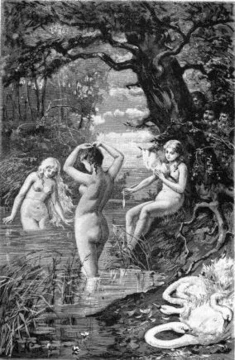
On his journey, the prince encounters a lake where thirty ducks (Russian) or twelve geese (Polish) swim, with clothes on the shore. He takes one set of clothes, and a bird (the youngest daughter of the creature) begs for its return. She becomes a woman, thanks him, and advises him how to approach her father. The father sets three tasks: build a marble palace in a day, identify the youngest daughter among her sisters (marked by a ladybug or fly), and make a pair of boots. With the maiden's help, the first two tasks succeed; for the third, they flee. The maiden uses spittle or frost to delay pursuit, and they transform into a river and bridge, then a forest, then a church and priest, escaping the father.
In longer variants, the prince later kisses a child and forgets the maiden. She becomes a flower, then is revealed by an old man, and eventually attends the prince's wedding feast. She makes a wedding cake from which two doves emerge; one dove reproaches the other for abandoning its mate, reminding the prince of his forgotten bride. He remembers, finds her, and they ride to his father's kingdom.
Reader's Guide
The tale 'King Kojata' is significant as a representative of the widespread ATU 313 tale type, 'The Magic Flight', with the 'Forgotten Fiancée' episode (type 313C). It illustrates the 'rash promise' motif and the swan maiden narrative, where enchanted princesses transform into birds. The story has been collected in multiple variants across Slavic cultures, including Polish, Russian, and Czech versions, and was translated by Andrew Lang, A. H. Wratislaw, and others. Its inclusion in Lang's 'The Green Fairy Book' and other compilations helped introduce it to a wider audience. The antagonist is sometimes identified with Koschei the Deathless, a figure from Russian folklore. The tale's structure—a hero aided by a magical helper, performing impossible tasks, and escaping through transformations—has parallels in many European folktales and remains a classic example of the genre.
Did You Know?
- In Russian variants, the antagonist is called Koschei (also spelled Kostei, Koshchei, Kostej, or Koszcziej).
- Andrew Lang included the Russian version, titled 'King Kojata', in 'The Green Fairy Book'.
The Core Narrative and the Transformation Mechanism
The central plot revolves around a man who encounters a supernatural female being, typically while she is bathing in a body of water. The critical action is his theft, concealment, or destruction of her feathered garment—often a swan skin or a cloak adorned with swan feathers—which is the very object that enables her shapeshifting between human and bird form. By removing this garment, he strips her of the ability to fly or swim away, effectively compelling her to remain and become his wife. In many versions, she is one of a group of celestial maidens, and it is frequently the youngest among them who is captured. The motif of the stolen feather cloak, catalogued as K 1335 and D 361.1 in motif indices, is the linchpin of the entire tale. In numerous tellings, the bird wife ultimately departs from her husband, leaving him to search for her, which is why the ATU classification also describes the type as The Man on a Quest for His Lost Wife.
Ancient Origins and Cross-Cultural Distribution
The earliest known written record of this narrative type comes from fourth-century China, preserved in texts such as Gan Bao's Sou shen ji and Guo Pu's Xuan zhong ji. In the Chinese version, a man from Xinyu town in what is now Jiangxi Province witnesses six or seven bird maidens bathing and seizes the feather cloak of one, forcing her into marriage. This feather-garment subtype has cognate tales distributed across the globe. Other ancient parallels include the Völundarkviða from Germanic tradition and Grimm's Fairy Tales entry KHM 193, The Drummer. In Japan, the Ōmi fudoki records a heavenly woman whose hagoromo is stolen, compelling her into marriage, while the Tango fudoki presents a variant where the garment is hidden and the woman becomes an adoptive daughter. The Dunhuang manuscripts also preserve a crane-maiden variant. The sheer geographic and temporal spread—from fourth-century China to medieval Ireland to South American duck and heron tales—underscores the motif's extraordinary antiquity.
Folkloristic Scope and the Magic Wife Framework
The swan maiden tale, classified as ATU 400, sits within a much broader folkloristic landscape. While the name suggests a specific avian identity, the supernatural wife in these narratives can be a swan, goose, crane, duck, heron, dove, vulture, or parrot, and in some tellings she is a star, a celestial nymph, or a lake fairy. Russian folklorist Eleazar M. Meletinskii studied the human-animal marriage tradition extensively, though he cautioned that subsuming all such tales under the swan maiden label excessively broadens the topic. The swan maiden motif is a specific instance of the far more widespread Magic Wife motif, which scholars regard as one of the most widely distributed narrative elements in the world, likely many millennia old. It is also among the most interconnected motifs, serving as a central reference point for numerous other story types. The Enzyklopädie des Märchens sometimes restricts discussion to cases where the wife is specifically a swan, goose, or other bird, but the broader ATU 400 classification encompasses a far wider spectrum of supernatural beings and transformation mechanisms.
Germanic and Celtic Medieval Manifestations
In Germanic tradition, the swan maiden is closely linked to the Valkyries, a connection Jacob Grimm noted in his Deutsche Mythologie. Their magic swan-shirt enables avian transformation, mirroring the international pattern. The Wayland the Smith legend features Swanhilde, daughter of a mortal woman and a fairy king, who can fly as a swan but is wounded and rescued by the master-craftsman Wieland. Their marriage is shattered when the Neidings steal his ring, kidnap Swanhilde, and cripple Wieland, who ultimately fashions wings for himself and escapes. In the Völsunga saga, King Agnar withholds Brynhild's magical swan shirt to bind her into his service. The Kara-lied tells of Kára and Helgi Haddingjaskati. In Celtic tradition, the Oidheadh chloinne Lir is the most celebrated swan-transformation narrative, counted among the Three Sorrows of Storytelling. The Wooing of Étaine features a recognition test where Eochu must identify his beloved among lookalike swans, and Óengus encounters Caer Ibormeith in swan form, wearing a golden chain and accompanied by 150 swan-form maidservants.
Frequently Asked Questions
Who is King Kojata?
King Kojata is the central figure in a Russian folk narrative gathered by Alexander Afanasyev, a story also circulated under the titles 'The Unlooked for Prince' and 'Prince Unexpected.' He belongs to the Slavonic tradition of swan-maiden tales and is defined by a hasty vow he makes early in the plot.
What is King Kojata's role or defining trait in the tale?
His defining trait is a rash, impulsive promise that sets the entire conflict in motion, and he relies on a magical helper to navigate the consequences. He is not a warrior or sorcerer in the traditional sense but rather a king whose word, once spoken, becomes an inescapable obligation.
Why is King Kojata important to swan-maiden scholarship?
He anchors a specific Russian exemplar of the ATU 313 'Magic Flight' type, giving folklorists a concrete Slavonic data point for comparing how the rash-promise and magical-helper motifs play out across cultures. Afanasyev's collection preserved this variant for modern comparative study.
Which tale type and motifs are associated with King Kojata?
The story is catalogued under ATU 313, 'The Magic Flight,' and its core motifs include a rash promise, a magical helper who intervenes on the protagonist's behalf, and the forgotten-fiancée pattern that drives the reunion. These three elements together distinguish the Russian version from other regional tellings of the same type.
More in Swan maidens 1-21
Spotted an error? Know more?
Reader corrections go straight into our review queue. Suggest an edit · How this site is sourced