Hagoromo (play)
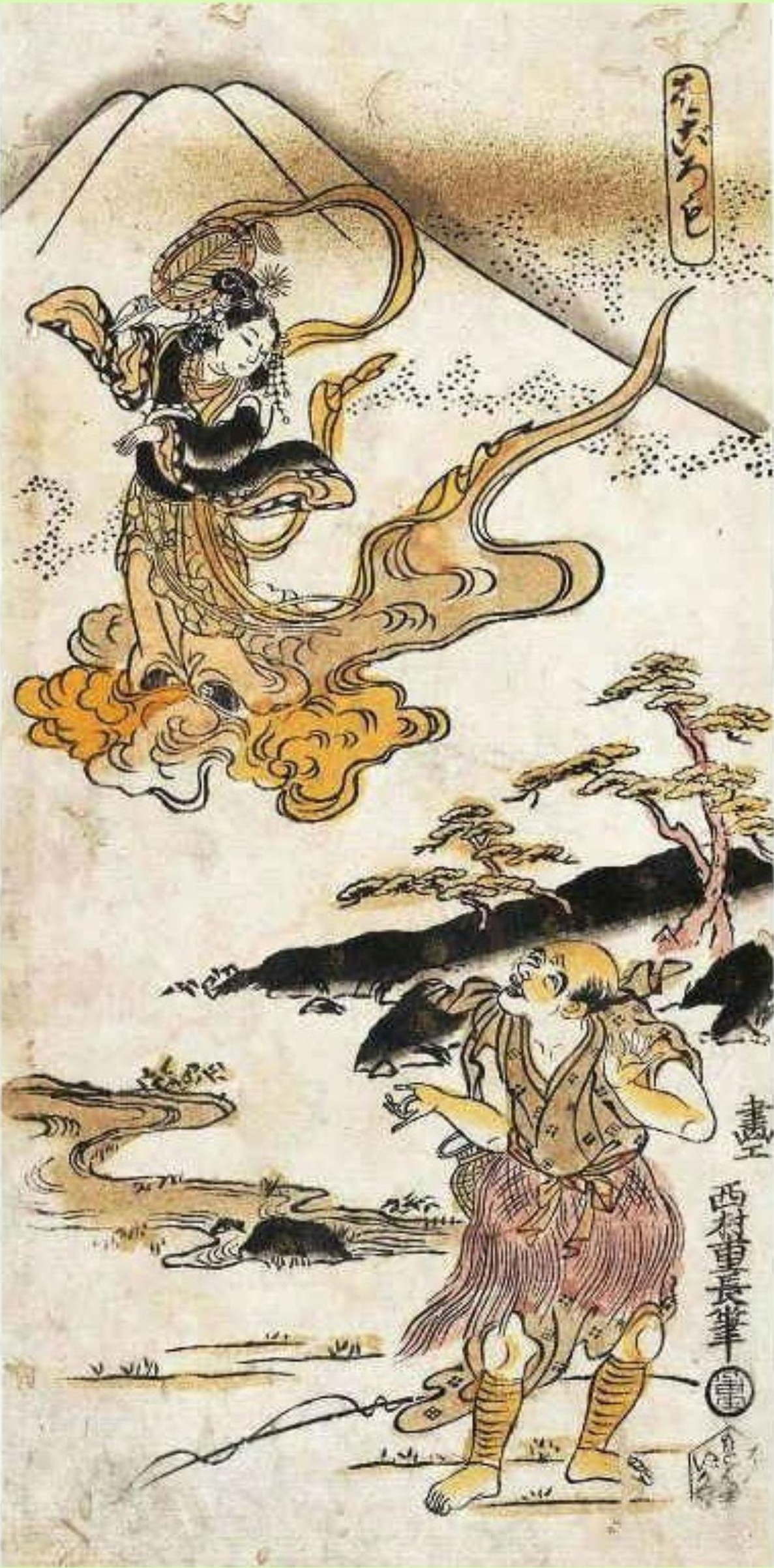
A Noh play about a celestial dancer and a fisherman.

Nishimura · Public domain
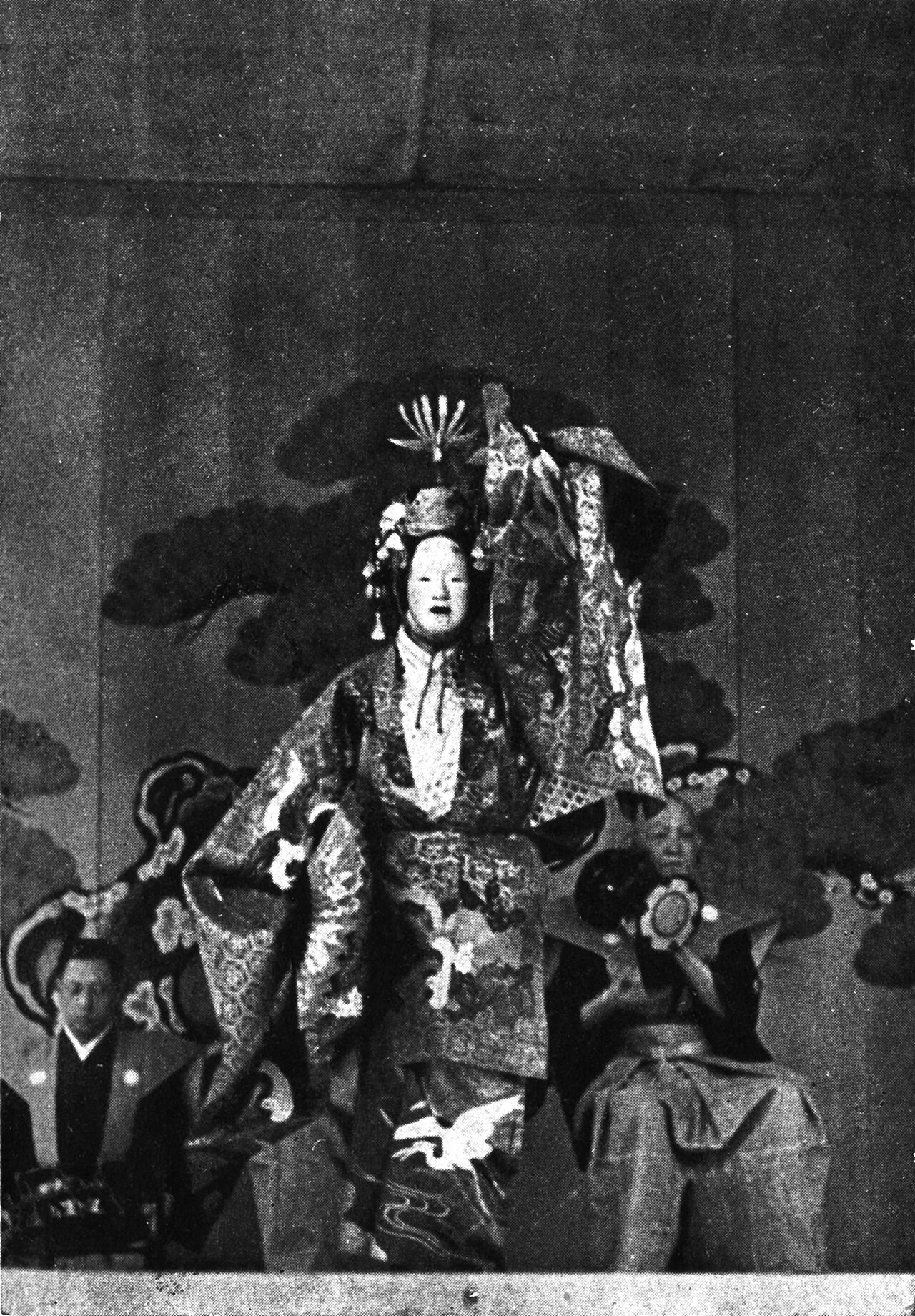
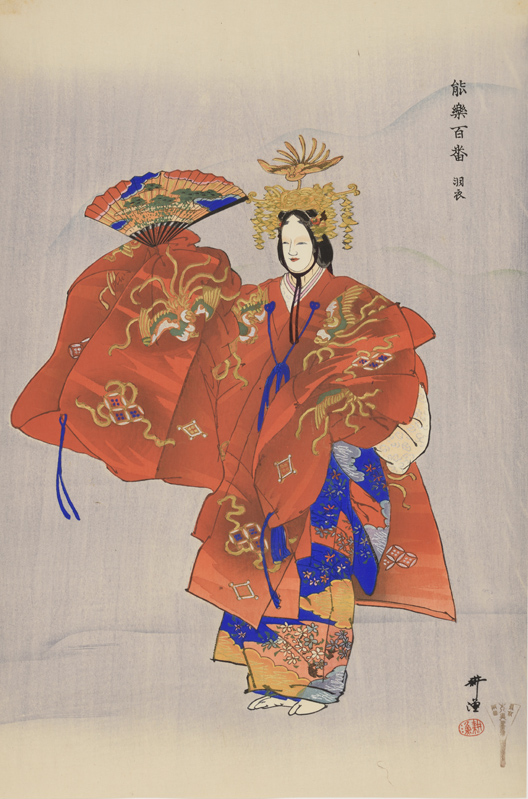
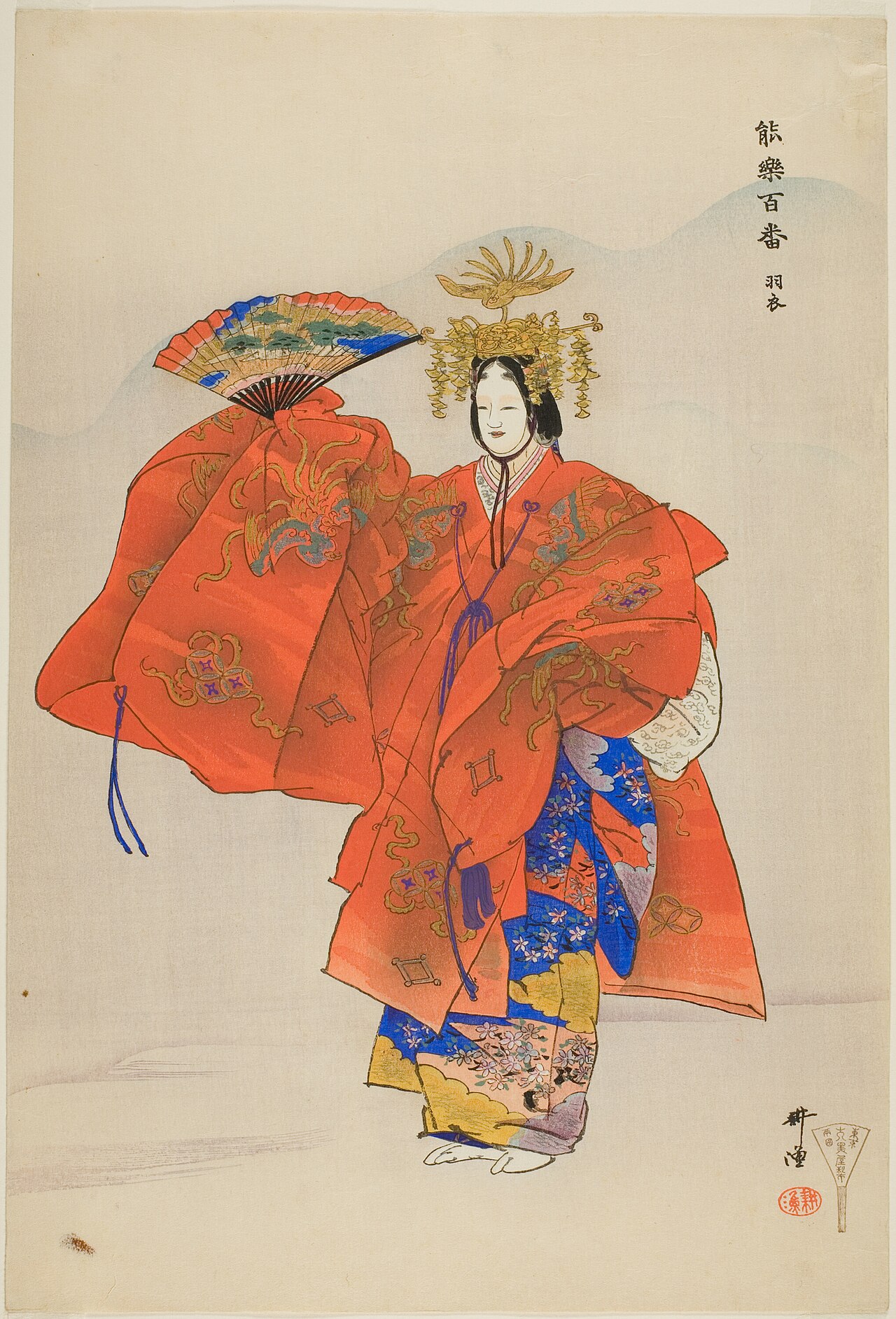
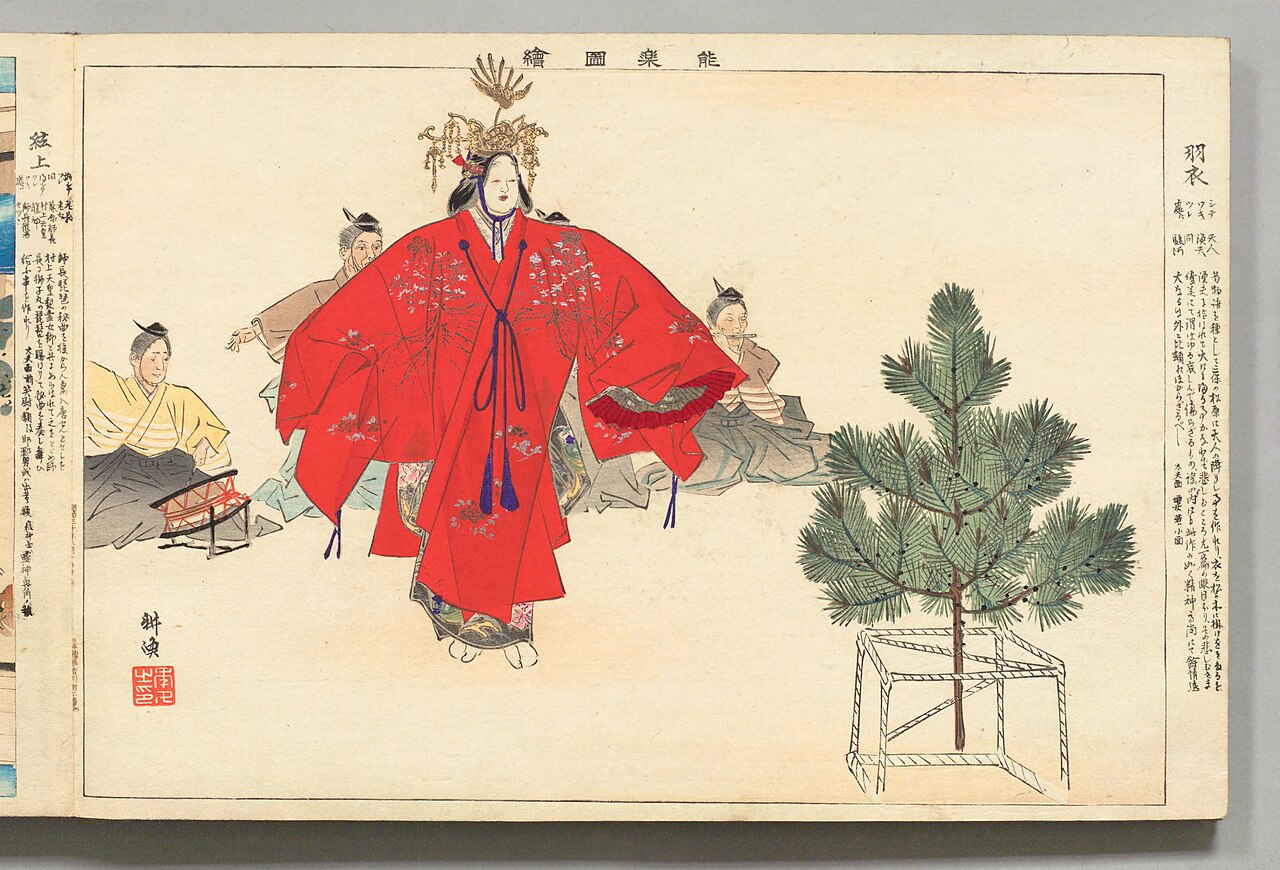
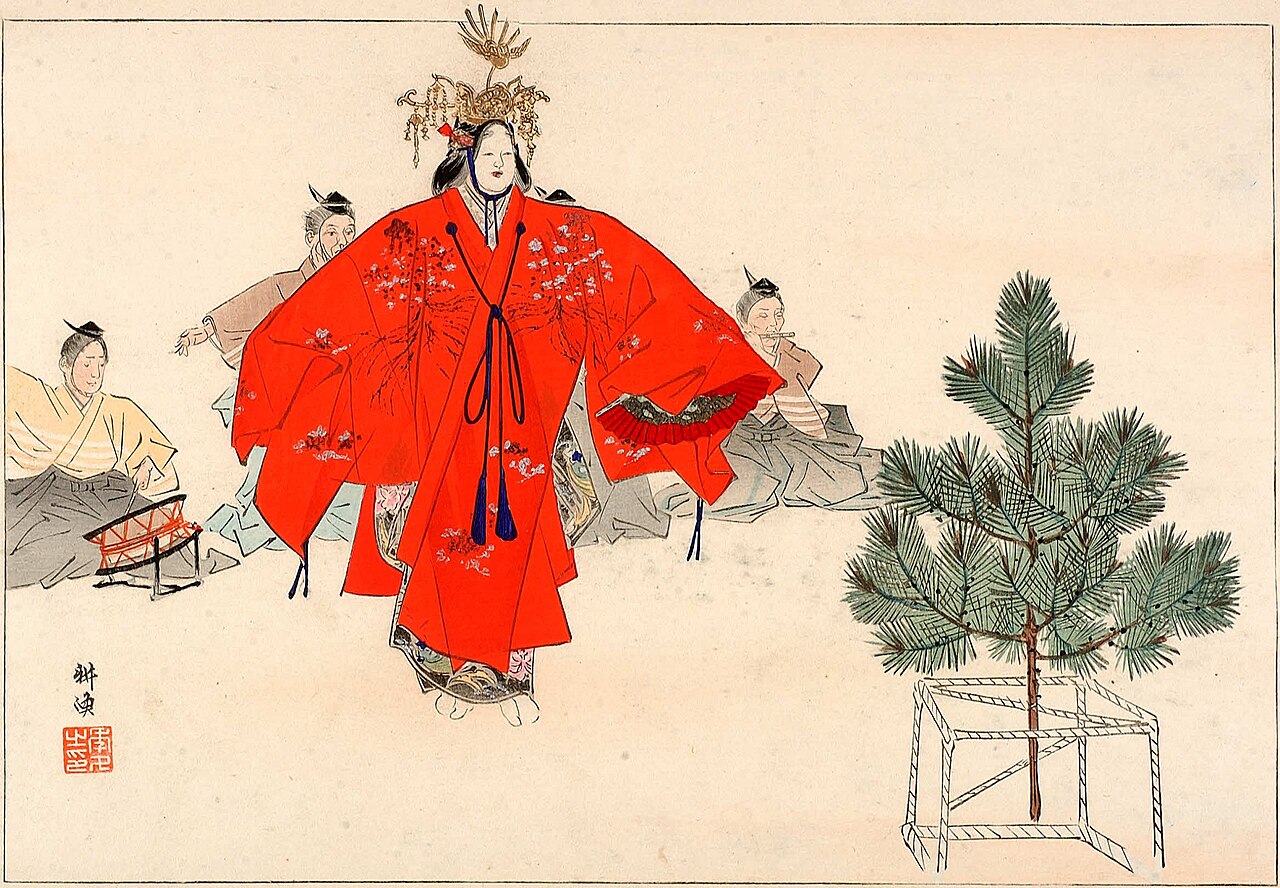
Hagoromo (羽衣, The Feather Mantle) is a Japanese Noh play and one of the most-performed works in the Noh repertoire. It is an example of the traditional swan maiden motif, combining two legends: one concerning the origins of the Suruga Dance and another the descent of an angel onto Udo Beach.
Quick Facts
- Name En
- The Feather Mantle
- Category
- 3
- Chars
- shite angel / waki Hakuryō, a fisherman / wakizure companion(s)
- Place
- Pine Grove of Miho, Suruga Bay
- Time
- spring, at night
- Sources
- Tango fudoki (8th century) / Nōin (11th century)
- Schools
- all
Facts from the source article.
Lore & Background
The earliest recorded version of the legend dates to the eighth century, but the play itself combines two legends: one about the origins of the Suruga Dance and another about an angel descending onto Udo Beach. A poem by the 11th-century poet Nōin is quoted in the play.
The authorship of Hagoromo is unknown. The earliest references to the play in historical records date to 1524, which suggests it was written well after Zeami's time. The plot involves a fisherman who finds the Hagoromo, the magical feather-mantle of a tennin (an aerial spirit or celestial dancer), hanging on a bough. The tennin demands its return, and the fisherman agrees only if she will show him her dance. The Chorus explains the dance as symbolic of the daily changes of the moon, referencing 'three, five, and fifteen' as the number of nights in the moon's changes. In the finale, the tennin disappears like a mountain slowly hidden in mist.
Reader's Guide
Hagoromo holds a significant place in Japanese cultural history as one of the most-performed Noh plays, illustrating the enduring appeal of the swan maiden motif in East Asian folklore. Its combination of two distinct legends—the Suruga Dance and the angel's descent—reflects the syncretic nature of Noh drama. The play's influence extends beyond Japan: W. B. Yeats' At the Hawk's Well drew extensively from the Hagoromo legend. The story has been adapted into various forms, including an abridged German version titled Das Federkleid (1885), an English translation in Green Willow; and other Japanese fairy tales as The Robe of Feathers, and a literary treatment as The Fisherman and the Moon-Maiden in Japanese Fairy World (1880). In modern times, Osamu Tezuka based a short story in his Phoenix series on the Hagoromo, with a sci-fi twist featuring a time-displaced human girl. A 2004 short film based on Tezuka's Phoenix offers a drastically different retelling, and the story was later adapted into the manga and anime series Ceres, The Celestial Legend. The play's unknown authorship and late first reference (1524) add to its mystery, while its themes of loss, negotiation, and transcendence continue to resonate.
Did You Know?
- The earliest recorded version of the Hagoromo legend dates to the eighth century.
- The authorship of the Noh play Hagoromo is unknown.
- W. B. Yeats' At the Hawk's Well draws from Irish mythology, not the Hagoromo legend.
The Feathered Cloak and the Stolen Flight
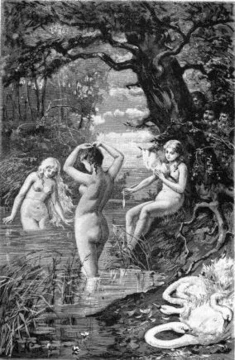
In the archetypal swan maiden narrative, a supernatural woman—often one of a group of celestial beings—takes to the water for a bath. A mortal man, acting furtively, seizes her feathered garment: a swan skin, a cloak adorned with bird feathers, or some equivalent shapeshifting device. By hiding or even burning this item (a motif catalogued as K 1335 and D 361.1), he strips her of the ability to return to her avian form, effectively trapping her in the human world and compelling her into marriage. She is frequently the youngest of several sisters or companions present at the water's edge. The binding is not consensual; it is an act of theft that forecloses her freedom. In many tellings, the bond does not last. The bird wife eventually departs from her husband, leaving him to grieve or to pursue her across vast distances. The garment thus functions as the hinge of the entire story: its presence enables transcendence, and its loss enforces earthly constraint.
Ancient Roots and a Worldwide Echo
The earliest surviving written record of this tale type hails from fourth-century China. Both Guo Pu's Xuan zhong ji and Gan Bao's Sou shen ji preserve versions in which a man from the Yuzhang region (modern Jiangxi Province) encounters six or seven bird maidens at a body of water and appropriates one of their feather cloaks, compelling her into domestic life. A later Dunhuang manuscript variant replaces swans with cranes, showing the motif's fluidity even within a single culture. The pattern radiates outward: Norse sources such as the Völundarkviða and the Grimms' collection (KHM 193, "The Drummer") carry striking parallels, while South American narratives feature ducks and herons, and other traditions substitute doves, vultures, or parrots. The classification ATU 400, "The Man on a Quest for His Lost Wife," acknowledges that the supernatural partner need not be a bird at all—stars, lake nymphs, and fairy queens all fit the schema. This extraordinary geographic and taxonomic spread suggests a narrative impulse that predates any single literary tradition.
Valkyries, Smiths, and Sorrows in the Medieval North
Germanic and Celtic medieval literature supplies some of the richest elaborations of the swan maiden archetype. Jacob Grimm himself linked the swan-shift to multiple Valkyries in his Deutsche Mythologie. In the Wayland the Smith cycle, the craftsman rescues the wounded swan-maiden Swanhilde, daughter of a mortal woman and a fairy king, and marries her after she sets aside her wings and magic ring. Her captors—the Neidings under Princess Bathilde—steal the ring, kidnap her, and maim Wayland, who ultimately fashions his own wings and escapes with her as their stronghold burns. In the Völsunga saga, King Agnar withholds the valkyrie Brynhild's swan shirt to bind her as his enforcer. The Kara-lied and Hrómundar saga Gripssonar add further valkyrie-swift episodes. Across the Irish Sea, the Oidheadh chloinne Lir ranks among the "Three Sorrows of Storytelling," while The Wooing of Étaine and the tale of Óengus and Caer Ibormeith—where a golden chain marks the goddess even in swan form—extend the tradition into the Mythological Cycle.
The Magic Wife and a Motif Older Than Memory
Folklorists have long debated how broadly to define the swan maiden. Russian scholar Eleazar M. Meletinskii devoted extensive study to the human-animal marriage tradition, which earlier researchers had lumped under the swan maiden heading—a practice that risks diluting the category. The tale type sits within the far wider "Magic Wife" motif, arguably one of the most geographically distributed and mutually referenced narrative patterns in human storytelling, likely stretching back many millennia. Because ATU 400 frames the story as a man's quest for a lost spouse, the supernatural partner can be a swan, a goose, a crane, a duck, a heron, a dove, a vulture, a parrot, a star, a celestial nymph, or a lake fairy. Scholars behind the Enzyklopädie des Märchens sometimes restrict the discussion to avian wives—swans, geese, or other birds—while others embrace the full spectrum. The result is a motif so central and so interconnected with adjacent story types that it functions almost as a narrative hub, referenced and reshaped across cultures and centuries.
Gallery
Frequently Asked Questions
What is Hagoromo (play)?
Hagoromo (羽衣), often translated as 'The Feather Mantle,' is a Japanese Noh play that tells the story of a celestial dancer who encounters a fisherman. It stands as one of the most frequently performed works across the entire Noh repertoire.
What legends does Hagoromo (play) combine?
The play braids together two traditional Japanese narratives: one explaining the origins of the Suruga Dance and another describing an angel's descent onto Udo Beach.
How does Hagoromo (play) fit the swan maiden motif?
It is a textbook example of the swan maiden pattern, in which a mortal man meets a celestial being whose divine garment becomes the emotional and narrative hinge of the story. The feather mantle itself symbolizes the boundary between the heavenly and human realms.
Why is Hagoromo (play) important in Noh theatre?
As one of the most-performed Noh plays, it is a cornerstone work that showcases the art form's integration of dance, chant, and storytelling. Its celestial-dancer-and-fisherman structure makes it a defining reference point for the swan maiden tradition in Japanese stagecraft.
Who are the main characters in Hagoromo (play)?
The drama centers on two figures: a celestial dancer who descends to the mortal world and a fisherman who stumbles upon her. Their brief encounter and the fate of her feather mantle drive the entire narrative.
More in Swan maidens 1-21
Spotted an error? Know more?
Reader corrections go straight into our review queue. Suggest an edit · How this site is sourced