Helreið Brynhildar
A short Old Norse poem on Brynhildr's afterlife journey.

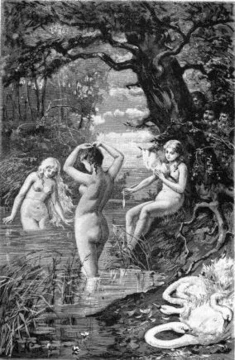
Helreið Brynhildar, meaning "The Hel-ride of Brynhild" in Old Norse, is a brief poem from the Poetic Edda. With the exception of its sixth stanza, the entire poem also appears quoted within the saga Norna-Gests þáttr. The poem follows the dead Brynhildr as she travels to the underworld and faces a giantess who accuses her of causing the deaths of heroes, coveting another woman’s husband, and bringing down the house of the Nibelungs. Brynhildr responds by explaining that the sons of Gjúki forced her into breaking her oaths. She recounts her past as a valkyrie called Hildr the helmed, living in Hlymdalir, until a king—likely Agnarr—captured her and her seven sisters by taking their swan-robes from under an oak. She later married the young king, though her age at marriage is not specified in the poem. Defying Odin, she caused the death of the aged Hjalmgunnar, king of the Goths, and gave victory to Auða’s young brother, Agnarr. In anger, Odin imprisoned her in Skatalund behind overlapping red and white shields, cursed her to sleep until a fearless man freed her, and surrounded her with a ring of fire. Sigurd arrived on Grani and woke her, though the poem does not mention him bringing Fafnir’s gold or sharing her bed for eight nights. Gudrun later reproached Brynhildr for sleeping in Sigurd’s arms and admitted that she and others had tricked Brynhildr out of her relationship with Sigurd, forcing her to marry Gunnar instead. The poem ends with Brynhildr declaring that men and women are born to suffer, but that she and Sigurd will never be parted again. Commentator Henry Adams Bellows called the poem a masterpiece with "extraordinary dramatic unity" and one of the most vivid and powerful in the Edda, though some scholars argue parts originally belonged to Sigrdrífumál, and the two poems are closely related in content. The material is largely Scandinavian, with few links to the German tradition of the Nibelungenlied.
- Type
- Poem
- Language
- Old Norse
- Found in
- Poetic Edda
- Also quoted in
- Norna-Gests þáttr
- Subject
- Brynhildr's journey to the afterlife
- Notable commentator
- Henry Adams Bellows
Lore & Background
The poem follows the dead Brynhildr as she rides in a wagon on her journey to the underworld. During her journey, she passes a house where a giantess (gýgr) lived. The giantess accuses Brynhildr of having caused the deaths of heroes and of having wanted another woman's husband (Sigurd). The giantess further accuses Brynhildr of having caused the fall of the house of Nibelungs (Gjúki's sons). Brynhildr responds that she will tell her the truth and how the sons of Gjúki made her an unhappy oath-breaker. The poem does not describe the burning of Sigurd or Brynhildr on pyres; those events are found in other Eddic poems or the Völsunga saga.
Reader's Guide
Helreið Brynhildar is significant as a vivid and dramatic poem within the Poetic Edda, noted by Henry Adams Bellows for its 'extraordinary degree of dramatic unity' and as one of the 'most vivid and powerful' poems in the collection. It has been argued that some parts originally belonged to Sigrdrífumál, and the two poems are very close in content. The material is mostly Scandinavian, with few elements connecting it to the corresponding German tradition in the Nibelungenlied. The poem provides a unique perspective on Brynhildr's character, including her past as a valkyrie named Hildr the helmed, her conflict with Odin, and her eventual reunion with Sigurd in death. Its inclusion in Norna-Gests þáttr indicates its importance in medieval Norse storytelling.
Did You Know?
- The poem is found in the Poetic Edda and most of it is also quoted in Norna-Gests þáttr.
- Henry Adams Bellows called it a masterpiece with an 'extraordinary degree of dramatic unity'.
- The poem describes Brynhildr as formerly called Hildr the helmed, living in a dwelling of valkyries called Hlymdalir.
Place in the Eddic Corpus and Critical Reception
Helreið Brynhildar is a compact Old Norse poem preserved in the Poetic Edda, and the majority of its stanzas—every one except the sixth—also survive within the prose narrative of Norna-Gests þáttr. This dual transmission underscores its importance in the medieval Icelandic manuscript tradition. The nineteenth-century scholar Henry Adams Bellows singled it out in his commentaries as a true masterpiece, praising its extraordinary degree of dramatic unity and ranking it among the most vivid and powerful compositions in the entire Eddic collection. That said, not all scholars agree on its boundaries: it has been argued that certain passages originally belonged to the closely related poem Sigrdrífumál, the two works sharing a great deal of thematic and narrative material. What distinguishes Helreið Brynhildar from the broader Germanic Sigurd-Brynhildr cycle is its predominantly Scandinavian character; very few elements link it to the German Nibelungenlied tradition, making it a distinctly Norse articulation of a pan-Germanic story.
The Funeral Pyres and the Journey to Hel
The dramatic engine of Helreið Brynhildar is the cremation of two dead lovers on separate pyres. Sigurd is burned first, and then Brynhildr is laid upon a richly adorned wagon and set alight. That same wagon becomes her conveyance on the journey into the afterlife, carrying her along a road that passes a house once inhabited by a giantess, or gýgr. It is there that the poem's central confrontation unfolds. The giantess hurls a catalogue of accusations at Brynhildr: she brought about the deaths of heroes, she coveted a husband who belonged to another woman, and she was responsible for the destruction of the house of Nibelungs, the sons of Gjúki. Rather than deflect, Brynhildr accepts the charge and declares she will speak the full truth. She explains how the sons of Gjúki conspired to make her into an unhappy oath-breaker, setting the stage for the long flashback that forms the bulk of the poem.
Brynhildr's Origins and Odin's Curse
Brynhildr's self-narration reveals a layered past. She was once known as Hildr the helmed, residing in Hlymdalir, a dwelling associated with the valkyries. Her freedom ended when a monarch—most likely Agnarr—seized the swan-robes of Brynhildr and her seven sisters, which they had left beneath an oak tree, and thereby captured them. At only twelve winters of age, she was wed to the young king. In a decisive act against Odin's will, she caused the death of the aged Hjalmgunnar, king of the Goths, and directed victory instead to Auða's young brother, Agnarr. Odin's fury was swift and absolute: he imprisoned her in Skatalund, enclosed within a barrier of overlapping red and white shields, and condemned her to sleep until a man without fear could release her. To make that liberation even more difficult, he conjured a ring of fire around her resting place. Sigurd eventually came riding on Grani, bearing Fafnir's gold, and the two shared a bed for eight nights without ever touching one another.
The Betrayal, the Final Words, and the Poem's Afterlife
The emotional turning point arrives when Brynhildr learns from Gudrun the full extent of her deception. Gudrun reproaches her for having slept in Sigurd's arms, then confesses that the two women had tricked Brynhildr out of her bond with Sigurd and compelled her to take Gunnar instead. Yet Brynhildr's final words rise above personal grievance. She declares that men and women live in this world only to suffer, but that she and Sigurd shall never be parted again—a line that has resonated powerfully across centuries of readership. The poem has been rendered into English by Henry Adams Bellows, Benjamin Thorpe, and the celebrated collaboration of W. H. Auden with P. B. Taylor. On the scholarly side, Sophus Bugge produced an edition of the manuscript text, while Guðni Jónsson offered a version with normalized spelling. Andy Orchard's Dictionary of Norse Myth and Legend further anchors the poem within the wider mythological landscape, ensuring its continued presence in both academic study and popular appreciation of Norse literature.
Frequently Asked Questions
Who is Helreið Brynhildar?
It is a brief Old Norse poem preserved in the Poetic Edda that narrates Brynhildr's passage into the realm of the dead. The title translates roughly as "The Hel-ride of Brynhild."
What happens in Helreið Brynhildar?
Brynhildr arrives in the underworld where a giantess confronts her, charging her with slaying heroes, seizing another woman's husband, and destroying the Nibelung lineage. Brynhildr pushes back, arguing that the sons of Gjúki compelled her to violate her sworn oaths.
Where else does Helreið Brynhildar appear outside the Poetic Edda?
With one stanza as the exception, the full text is also embedded within the saga Norna-Gests þáttr. This dual preservation makes it one of the few Eddic poems with a second manuscript witness.
Why is Helreið Brynhildar significant to fans of Norse mythology?
It offers a rare first-person glimpse into Brynhildr's afterlife and her own justification for the catastrophic events of the Nibelung cycle. Commentator Henry Adams Bellows highlights it as a key text for understanding Brynhildr's character beyond the Völsunga saga.
More in Swan maidens 1-21
Spotted an error? Know more?
Reader corrections go straight into our review queue. Suggest an edit · How this site is sourced