Swan maiden
A supernatural bird-wife who departs after her feather cloak is stolen.

Jim Osley · CC BY-SA 2.0
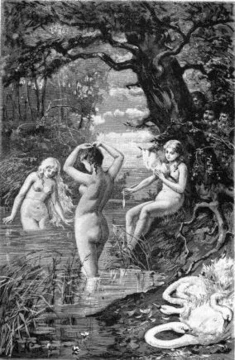
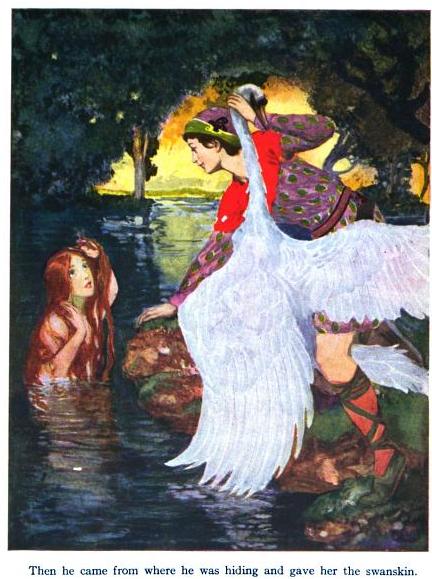
The swan maiden tale, known in German as *Schwanjungfrau*, is classified under the Aarne–Thompson–Uther index as type ATU 400. This story type, also called "The Man on a Quest for His Lost Wife," involves a man who enters into a pact or marriage with a supernatural woman who eventually leaves him. The wife can shift between human and bird form by using a feathered cloak. The object that enables this transformation is typically a swan skin or a garment adorned with swan feathers. In the standard version, a man secretly steals, hides, or burns the feather garment of a maiden while she bathes in a body of water. This theft prevents her from flying or swimming away, compelling her to become his wife. Often, she is one of several maidens present—frequently celestial beings—and it is usually the youngest who is captured. In many versions, the bird wife later abandons her husband. The oldest known example of this narrative comes from China, recorded in the 4th-century work *Sou shen ji* ("In Search of the Supernatural").
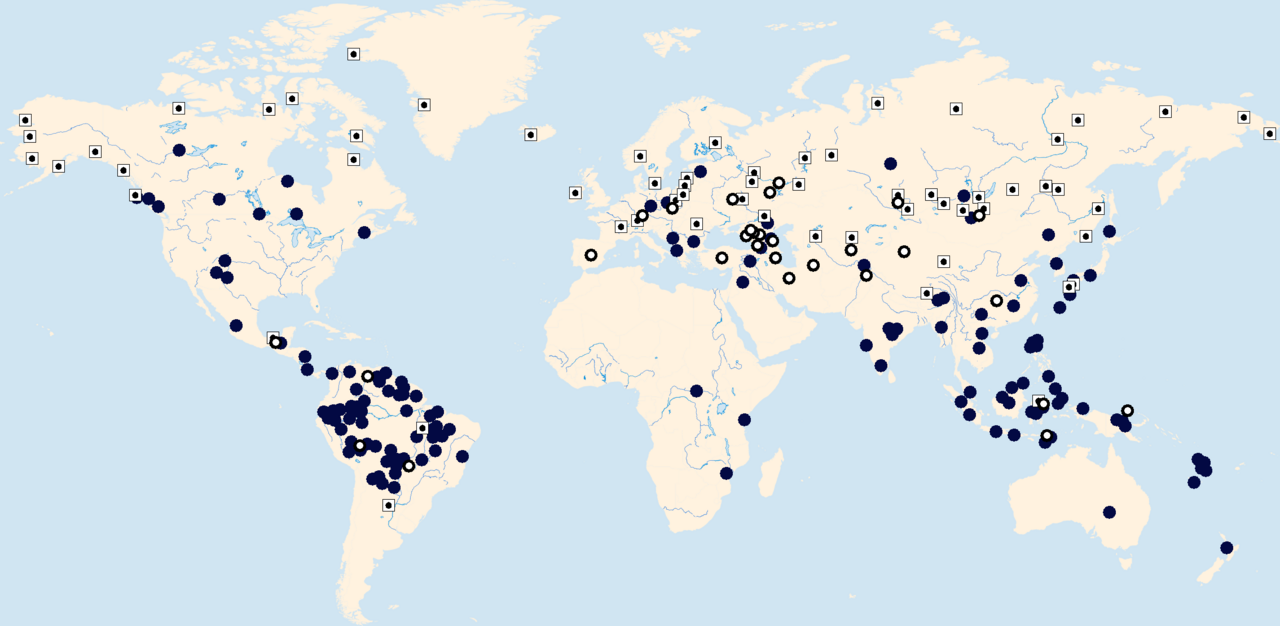
The term "swan maiden" can be more broadly understood as "bird-maiden," since the creature may be a swan, goose, crane, duck, heron, dove, vulture, parrot, or other bird. Because tale type ATU 400 is "The Man on a Quest for His Lost Wife," it can also include a wide range of supernatural beings, such as stars, celestial nymphs, or a lake fairy. Russian folklorist Eleazar M. Meletinskii studied human-animal marriage traditions extensively, which were once grouped under "swan maiden," but this would make the topic too broad. Swan maiden tales also fall under the larger category of "Magic Wife." This motif, in its broad sense, is one of the most widely distributed in the world, likely many millennia old, and the best-known supernatural wife figure in storytelling. It is one of the most interconnected and central motifs among all narratives.
In Germanic mythology, the swan maiden is linked to multiple Valkyries, a trait noted by Jacob Grimm in *Deutsche Mythologie*. Their magical swan-shirt allows them to transform into birds. In Germanic heroic legend, the story of Wayland the Smith involves him falling in love with Swanhilde, a swan maiden who is the daughter of a mortal woman and a fairy king. The king forbids his wife to ask about his origins; when she does, he vanishes.
- Classification
- ATU 400
- Earliest recorded example
- Chinese, Sou shen ji (4th century)
- Associated mythology
- Germanic, Chinese, Japanese, Irish
- Key motif
- K 1335, D 361.1 (stealing or hiding feather garment)
- Also known as
- bird-maiden, Magic Wife
Lore & Background
In Germanic mythology, the swan maiden is associated with multiple Valkyries, as observed by Jacob Grimm. In Germanic heroic legend, Wayland the Smith falls in love with a swan maiden named Alvitr or Hervör, not Swanhilde (who is a different figure, the daughter of Sigurd and Gudrun). The detail about being wounded by a spear and falling to earth is not from the oldest sources. Another tale concerns the valkyrie Brynhild, but her story involves disobeying Odin, not the theft of a swan shirt; the stolen swan shirt motif is associated with other valkyries. A third valkyrie tale involves Kára and Helgi Haddingjaskati, attested in the Kara-lied.
In China, the oldest attestation of the archetypal swan maiden narrative comes from the Sou shen ji and the Xuan zhong ji.
Reader's Guide
The swan maiden tale is one of the most widely distributed motifs in the world, most probably being many millennia old, and the best known supernatural wife figure in narratives. It falls under the broader scope of "Magic Wife," a motif that is one of the most interconnected and centrally referred to among all stories. The tale type ATU 400 can involve a broad spectrum of supernatural creatures, including stars, celestial nymphs, or a fée of the lake. Scholarship has remarked that the swan maiden appears throughout the ancient Celtic lands, while researcher Maria Tatar points out that the tale is widespread in Nordic regions. Scholar Lotte Motz contrasted its presence: in more southern countries it appears as a fairy tale character, whereas in northern regions it becomes a myth and an element of faith. In East Asia, according to professor Alan Miller, the swan maiden tale is one of the most popular of all Japanese folktales, and scholar Manabu Waida asserted its popularity in Korea, Manchuria, China, and among the Buryat, Ainu, and Annamese. The tale has many analogues around the world, notably the Völundarkviða and Grimms' Fairy Tales KHM 193 "The Drummer."
Did You Know?
- The oldest narrative example of the swan maiden type is Chinese, recorded in the Sou shen ji (4th century).
- In Japanese folklore, the swan maiden appears in the Ōmi fudoki and Tango fudoki as a heavenly woman whose feather garment is taken.
The Core Narrative and Transformation Motif
The swan maiden tale, catalogued as ATU 400, follows a remarkably consistent dramatic arc across cultures. A supernatural female figure—often one of a group of celestial maidens, frequently the youngest—is found bathing in a body of water. A man, acting furtively, steals, conceals, or even burns her feathered garment, the very object that enables her to shift between human and bird form. Deprived of this swan skin or feather cloak, she cannot take to the sky or return to the water, and is compelled to become his wife. The transformation key is almost always a garment: a swan skin, a cloak studded with feathers, or an equivalent animal pelt in parallel tales. In many versions the wife eventually departs, leaving the husband to search for her, which is why the tale type is also titled "The Man on a Quest for His Lost Wife." The motif of the hidden feather garment, indexed as K 1335 and D 361.1, serves as the structural hinge around which the entire narrative turns.
Ancient Chinese Origins and East Asian Parallels
The earliest recorded instance of the swan maiden archetype anywhere in the world comes from fourth-century China. Guo Pu's Xuan zhong ji and Gan Bao's Sou shen ji ("In Search of the Supernatural") both preserve versions of the tale. In the Sou shen ji account, a man from Xinyu town in the Yuzhang region, present-day Jiangxi Province, witnesses six or seven bird maidens and seizes one of their feather cloaks, compelling her to become his wife. This "feather garment" subtype is recognized as a distinct branch of the broader swan maiden family, with cognate tales scattered across the globe. Centuries later, Dunhuang manuscripts contain a closely related story in which a poor man named T'ien K'un-lun encounters three crane maidens bathing at a lake. In Japan, the Ōmi fudoki records a heavenly woman whose hagoromo, her feather garment, is taken by a man, forcing a marriage. The Tango fudoki offers a variant where the garment is hidden and the woman becomes an adoptive daughter of a childless couple.
Germanic and Celtic Medieval Traditions
In Germanic heroic legend, the swan maiden is intimately linked to the Valkyries, a connection Jacob Grimm noted in his Deutsche Mythologie. The Wayland the Smith cycle tells of Swanhilde, daughter of a mortal woman and a fairy king, who can fly as a swan. Wounded by a spear, she crashes to earth and is rescued by the master-craftsman Wieland, marrying him and setting aside both her wings and her magic ring of power. When the Neidings steal the ring, kidnap Swanhilde, and destroy Wieland's home, he fashions wings for himself and escapes with her. In the Völsunga saga, King Agnar withholds the valkyrie Brynhild's magical swan shirt, binding her to his service. The Kara-lied recounts Kára and Helgi Haddingjaskati, and Hrómundar saga Gripssonar features a similarly named swanshift character. In the Irish tradition, Oidheadh chloinne Lir stands as the most celebrated swan-transformation narrative, while The Wooing of Étaine and the story of Óengus and Caer Ibormeith, where she appears in swan form wearing a golden chain among 150 swan-maidservants, further enrich the Celtic corpus.
Folkloristic Scope and the Magic Wife Tradition
The swan maiden is only one facet of a far vaster narrative family. Because ATU 400 is formally titled "The Man on a Quest for His Lost Wife," the supernatural spouse can be a star, a celestial nymph, or a fée of the lake rather than a bird at all. In practice the bird-maiden may be a goose, crane, duck, heron, dove, vulture, or parrot, as South American and other regional examples demonstrate. Russian folklorist Eleazar M. Meletinskii devoted extensive study to the human-animal marriage tradition, which earlier scholarship had lumped under the "swan maiden" label, a categorization that stretches the topic too broadly. The swan maiden tales also nest within the even wider "Magic Wife" motif, one of the most geographically widespread and intertextually interconnected narrative patterns in world folklore. Scholars regard this motif as potentially many millennia old and as the best-known supernatural-wife figure across all storytelling traditions, serving as a central node to which countless other tales connect.
Gallery


Frequently Asked Questions
What is a swan maiden?
A swan maiden is a supernatural bird-wife figure who appears across multiple world mythologies, most commonly in Germanic, Chinese, Japanese, and Irish traditions. She is a shapeshifting woman who can become a bird by donning a feathered cloak or swan-skin garment. In folklore scholarship, this tale type is catalogued under the Aarne-Thompson-Uther index as ATU 400.
What is the central plot device in swan maiden stories?
The defining motif (classified as K 1335, D 361.1) involves a man secretly stealing, hiding, or destroying the maiden's feathered garment while she is bathing. This act traps her in human form and forces a marriage or pact, but it ultimately sets the stage for her departure once she recovers or retrieves the cloak.
Where is the earliest known swan maiden story recorded?
The oldest documented example comes from the Chinese text Sou shen ji, dating to the 4th century CE. Despite this early Chinese origin, the tale type has since been identified in Germanic, Japanese, and Irish folklore traditions as well.
What are other names for the swan maiden figure?
Beyond "swan maiden" (German: Schwanjungfrau), the character is also referred to as a "bird-maiden" or a "Magic Wife" in folkloristic literature. The broader tale type is sometimes called "The Man on a Quest for His Lost Wife."
How does the swan maiden story typically end?
In the standard version, the maiden eventually departs from her human husband once she regains access to her feathered cloak. The ATU 400 classification reflects that the narrative then often shifts to the man's quest to find his lost supernatural wife.
More in Swan maidens 1-21
Spotted an error? Know more?
Reader corrections go straight into our review queue. Suggest an edit · How this site is sourced