The Beautiful Palace East of the Sun and North of the Earth
A Swedish swan maiden tale of love, loss, and a quest to a palace beyond the sun and earth.

Various Oriental scholars · Public domain
The Beautiful Palace East of the Sun and North of the Earth is a Swedish folktale collected from Småland by George Stephens and Gunnar Olof Hyltén-Cavallius. It features versions of the swan maiden, a mythic female character that alternates between human and animal shapes. The story is classified in the international Aarne-Thompson-Uther Index as tale type ATU 400, 'The Man on a Quest for the Lost Wife', in a form that appears in Northern Europe, namely, in Scandinavia and the Baltic Sea.
- Collected by
- George Stephens and Gunnar Olof Hyltén-Cavallius
- Region of origin
- Småland, Sweden
- Tale type
- ATU 400 (The Man on a Quest for the Lost Wife)
- Associated motif
- Swan maiden
- Translations
- English by Benjamin Thorpe as 'The Beautiful Palace East of the Sun and North of the Earth' (Note: The title 'East of the Sun and West of the Moon' belongs to a separate Norwegian folktale, not a tran
Lore & Background
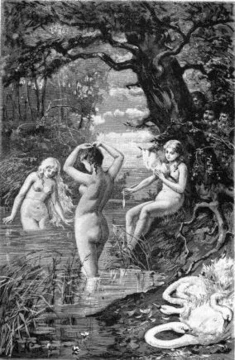
A man dwells in a forest near a rich green meadow. In summer mornings, the grass is treaded all over. He orders his three sons to stand guard near the meadow. The elder two fail because they fall asleep. When it is the youngest's turn, near 'the hour of the matins', he sees three doves come to the meadow, take off their plumages and become human maidens. The youth hides their plumages. The maidens beg him to return their feathers. One girl says they are a princess and two court attendants that live in a palace east of the sun and north of the earth. The youth asks the princess to become his bride, and she agrees. They promise to remain faithful until their wedding, then she departs. The youth prepares a wedding feast. At midnight, a luxurious carriage brings the princess and her court attendants. Just before sunrise, the princess tells her bridegroom she must depart, since a Troll killed her father, the true king of the palace, and she can only enjoy some hours of freedom around midnight. She gives him her golden ring, her court attendants a golden ball, and rushes to leave. The youth decides to go after her. He finds two giants fighting over a pair of magical boots that allow the wearer to take a hundred miles with every step. He convinces the giants to give him the boots. He reaches another forest, where two giants fight over a cloak of invisibility. He convinces them to give him the cloak. He finds another duo of giants fighting over a sword that kills on its point and revives with its hilt. He wins the sword. He traverses a vast desert and sees a light from a little cot. A 'very very old old' woman takes him in. The next morning, she summons all 'beasts of the field' to consult if anyone knows the location of the palace. None know it. He arrives at another vast desert, with a little cot belonging to an ever older woman, ruler of the fishes in the sea. She summons all fishes. None know where the palace is. She bids him consult with her eldest sister, who rules the fowls in the air. He reaches a third vast desert, with a small cot on a mountain. The eldest sister summons all her subjects. The phoenix is not among them. The phoenix arrives and says his lateness is due to him coming from the palace east of the sun and north of the earth. The eldest woman proclaims the phoenix's punishment is to take the youth to the palace.
Reader's Guide
The tale is classified as ATU 400, 'The Man on a Quest for the Lost Wife'. The middle episode of the hero acquiring magic objects from quarreling men is classified as ATU 518, 'Men Fight Over Magic Objects', though folklorists argue this narrative does not exist as an independent tale type and usually appears in combination with ATU 400. An alternate opening to swan maiden tales involves seven white birds stealing golden apples or trampling fields. A variation in Scandinavian tales has a man's third or only son stand guard on his father's fields at night and see three maidens dancing in a meadow.
Did You Know?
- The tale was translated to English as 'The Beautiful Palace East of the Sun and North of the Earth' by Benjamin Thorpe and as 'East of the Sun and North of the Earth'.
- The hero acquires magical boots that allow him to take a hundred miles with every step, a cloak of invisibility, and a sword that kills on its point and revives with its hilt.
- The phoenix carries the youth to the palace after being summoned by the eldest sister, ruler of the fowls.
- The story features a troll who killed the princess's father, the true king of the palace.
The Feather Cloak and the Captured Bride
The central mechanism of the swan maiden narrative revolves around a garment—typically a swan skin or a cloak adorned with swan feathers—that grants its wearer the ability to shift between human and avian form. In the most common version, a man encounters a group of supernatural maidens bathing in a body of water. He secretly steals, hides, or even burns the feathered garment of one among them, frequently the youngest of the group. Deprived of her means of flight or swimming, the maiden is compelled to remain and become his wife. This act of concealment, catalogued in folklore studies as motif K 1335, forms the hinge upon which the entire tale turns. The bird wife, however, is rarely content in her earthly captivity; in many variants she eventually departs from her husband, setting in motion a quest narrative. The transformation key is not merely a plot device but the story's emotional and symbolic core, representing the tension between freedom and domesticity, the celestial and the terrestrial.
Ancient Roots and Worldwide Echoes
The swan maiden story is among the oldest narrative types known to humanity. The earliest recorded example originates in China, preserved in texts such as Gan Bao's Sou shen ji (In Search of the Supernatural, 4th century) and Guo Pu's Xuan zhong ji. In the Chinese version, a man from Xinyu town in the Yuzhang region witnesses six or seven bird maidens and steals the feather cloak of one, forcing her into marriage. A later Dunhuang manuscript variant features a poor man named T'ien K'un-lun encountering three crane maidens at a lake. Beyond East Asia, the tale radiates across continents. Germanic tradition offers the Völundarkviða and Grimm's KHM 193, while medieval Japanese records in the Ōmi fudoki and Tango fudoki describe heavenly women whose feather garments are seized or hidden. The sheer geographic spread—from Jiangxi to Ireland to South America—testifies to a motif that likely predates recorded history by many millennia.
Taxonomy and the Magic Wife Tradition
Folklorists have long debated the precise boundaries of the swan maiden category. Classified under ATU 400, the type encompasses not only swans but geese, cranes, ducks, herons, doves, vultures, and parrots. The Enzyklopädie des Märchens sometimes narrows the discussion to avian wives specifically, while the broader ATU framework admits stars, celestial nymphs, and lake fairies. Russian folklorist Eleazar M. Meletinskii studied the human-animal marriage tradition extensively, though he cautioned that lumping all such tales under a single label excessively broadens the scope. The swan maiden narrative also nests within the even wider Magic Wife motif, which scholars regard as one of the most widely distributed and interconnected story patterns in the world. This motif, probably many millennia old, sits at a hub from which numerous other narratives radiate, making the swan maiden not an isolated curiosity but a node in a vast web of human storytelling.
Valkyries, Smiths, and Sorrows in the Medieval West
In Germanic heroic legend, the swan maiden takes on the guise of the Valkyrie. Jacob Grimm observed in Deutsche Mythologie that multiple Valkyries share this trait, their magic swan-shirt enabling avian transformation. The Wayland the Smith cycle tells of Swanhilde, daughter of a mortal woman and a fairy king, who falls wounded to earth and is rescued by the master-craftsman Wieland. After marrying him and surrendering her wings and magic ring, she is kidnapped by the Neidings; Wieland, himself crippled in his search, fashions wings and escapes. In the Völsunga saga, King Agnar withholds Brynhild's swan shirt to bind her as his enforcer. Across the water, Middle Irish literature offers the Oidheadh chloinne Lir, one of the Three Sorrows of Storytelling, where transformation into swans is central. In The Wooing of Étaine, a husband must identify his beloved among swan-shaped lookalikes, and Óengus finds Caer Ibormeith in swan form, wearing a golden chain, attended by 150 swan-maidservants.
Gallery




Frequently Asked Questions
What is The Beautiful Palace East of the Sun and North of the Earth?
It is a Swedish folktale from Småland that centers on a swan maiden and her husband's journey to recover her. The story was gathered by collectors George Stephens and Gunnar Olof Hyltén-Cavallius.
Who collected The Beautiful Palace East of the Sun and North of the Earth?
The tale was recorded by George Stephens and Gunnar Olof Hyltén-Cavallius in the Småland region of Sweden. Benjamin Thorpe later rendered it into English under two different titles.
What tale type does The Beautiful Palace East of the Sun and North of the Earth fall under?
Scholars classify it as ATU 400, 'The Man on a Quest for the Lost Wife,' a widely distributed narrative pattern found across European and other folk traditions.
How does the swan maiden motif appear in The Beautiful Palace East of the Sun and North of the Earth?
The story features a mythical figure who can shift between human and swan form, and the central plot revolves around her husband searching for her after she is lost.
Why is The Beautiful Palace East of the Sun and North of the Earth notable among swan maiden tales?
It stands out as a well-documented Swedish example of the ATU 400 quest pattern and has been published in English under both its full title and the shorter 'East of the Sun and West of the Moon,' giving it broader reach in comparative folklore studies.
More in Swan maidens 1-21
Spotted an error? Know more?
Reader corrections go straight into our review queue. Suggest an edit · How this site is sourced