Völundarkviða
A mythological poem of the Poetic Edda about the artisan Völundr.

Vǫlundarkviða (Old Norse for "the lay of Völund," also spelled in various anglicized forms) is a mythological poem from the Poetic Edda. It tells the story of the craftsman Völundr, who is captured by a petty-king named Níðuðr (implied to rule over Närke, in present-day Sweden), and then exacts a violent revenge before escaping.
The poem survives in full in the thirteenth-century Icelandic Codex Regius, and the start of its prose prologue also appears in the AM 748 I 4to manuscript fragment. Its vocabulary and certain formulaic phrases show clear West Germanic influence, particularly from Old English, suggesting it was composed in or shaped by traditions from the Norse diaspora in England, likely around the tenth or eleventh century. Most of the story's analogues are also West Germanic in origin.
Visual depictions of the tale appear on the eighth-century Northumbrian Franks Casket, the eighth-century Gotlandic Ardre image stone VIII, and several tenth-to-eleventh-century carvings from Northern England, such as the Leeds Cross, a fragment in Leeds City Museum, and the Sherburn in Elmet fragments 2 and 3. In written sources, a largely similar account (Velents þáttr smiðs) appears in the Old Norse Þiðrekssaga af Bern, which was translated from lost Low German sources, and the first two verse-paragraphs of the Old English poem Deor allude to an evidently similar story.
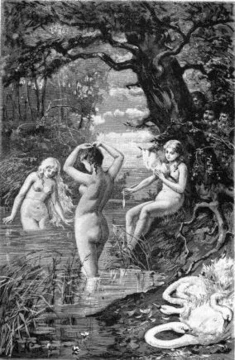
The poem opens with a prose introduction that sets the scene, provides character background, and partly summarizes the verse; this passage may be much younger than the poem itself. The first six stanzas describe three swan-maidens—called young women, stately women, foreign beings, and southerners—who come to a lake or sea shore and meet three brothers: Egill, Slagfiðr, and Völundr. Each maiden takes one brother. After nine winters, the women leave without explanation, simply departing to fulfill their fate. Slagfiðr and Egill go searching for their women, but Völundr stays home, forging arm-rings for his.
In stanzas 7 through 19, the local king Níðuðr, lord of the Njárar, discovers Völundr living alone and has him captured while asleep. Níðuðr takes Völundr’s sword and gives one of the rings Völundr made for his missing bride to his daughter Bǫðvildr.
- Title
- Völundarkviða
- Language
- Old Norse
- Manuscript
- Codex Regius (13th century)
- Genre
- Mythological poem
- Preserved in
- Poetic Edda
- Atu type
- 313, 313C, 400, 465
Lore & Background
The poem is preserved in its entirety among the mythological poems of the thirteenth-century Icelandic manuscript Codex Regius, and the beginning of the prose prologue is also found in the AM 748 I 4to fragment. The vocabulary and some formulaic phrasing show influence from West Germanic, especially Old English, suggesting composition in or influence from the Norse diaspora in England around the tenth or eleventh century. Most analogues are West-Germanic in origin. The story is also portrayed on the front panel of the eighth-century Northumbrian Franks Casket and on the eighth-century Gotlandic Ardre image stone VIII, along with several tenth-to-eleventh-century carvings from Northern England.
Reader's Guide
Vǫlundarkviða is significant as one of the mythological poems of the Poetic Edda, preserving a narrative of revenge and flight that appears in both visual and written sources across Germanic traditions. The poem's West Germanic influences and analogues, including the Old Norse Þiðrekssaga af Bern and the Old English poem Deor, highlight its place in a broader cultural exchange. Its evocative imagery, such as the description of men in studded corslets with glistening shields under the waning moon, and the concluding lament of Bǫðvildr—called 'unsurpassable as a conclusion' by philologist Finnur Jónsson—demonstrate its literary merit. The poem's relationship to Aarne–Thompson–Uther tale types 313, 313C, 400, and 465 further underscores its folkloric connections.
Did You Know?
- The poem is preserved in the thirteenth-century Icelandic manuscript Codex Regius.
- Its vocabulary shows influence from Old English, a West Germanic dialect.
- The story is depicted on the eighth-century Franks Casket and Ardre image stone VIII.
More in Swan maidens 1-21
Spotted an error? Know more?
Reader corrections go straight into our review queue. Suggest an edit · How this site is sourced