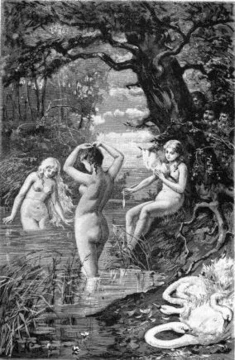
The Swan Queen
A swan maiden who becomes human, marries, and returns to bird form.

The Swan Queen is a figure from a Lithuanian fairy tale related to the swan maiden motif. The tale involves a swan or goose that transforms into a human girl, is adopted by a peasant couple, marries a prince, and later regains her bird form through her swan flock.
- Type
- Fairy tale character
- Origin
- Lithuanian folklore
- Classification
- ATU 400 (The Swan Maiden)
- First published
- 1924 (German translation by Carl Cappeller)
- Known for
- Transformation between swan and human; loss and recovery of birdskin
Lore & Background
In the tale, a peasant couple find a swan or goose and bring it home. The bird transforms into a human girl whom they adopt as their daughter. After her birdskin is destroyed and she marries a human prince, her bird flock gives her a new set of garments and she turns back into a bird. The tale was first published by Carl Cappeller in a 1924 German language translation of Lithuanian fairy tales with the title Von der Schwanenjungfrau, die des Königs Gattin wurde. It was also translated into Russian as "Королева Лебедь" and as "Лебедь — жена короля".
Reader's Guide
The Swan Queen represents a variant of the international swan maiden tale type, classified by Bronislava Kerbelyté as AT 400* (The Swan Maid). Lithuanian folklorist Jonas Balys identified a specific Lithuanian version as type 404*, Mergaitė - gulbė, not included in the international Aarne–Thompson Index at the time. In these variants, after the human burns the swan maiden's feather skin, they marry, but her swan flock later gives her a new set of feathers. The tale also appears among the Mari, Chuvash, and Bulgarian peoples, often with similar motifs of featherskin loss and recovery. Literary versions include Arthur Ransome's adaptation The Swan Princess. The story's significance lies in its exploration of transformation, identity, and the tension between human and animal worlds.
Did You Know?
- The tale was first published in a 1924 German translation by Carl Cappeller.
- Lithuanian folklorist Jonas Balys classified it as type 404*, Mergaitė - gulbė.
- In some variants, the swan maiden returns to suckle her baby after regaining her bird form.
- A similar narrative is attested in Bulgarian folktale catalogue type *400A, 'Bird-daughter'.
More in Swan maidens 1-21
Spotted an error? Know more?
Reader corrections go straight into our review queue. Suggest an edit · How this site is sourced