The Sea Tsar and Vasilisa the Wise
Russian fairy tale of a prince and a sea king's daughter.

The Sea Tsar and Vasilisa the Wise is a Russian fairy tale collected by Alexander Afanasyev and published as number 219 in his *Russian Fairy Tales*. It centers on the Sea Tsar and Vasilisa the Wise, and is categorized under Aarne-Thompson-Uther type ATU 313, known as "The Magic Flight," "Girl Helps the Hero Flee," or "The Devil's (Ogre's/Giant's) Daughter."
In the story, a human king aids an injured eagle and receives two magical caskets as a reward. When he opens them, he cannot close them again until the Sea Tsar appears. The Sea Tsar offers to seal the caskets in exchange for "the thing which you do not know is in your own house"—which turns out to be the king’s newborn son, born during his absence. The king returns home to discover his mistake.
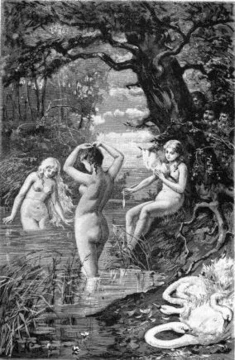
Years later, the prince learns of the bargain. The king leaves him on the seashore for the Sea Tsar, but the prince wanders into a forest and meets Baba Yaga. She tells him that the Sea Tsar’s daughters visit a nearby lake, bathing there in animal or bird forms. The prince spies on them and hides the garment of the youngest daughter. After her sisters fly away, she asks him to come out, and he returns her magic garment before she departs.
The prince then goes to the Sea Tsar’s underwater realm to fulfill the pact. The Sea Tsar orders him to complete three difficult tasks over three days. The prince confides in Vasilisa the Wise, the youngest daughter, who promises to help. After the tasks are done, the Sea Tsar tells the prince to choose a wife from his twelve daughters. Vasilisa conspires with the prince so that he picks her from among her identical sisters.
After their marriage, the prince confesses his wish to visit his parents. Vasilisa warns that the Sea Tsar will pursue them if they flee the undersea kingdom. They escape to "Holy Russia," but the Sea Tsar sends hunting parties after them twice. Vasilisa uses magical disguises to hide them. On the third pursuit, the Sea Tsar himself chases them. Vasilisa transforms herself into a duck and her husband into a drake. The Sea Tsar becomes an eagle and tries to seize them, but they dive deep into the lake, where he cannot follow, and escape. Defeated, the Sea Tsar returns home, and the couple returns safely to solemnize their wedding.
In some variants, the enchanted maiden warns the prince not to kiss anyone in the palace, or he will forget her. When he does kiss someone, he forgets her entirely. Later, he plans to marry another princess, but his first love arrives at the ceremony and makes him remember.
The tale’s title has been translated in many ways, including *Vassilissa the Cunning, and The Tsar of the Sea*, *The King of the Sea and Melania, the Clever*, *The Water King and Vasilissa the Wise*, and *The King of the Sea and Vassilissa the Wise*.
The story’s opening blends ATU type 222, "The Battle of the Birds" or "War of Quadrupeds and Birds," with ATU 537, "The Helpful Eagle (Etana)." This combination is typical of ATU 313B, "Girl helps in hero’s flight," with an introduction called "The Forbidden Box." Professor Jack V. Haney noted that this pairing of AT 222* and AT 313 is more common in East Slavic regions. According to the East Slavic Folktale Classification, type 222B*, "Мышь и воробей" ("Rat and Sparrow"), often appears as the opening of type 313.
The main part of the tale is classified as ATU 313, "The Magic Flight." The East Slavic system recognizes three subtypes: SUS 313A (antagonist pulls hero’s father by the beard), SUS 313B (rat and sparrow quarrel episode), and SUS 313C (ending with "The Forgotten Bride"). Some variants end with ATU 313C, featuring the "Kiss of Oblivion" motif, where the hero breaks a taboo—usually a parental kiss—and forgets his bride until she reappears on his wedding day. Folklorist Hans-Jörg Uther’s 2004 revision merged these subtypes back into the general ATU 313. Slavicist scholars note that the "Forgotten Bride" motif appears frequently as the final part of ATU 313 tales, often combined with the opening episode.
Quick Facts
- Folk Tale Name
- The Sea Tsar and Vasilisa the Wise
- Aarne-Thompson Grouping
- ATU 313 ("The Magic Flight")
- Region
- Russia
- Published In
- Russian Fairy Tales by Alexander Afanasyev
- Related
- The Battle of the Birds / The Master Maid
Facts from the source article.
Lore & Background
The tale begins with a human king who helps an injured eagle and receives two magical caskets. Unable to close them, he is aided by the Sea Tsar in exchange for 'the thing which you do not know is in your own house'—his newborn son. Years later, the prince learns of the bargain and is left on the seashore for the Sea Tsar. He wanders into a forest, meets Baba Yaga, and learns that the Sea Tsar's daughters bathe in a nearby lake as birds. The prince hides the garment of the youngest, Vasilisa the Wise, and later returns it. He then travels to the underwater realm to serve the Sea Tsar, who sets three difficult tasks. Vasilisa helps him complete them, and the prince chooses her as his wife. After marrying, they escape to 'Holy Russia', with Vasilisa using magical disguises to evade pursuit. The Sea Tsar himself chases them, but Vasilisa transforms into a duck and the prince into a drake; they dive into a lake, escaping him. They return home to solemnise their wedding.
Reader's Guide
The tale is significant as a classic example of the ATU 313 tale type, 'The Magic Flight', and its subtypes. The opening merges ATU 222, 'The Battle of the Birds', and ATU 537, 'The Helpful Eagle (Etana)', a combination common in East Slavic areas. The main narrative involves the hero's flight from the Sea Tsar with the help of his daughter, Vasilisa the Wise. Some variants include the 'Kiss of Oblivion' motif (ATU 313C), where the hero forgets his bride after breaking a taboo. The tale's characters—the Sea Tsar, Vasilisa the Wise, and Baba Yaga—are prominent in Slavic folklore. The bird maidens are related to the swan maiden myth, and the Sea Tsar appears as a magical antagonist. The tale has been translated under various titles, including 'Vassilissa the Cunning, and The Tsar of the Sea' and 'The Water King and Vasilissa the Wise'.
Did You Know?
- The tale is classified as ATU 313, 'The Magic Flight', and its opening merges ATU 222 and ATU 537.
- The Sea Tsar's daughters bathe in a lake in the form of birds or other animals, varying between versions.
- In some variants, the prince forgets Vasilisa after kissing someone in the palace, a motif called 'Kiss of Oblivion'.
- The tale was published by Alexander Afanasyev in his collection Russian Fairy Tales, numbered 219.
Frequently Asked Questions
Who is The Sea Tsar and Vasilisa the Wise?
It is not a single character but a Russian fairy tale centered on a prince and the daughter of the Sea Tsar, Vasilisa the Wise. The story was recorded by Alexander Afanasyev and appears as entry 219 in his collected volume of Russian folk narratives.
What role does Vasilisa the Wise play in the tale?
As the Sea Tsar's daughter, she is the key figure who assists the prince in escaping, which is why the story falls under the ATU 313 'Magic Flight' type where a girl aids the hero's flight. Her cleverness and loyalty drive the central plot forward.
Why is this tale important in Russian folklore?
It is a canonical example of the ATU 313 type in the Russian tradition, preserved in Afanasyev's nineteenth-century collection that helped define the national folkloric canon. Scholars cite it as a foundational text for studying the 'magic flight' motif in Slavic storytelling.
What is the Aarne-Thompson-Uther number for this story?
The tale is classified as ATU 313, which covers both 'The Magic Flight' and the variant title 'The Devil's (Ogre's/Giant's) Daughter.' This grouping links it to a wide family of cross-cultural narratives in which a supernatural father's daughter aids a mortal hero's escape.
More in Swan maidens 1-21
Spotted an error? Know more?
Reader corrections go straight into our review queue. Suggest an edit · How this site is sourced