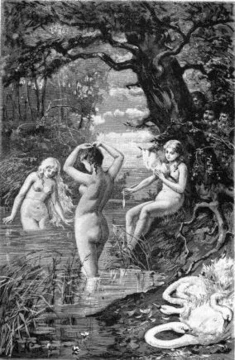
The Nine Peahens and the Golden Apples
Serbian epic poem of a prince's quest for his lost swan-maiden wife.

"The Nine Peahens and the Golden Apple" (Serbian: Златна јабука и девет пауница) is a Serbian epic poem. Folklorists classify it under ATU type 400*, "The Swan Maiden," and ATU type 400, "The Quest for the Lost Wife."
Vuk Stefanović Karadžić first published the tale as a fairy tale in 1853. English translations followed: Elodie Lawton Mijatović rendered it as "The Golden Apple-tree, and the Nine Peahens" in 1874, and Woislav M. Petrovitch used a similar title in 1914. A Serbian version appeared in 1889, translated by A. H. Wratislaw as "The Golden Apples and the Nine Peahens" in *Sixty Folk-Tales from Exclusively Slavonic Sources* (tale number 38). American illustrator and poet Katherine Pyle retold it as "The Seven Golden Peahens," keeping the Serbian origin. Parker Fillmore called it *The Enchanted Peafowl* and credited it as Yugoslavian. Anthropologist Andrew Lang included a retranslation from a German version of Karadžić's tale in *The Violet Fairy Book*, and Ruth Manning-Sanders included a Hungarian variant in *The Glass Man and the Golden Bird: Hungarian Folk and Fairy Tales*.
The story begins with an emperor whose golden apple tree is robbed nightly. His three sons take turns watching. The older two fall asleep, but the youngest stays awake. Nine peahens arrive; eight strip the tree, while the ninth transforms into a beautiful maiden beside him. They talk, and she leaves two apples. This repeats for two nights until the brothers spy on him. They strike a deal with a witch, who cuts a lock of the maiden's hair. The prince executes the witch, but the peahens never return.
Grieving, the prince searches for his beloved. He finds a castle with an aging empress and her daughter. Learning that nine peahens bathe in a nearby lake, he sets out despite the empress's attempts to detain him. She bribes his servant to blow a whistle when the peahens approach, putting the prince into an enchanted sleep. The ninth peahen tries to wake him but fails. She tells the servant they will return once more and then never again. The next day, the servant repeats the trick. The maiden instructs the servant to tell the prince to roll the under peg onto the upper. The prince beheads the servant and continues alone.
A hermit directs him to a castle where he finds the ninth peahen, now an empress. They marry immediately.
- First published
- 1853
- Original language
- Serbian
- Collector
- Vuk Stefanović Karadžić
- Atu classification
- Type 400 (The Quest for the Lost Wife) and Type 400* (The Swan Maiden)
- Notable translators
- Elodie Lawton Mijatović (1874), Woislav M. Petrovitch (1914), A. H. Wratislaw (1889)
Lore & Background
The story begins with an emperor's golden apple tree being robbed nightly. His three sons take turns watching; the older two fall asleep, but the youngest stays awake and sees nine peahens arrive. Eight plunder the tree, while the ninth transforms into a beautiful maiden and converses with him. She leaves two apples. This repeats for two nights until the brothers spy and enlist a witch, who cuts a lock of the maiden's hair. The prince executes the witch, but the peahens vanish. Grieving, the prince searches for his beloved. He encounters an aging empress who tries to detain him, but he learns that nine peahens bathe in a nearby lake. The empress bribes his servant to blow a whistle, putting the prince into an enchanted sleep each time the peahens approach.
Reader's Guide
The tale is significant as a classic example of the Swan Maiden narrative (ATU 400) combined with a dragon-rescue episode (ATU 302). It was collected by Vuk Stefanović Karadžić, a key figure in Serbian folklore, and has been widely translated, appearing in Andrew Lang's The Violet Fairy Book and Ruth Manning-Sanders' collection. The story's motifs—golden apples, a bird-maiden, a witch's interference, a magical horse, and helpers from grateful animals—are common in Eastern European and Balkan folklore. The tale also shows parallels to Ossetian Nart sagas and the Greek myth of the Garden of the Hesperides, as noted by historical linguist Václav Blažek. Its inclusion in multiple international anthologies underscores its enduring appeal and its role in preserving Serbian epic traditions.
Did You Know?
- It was first published in 1853 by Vuk Stefanović Karadžić and translated into English in 1874 by Elodie Lawton Mijatović.
- Anthropologist Andrew Lang included a re-translation of the tale in The Violet Fairy Book.
- The story contains a subtype AaTh 302C, 'The Magical Horse', where the hero tames a horse from a witch.
Frequently Asked Questions
What is The Nine Peahens and the Golden Apples?
It is a Serbian epic poem in which a prince sets out to recover his lost swan-maiden wife. Folklorists slot it into both ATU type 400 (The Quest for the Lost Wife) and ATU type 400* (The Swan Maiden), reflecting its dual narrative structure.
What role do the nine peahens play in the tale?
The nine peahens are the bird-woman figures at the heart of this Serbian swan-maiden variant, serving as the magical beings tied to the prince's lost wife. Their transformation and connection to the golden apples drive the central conflict of the poem.
How does The Nine Peahens and the Golden Apples end?
Following the ATU 400 'Quest for the Lost Wife' schema, the narrative resolves with the prince's search for his swan-maiden wife reaching its conclusion. The tale closes the cycle of loss and recovery that defines the quest structure.
Who first published The Nine Peahens and the Golden Apples?
Vuk Stefanović Karadžić collected and published the poem in 1853, presenting it as a fairy tale in its original Serbian language. English renderings followed in 1874 (Mijatović), 1889 (Wratislaw), and 1914 (Petrovitch).
Why is The Nine Peahens and the Golden Apples important to swan-maiden folklore?
Its dual ATU classification makes it a key example of how the Swan Maiden and Lost Wife motif-complexes overlap in a single narrative. As one of the earliest documented Serbian variants, it anchors the Balkan branch of the broader swan-maiden tradition.
More in Swan maidens 1-21
Spotted an error? Know more?
Reader corrections go straight into our review queue. Suggest an edit · How this site is sourced