Apollo 8
First crewed spacecraft to orbit the Moon and return.

Unknown author Unknown author or not provided · Public domain
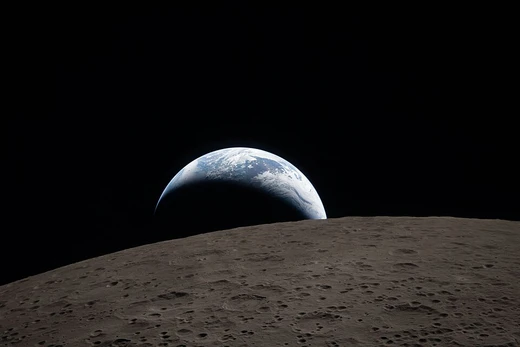
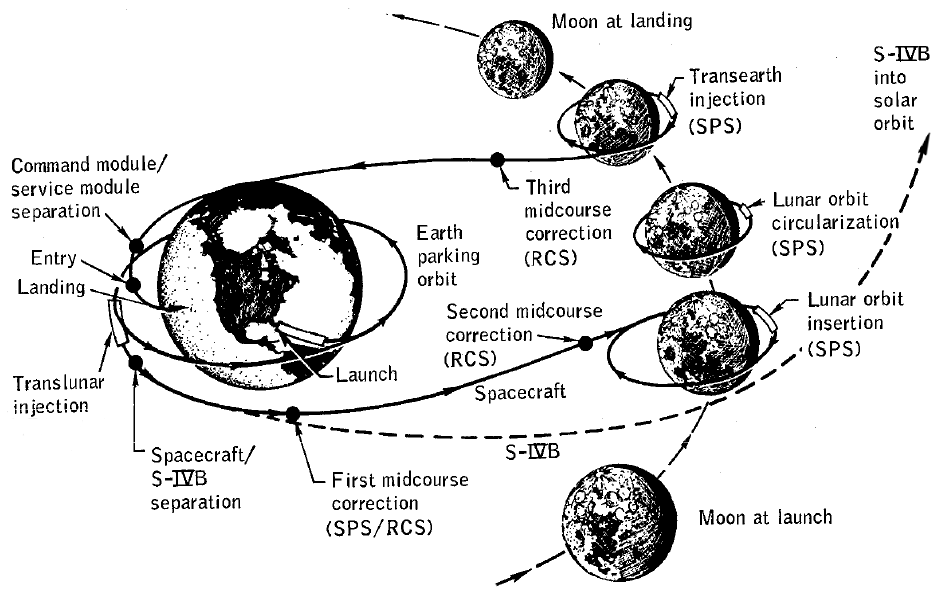
In December 1968, Apollo 8 became the first crewed spacecraft to orbit the Moon and the first human mission to reach lunar orbit. Over six days, the three astronauts—Frank Borman, Jim Lovell, and William Anders—circled the Moon ten times without landing, becoming the first people to witness and photograph the far side of the Moon as well as an Earthrise. This was the second crewed flight of the Apollo program (after Apollo 7, which stayed in Earth orbit) and the first time a Saturn V rocket carried humans into space. It also marked the first human spaceflight to launch from Kennedy Space Center in Florida.
The mission was originally slated for early 1969 as a test of both the command module and the lunar module in an elliptical medium Earth orbit. But in August 1968, with the lunar module not yet ready, planners switched to a more ambitious command-module-only trip to lunar orbit. This shift meant that Jim McDivitt’s crew, who had been training for the first lunar module flight, took over that low-Earth-orbit mission (Apollo 9), while Borman’s crew—originally assigned to the lunar module test—was moved to Apollo 8. As a result, Borman’s team had two to three months less preparation time than planned, and their training shifted from lunar module work to translunar navigation.
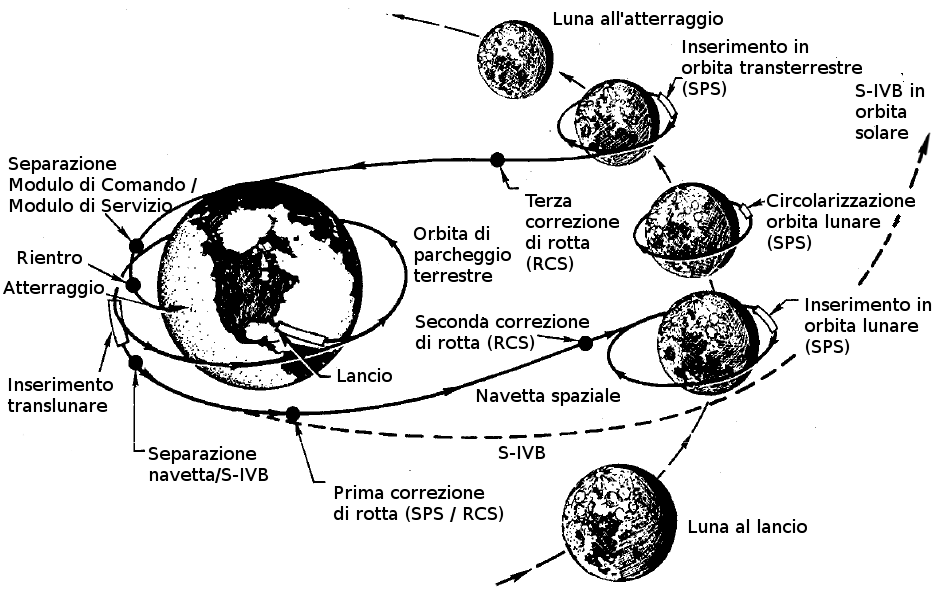
The journey to the Moon took 68 hours. Once in lunar orbit, the crew spent 20 hours circling the Moon ten times. On Christmas Eve, they broadcast a television program that became one of the most-watched shows in history at that time, reading the first ten verses from the Book of Genesis. Apollo 8’s success paved the way for Apollo 10 and, ultimately, Apollo 11, which fulfilled President John F. Kennedy’s goal of landing a man on the Moon before the decade ended. The astronauts splashed down in the northern Pacific Ocean on December 27, 1968, and were later named *Time* magazine’s “Men of the Year.”
**Background** In the late 1950s and early 1960s, the Cold War rivalry with the Soviet Union drove U.S. space efforts. The Soviet launch of Sputnik 1 on October 4, 1957—the first artificial satellite—sparked global fear and awe. It showed the Soviets could deliver nuclear weapons across continents and challenged American claims of technological and military superiority, triggering the Sputnik crisis and the Space Race. President Kennedy believed U.S. national interest requi
- Mission
- Apollo 8
- Launch date
- December 21, 1968
- Return date
- December 27, 1968
- Crew
- Frank Borman, Jim Lovell, William Anders
- Nationality
- United States
- Field
- Human spaceflight
- Known for
- First crewed mission to orbit the Moon
Quick Facts
- Insignia
- Apollo-8-patch.png
- Mission Type
- Crewed lunar orbital CSM flight (C')
- Operator
- NASA
- Mission Duration
- 6days, 3hours, 42seconds
- Spacecraft
- Apollo CSM-103 · Apollo LTA-B
- Manufacturer
- North American Rockwell
- Launch Mass
- CSM: 63650 lb · CM:12392 lb · SM:51258 lb · SC/LM Adapter (jettisoned; connects LTA to CSM; not part of the CSM craft): 4060 lb · LTA (not part of CSM; fixed to rocket): 19900 lb
- Landing Mass
- 10977 lb
- Launch Date
- December 21, 1968, 12:51:00 · timezone=yesUTC (7:51 am EST)
- Launch Rocket
- Saturn V SA-503
- Launch Site
- Kennedy, LC-39A
- Landing Date
- December 27, 1968, 15:51:42 · timezone=yes UTC (5:51:42 am HST)
Facts from the source article.
Lore & Background
Apollo 8 launched from the Kennedy Space Center in Florida on December 21, 1968. Originally planned as a test of the Lunar Module in Earth orbit, the mission profile was changed in August 1968 to a lunar orbital flight because the Lunar Module was not ready. Astronaut Jim McDivitt's crew, originally assigned to the Lunar Module test, became the crew for Apollo 9, and Borman's crew was moved to Apollo 8, leaving them with less training time than planned. The crew orbited the Moon ten times over twenty hours, during which they made a Christmas Eve television broadcast reading the first ten verses from the Book of Genesis, which became one of the most-watched TV programs of its time.
Reader's Guide
Apollo 8's successful mission paved the way for Apollo 10 and, with Apollo 11 in July 1969, the fulfillment of U.S. president John F. Kennedy's goal of landing a man on the Moon before the end of the decade. The mission demonstrated the capability of the Saturn V rocket for crewed flight and proved that humans could travel to and orbit the Moon. The crew's photographs of the far side of the Moon and Earthrise provided humanity with new perspectives of Earth and space. The astronauts returned to Earth on December 27, 1968, splashing down in the northern Pacific Ocean, and were named Time magazine's 'Men of the Year' for 1968.
Did You Know?
- Apollo 8 was the first crewed spacecraft to leave Earth's gravitational sphere of influence.
- The crew orbited the Moon ten times over twenty hours.
- Their Christmas Eve broadcast reading from Genesis was the most watched TV program at the time.
- The mission was originally planned as a Lunar Module test in Earth orbit but was changed to a lunar orbital flight.
The 'All-Up' Revolution in Rocket Testing
Before George Mueller took over as NASA's Associate Administrator for Manned Space Flight in 1963, the prevailing plan assumed twenty Saturn V rockets would be needed, with at least ten unpiloted test flights following the conservative one-stage-at-a-time philosophy that had governed Saturn I development. Mueller shattered that assumption. He introduced an all-up testing approach, flying three live stages together with the Apollo spacecraft on every uncrewed test. This bold strategy compressed the development timeline dramatically. The production lot shrank from twenty vehicles to fifteen, and only three uncrewed flights were planned to human-rate the super heavy-lift rocket. When the first flight succeeded and the second achieved qualified success, the third was simply cancelled. This efficiency was the difference between a Moon landing by 1969 and a program that might have stretched well past that deadline. The Saturn V went from a theoretical twenty-rocket gamble to a proven vehicle in just a handful of flights.
The Alphabetical Ladder and Apollo 8's Leap
In September 1967, Owen Maynard proposed an alphabetical sequence of mission types to organize the path toward a lunar landing. Two A-type flights would test the Command/Service Module and Saturn V uncrewed, a B-type would test the Lunar Module uncrewed, and a C-type would carry the first crew in Earth orbit. The original plan had Apollo 8 as a D-type mission, a complete CSM/LM test in Earth orbit. Then George Low proposed something bolder: commit a crew to lunar orbit ahead of schedule. The CSM was already a proven craft, and Lunar Module production delays made the original sequence impractical. Apollo 8 was reclassified to a C-prime mission, flying humans to the Moon. This single decision eliminated the need for a planned E-type medium Earth orbital test. The D-type objective was handed to Apollo 9, and the F-type mission, Apollo 10, would fly the combined spacecraft to the Moon for final rehearsal without landing. What was meant to be a cautious step-by-step climb became a dramatic leap, compressing the timeline and putting astronauts around the Moon sooner than anyone had formally planned.
The Price of Ambition
The Apollo program's path to the Moon was not without devastating cost. In 1967, a cabin fire during a ground test killed the entire crew of what was to become the first crewed flight. The tragedy struck during a preparation exercise for what had been designated AS-204, a flight later renamed Apollo 1 posthumously. This renaming created a lasting numbering confusion: the first three uncrewed flights never received simple Apollo designations, and the first crewed mission became Apollo 7 rather than Apollo 2. The program also carried the memory of Apollo 13, where an oxygen tank explosion en route to the Moon crippled the Command/Service Module Odyssey's electrical power and life support and rendered its propulsion system unsafe. The crew circled the Moon and returned safely, but the near-disaster underscored how fragile the endeavor remained. Even the launch escape system, tested extensively at White Sands from 1963 to 1966 on the Little Joe II rocket, was a reminder that failure was always a possibility and that every system had to be proven before a human sat atop it.
Twelve Walkers and a Mountain of Rock
The Apollo program, running from 1961 to 1972 under NASA's direction, ultimately delivered twelve men to the lunar surface and 842 pounds of Moon rock and soil back to Earth. The first of those landings came on Apollo 11, when Neil Armstrong and Buzz Aldrin set down their Lunar Module Eagle in the Sea of Tranquility while Michael Collins orbited above in the Command/Service Module Columbia. All three returned safely on July 24, 1969. Five more missions followed, each targeting different lunar sites, with the final landing in December 1972. The collected samples became a cornerstone for understanding the Moon's composition and geological history, giving scientists material they could study in laboratories rather than through telescopes. The program's scope was enormous: Saturn IB and Saturn V rockets lifted the spacecraft, uncrewed flights from 1966 onward proved their safety, and four crewed flights beginning in October 1968 validated the spacecraft's ability to execute a lunar landing mission. The result was not just a flag in the dust but a permanent expansion of humanity's scientific knowledge.
Gallery


Frequently Asked Questions
What was Apollo 8?
Apollo 8 was NASA's first crewed mission to travel beyond Earth orbit and circle the Moon, flying in December 1968. Three astronauts looped around the lunar surface ten times before returning safely to Earth.
Who flew on Apollo 8?
The crew was made up of Commander Frank Borman, Command Module Pilot Jim Lovell, and Lunar Module Pilot William Anders. All three were American astronauts who completed the mission without landing on the Moon.
What did Apollo 8 accomplish that no earlier mission had?
It was the first time human beings orbited another world, completing ten lunar revolutions over roughly six days. The crew also captured the first photographs of the Moon's far side and the iconic 'Earthrise' image.
Why is Apollo 8 considered so important?
It proved that humans could endure a deep-space journey and come home, confirming the fundamental assumptions behind the program's ultimate lunar-landing goal. It was also the first crewed flight of the Saturn V rocket and the first human launch from Kennedy Space Center.
When did Apollo 8 launch and return?
The spacecraft lifted off on December 21, 1968, and the crew splashed down in the Pacific Ocean on December 27, 1968. The entire round trip took just over six days.
More in Successful space missions 1-24
Spotted an error? Know more?
This is a living reference — every entry is fact-audited, and reader corrections feed straight into our audit queue. Suggest an edit · See this site's audit record