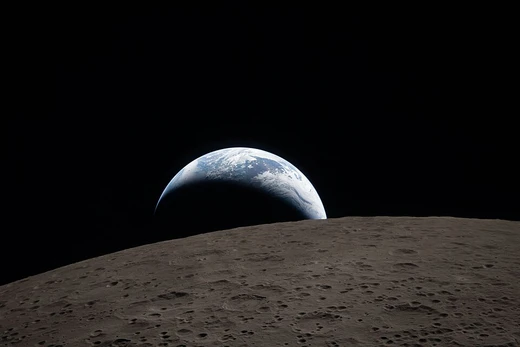
Apollo 17
Final Apollo Moon landing, with the only geologist to walk on the Moon.

NASA on The Commons · Public domain
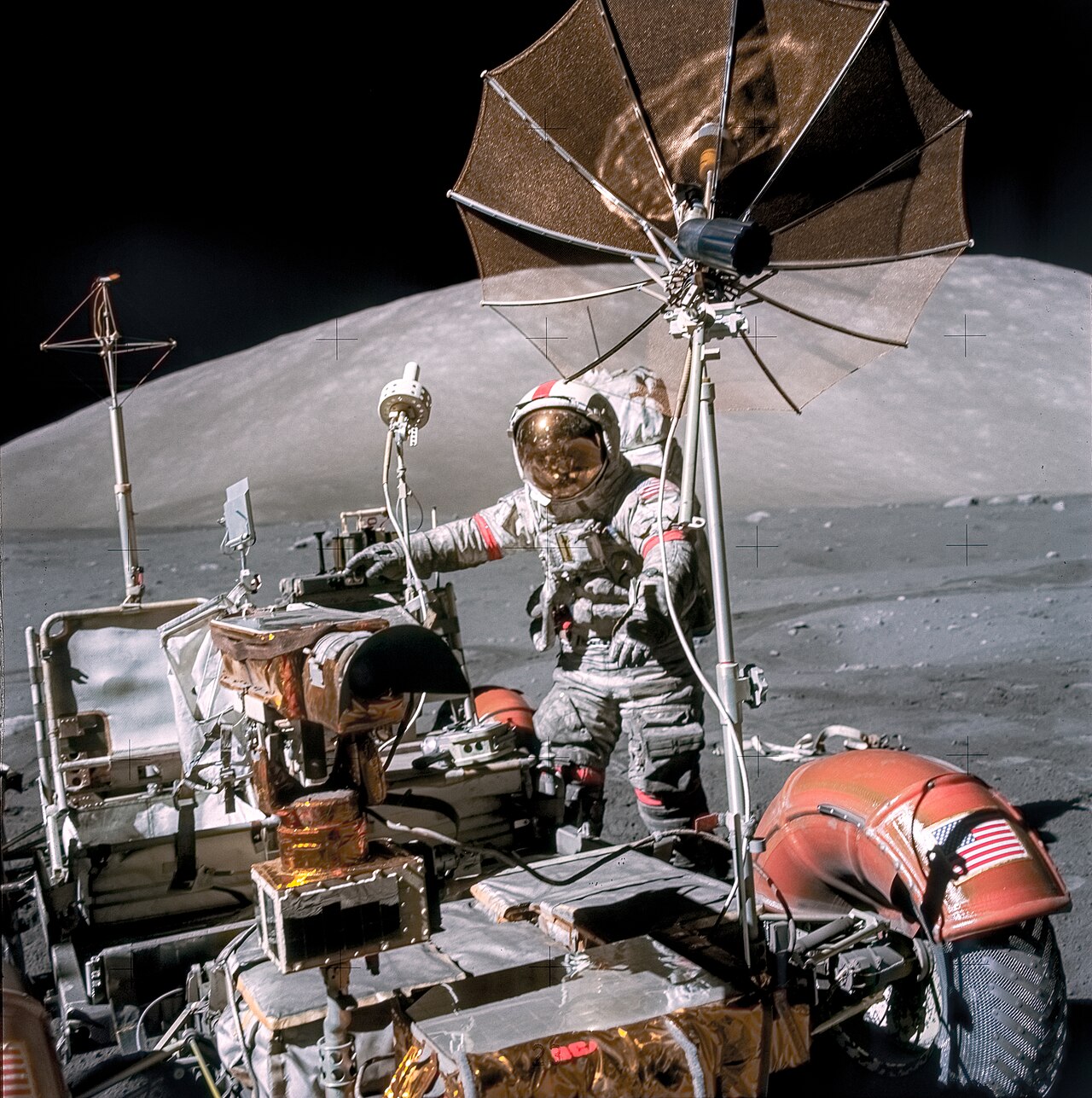
Apollo 17 (December 7–19, 1972) was the eleventh and final crewed mission of NASA's Apollo program, and the sixth and most recent time humans have set foot on the Moon. The crew consisted of Commander Gene Cernan, Lunar Module Pilot Harrison Schmitt, and Command Module Pilot Ronald Evans. Schmitt was the only professional geologist to land on the Moon, selected under pressure from the scientific community to send a scientist. The mission broke several crewed spaceflight records, including the longest lunar landing mission and largest lunar-sample return.
- Mission type
- Crewed lunar landing (J-type)
- Launch date
- December 7, 1972
- Return date
- December 19, 1972
- Crew
- Gene Cernan (Commander), Ronald Evans (CMP), Harrison Schmitt (LMP)
- Landing site
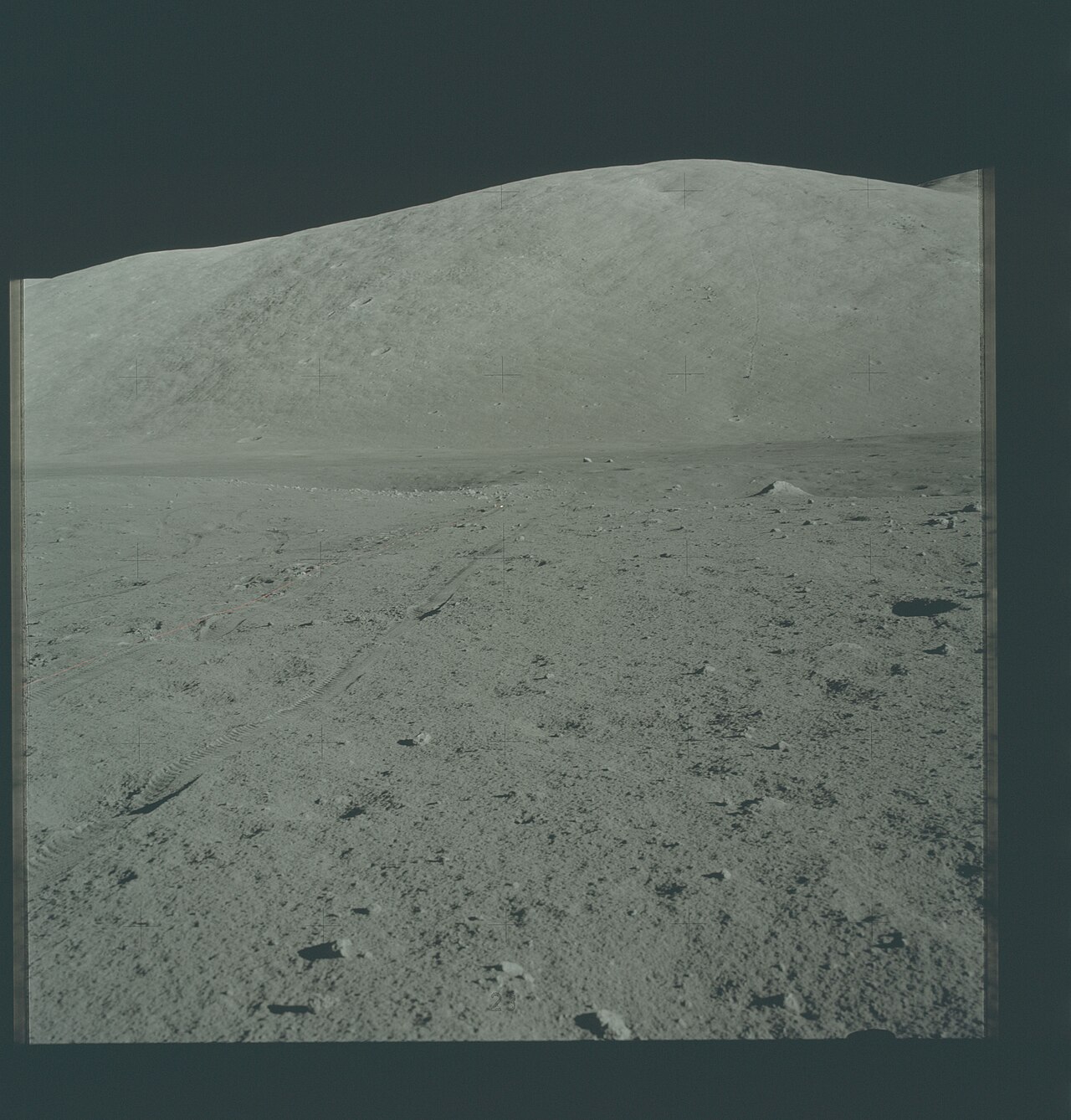
- Taurus–Littrow valley
- Lunar surface time
- 75 hours
- Sample mass returned
- Approximately 115 kg (254 lb)
Lore & Background
The crew was assembled after the cancellation of Apollo 18. Harrison Schmitt, originally slated for Apollo 18, was assigned to Apollo 17 as lunar module pilot, replacing Joe Engle. Commander Gene Cernan and Ronald Evans were selected from the Apollo 14 backup crew, despite objections from Apollo Spacecraft Program Office manager Jim McDivitt over a 1971 helicopter crash attributed to pilot error. The backup crew initially consisted of Apollo 15 astronauts, but they were removed due to the Apollo 15 postal covers incident and replaced by Apollo 16 crew members John Young and Charles Duke, along with Stuart Roosa, who flew on Apollo 14.
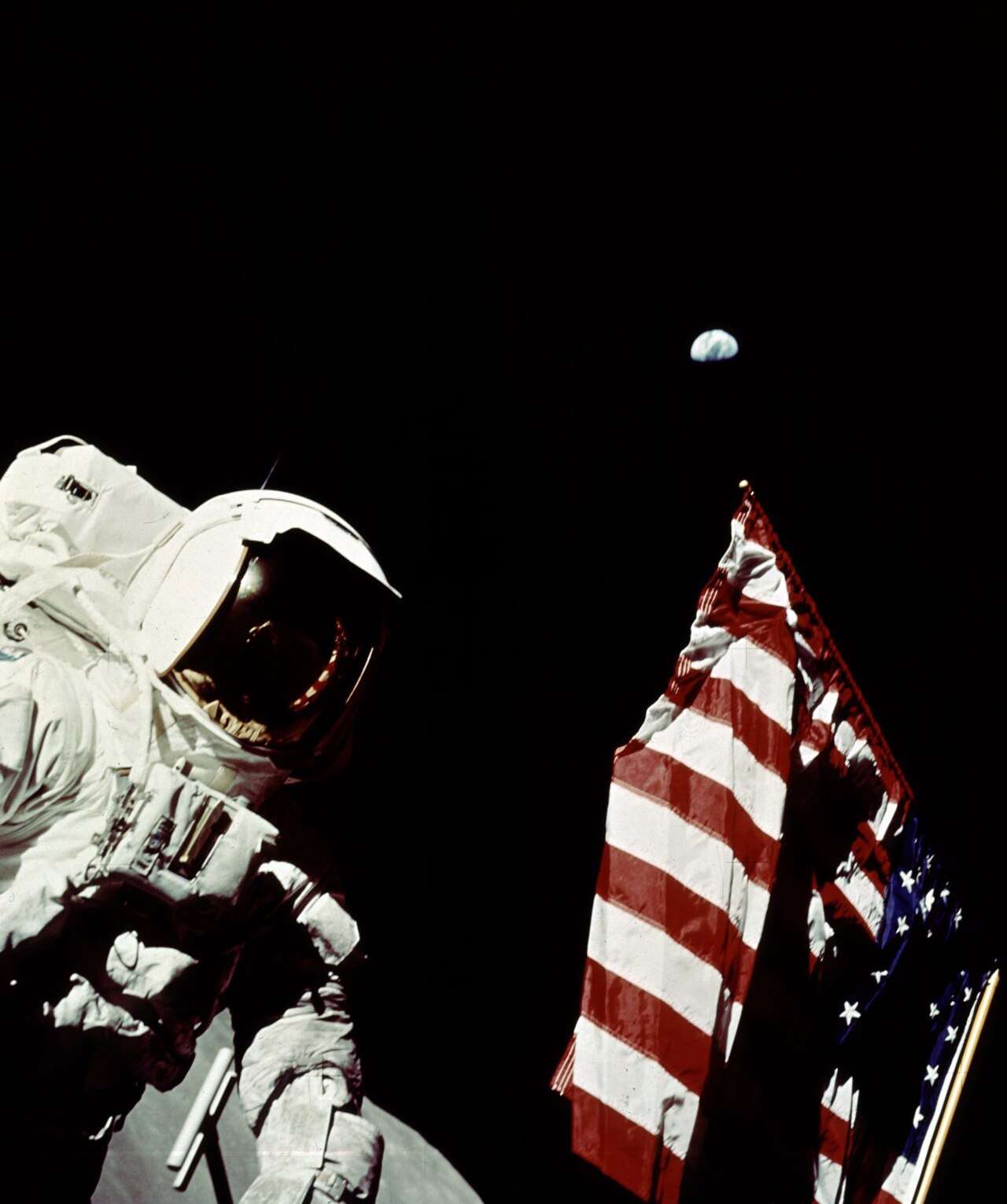
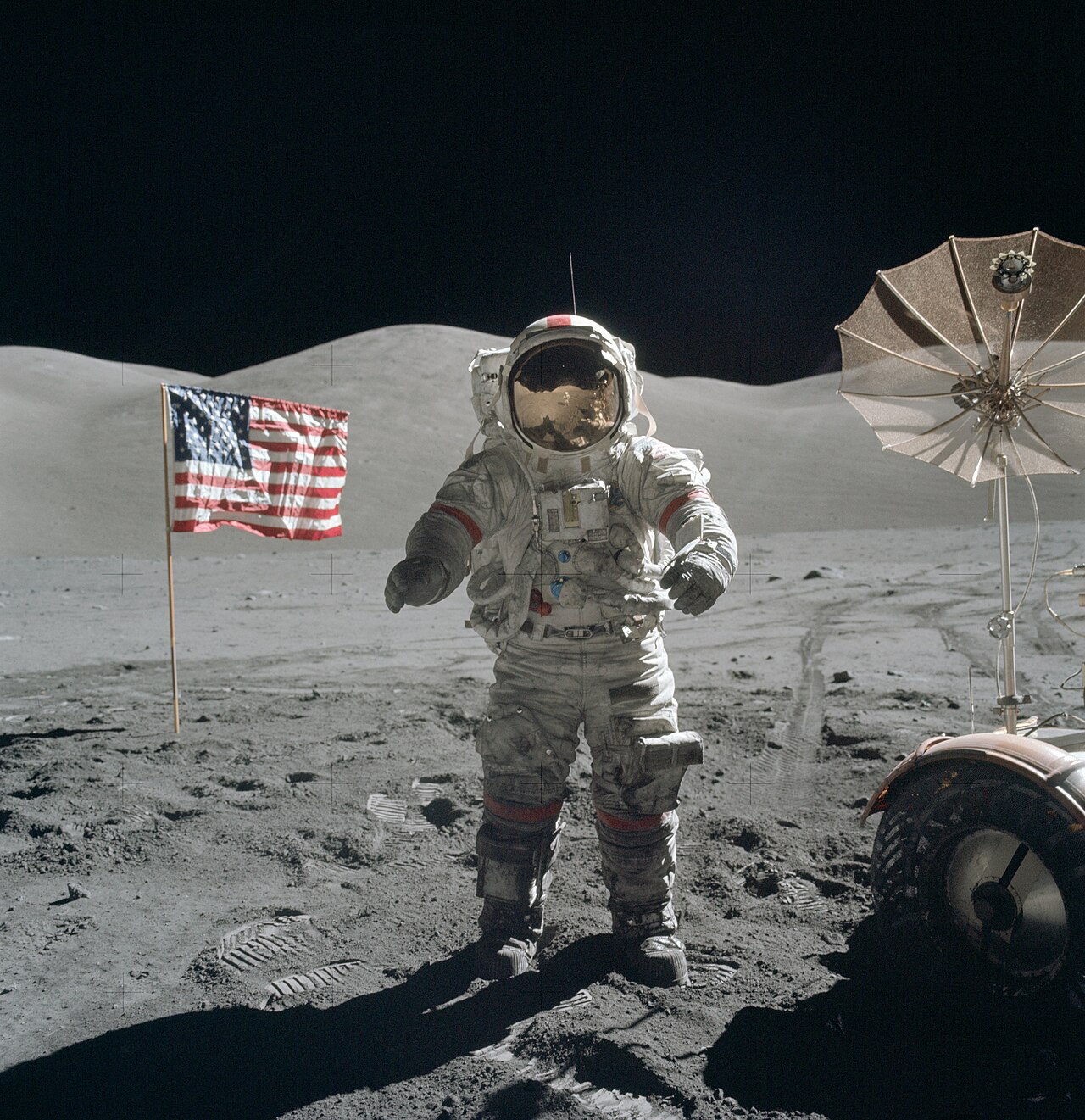
The mission launched at 12:33 a.m. EST on December 7, 1972, after the only launchpad delay in the Apollo program caused by a hardware problem. Cernan and Schmitt landed in the Taurus–Littrow valley, chosen to sample older lunar highland material and investigate possible volcanic activity. They completed three moonwalks, deployed scientific instruments, and discovered orange soil at Shorty crater, which proved volcanic in origin but from early lunar history. Ronald Evans remained in lunar orbit, taking measurements and photographs.
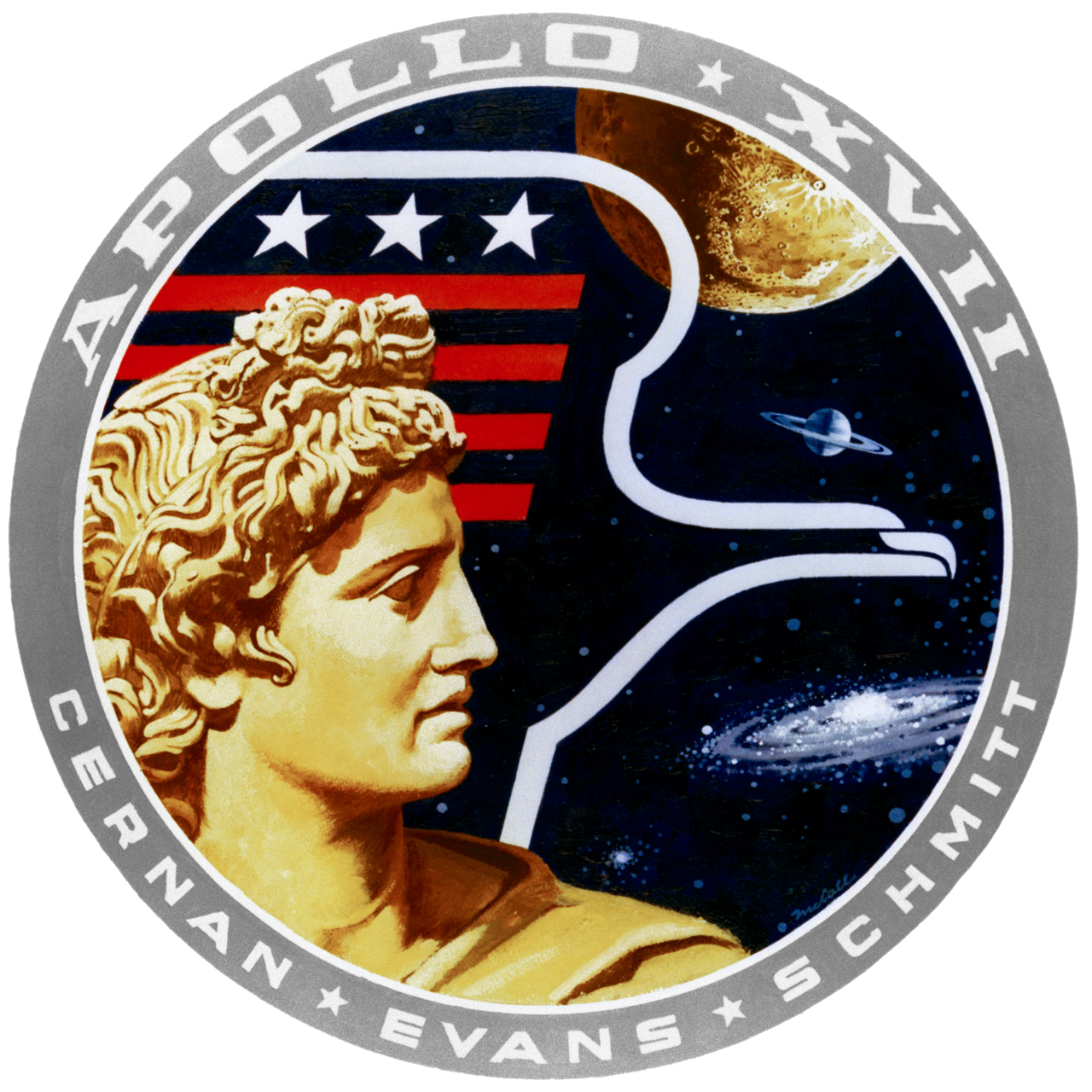
The mission's heavy scientific emphasis included a biological experiment with five mice that stayed in orbit with Evans. The command module was given the call sign "America," and the lunar module's call sign was not specified in the article. The mission insignia, designed by artist Robert McCall, features the Greek sun god Apollo and an American eagle, with colors including gold to represent a "golden age" of spaceflight.
Reader's Guide
Apollo 17 marked the end of the Apollo program and remains the most recent human presence on the Moon. Its scientific legacy is significant: it was the first and only mission to include a professional geologist (Harrison Schmitt) on the lunar surface, and it returned the largest sample of lunar material (approximately 115 kg). The discovery of orange soil at Shorty crater provided evidence of volcanic activity early in the Moon's history. The mission also set multiple records, including the longest crewed lunar landing mission (12 days, 14 hours), longest time on the lunar surface (75 hours), and greatest distance from a spacecraft during an extravehicular activity (7.6 km). The mission's emphasis on science, including a biological experiment with mice, reflected NASA's response to pressure to prioritize research. Apollo 17 was the last human flight beyond low Earth orbit until the Artemis II lunar flyby in April 2026.
Did You Know?
- Harrison Schmitt was the only professional geologist to land on the Moon, selected after pressure from the scientific community.
- The mission included a biological experiment with five mice that stayed in orbit with Command Module Pilot Ronald Evans.
- Orange soil discovered at Shorty crater was volcanic in origin, but from early in the Moon's history.
- Apollo 17 broke the record for the longest crewed lunar landing mission at 12 days and 14 hours.
The Final Chapter of a Decade-Long Endeavor
Apollo 17, launched in December 1972, served as the closing act of a program that had consumed more than a decade of American ambition, engineering, and institutional will. From its inception in 1961 to its final crewed flight, the Apollo program represented the National Aeronautics and Space Administration's most sweeping undertaking: placing human beings on another world. By the time Apollo 17's crew touched down, it had become the last of five post-Apollo 11 missions to deliver astronauts to the lunar surface. The program's arc—spanning uncrewed test flights, early crewed Earth-orbit demonstrations, and ultimately repeated lunar landings—had been meticulously sequenced over eleven years. That December 1972 marked not merely the end of one mission but the end of an era: the Saturn V rockets stood retired, the launch complexes quieted, and the question of whether humanity could reach the Moon had been answered not once but six times. For all its triumph, the program's conclusion also carried the weight of knowing that no further crewed flights to the Moon were planned, leaving Apollo 17 as the final human footprint in that chapter of exploration.
Inheriting a Proven Machine
Apollo 17 did not arrive in a vacuum of untested technology. Every system aboard that final lunar mission had been hardened through years of sequential validation. The Saturn V rocket that lifted the spacecraft from the pad had been qualified under George Mueller's 'all-up' testing philosophy, which mounted all three live stages plus the full Apollo stack on every uncrewed flight rather than testing one stage at a time. This aggressive approach compressed what had originally been planned as twenty rockets and ten uncrewed flights into just three uncrewed Saturn V tests, with the third ultimately cancelled after the first two succeeded. The Command/Service Module and Lunar Module had each undergone dedicated uncrewed demonstrations, and the launch escape system had been proven through pad-abort simulations and Little Joe II flights at White Sands. By the time four crewed missions from October 1968 onward demonstrated the spacecraft's ability to execute a lunar landing profile, the hardware was thoroughly vetted. Apollo 17 thus flew on a machine whose every major component had survived the gauntlet of uncrewed and crewed testing, a heritage of reliability that made the final landing as much an act of confidence as of exploration.
The Shadow of Failure and the Will to Persist
The path from the program's 1961 inception to Apollo 17's December 1972 landing was not a straight line of triumph. In 1967, a cabin fire during a ground test on the launch pad killed the entire crew of what would have been the first crewed flight, a tragedy that reshaped the mission numbering and forced a painful recalibration of the schedule. Later, the third lunar landing attempt was aborted mid-flight when an oxygen tank explosion disabled the Command/Service Module's electrical power and life support systems and rendered the propulsion unsafe, forcing the crew to circle the Moon and fight their way home. Yet the program did not fracture under these blows. After the 1967 loss, uncrewed flights resumed to test the Saturn V and Lunar Module, and the designation scheme was reorganized to absorb the tragedy. After the aborted landing, the next mission proceeded and succeeded. By the time Apollo 17 rolled out of its hangar, the program had absorbed two catastrophic failures and still delivered six successful crewed lunar landings, a testament to institutional resilience that made the final mission possible.
A Scientific Harvest for Humanity
Beyond the spectacle of human beings walking on another world, the Apollo program's most enduring contribution was scientific. Across the six crewed lunar landings that culminated with Apollo 17, twelve men set foot on the Moon's surface, and together they collected 842 pounds—nearly 382 kilograms—of rocks and soil samples that were returned to Earth laboratories. These materials fundamentally reshaped humanity's understanding of the Moon's composition and geological history, providing physical evidence that no telescope or radio signal could supply. The samples told a story of ancient volcanic activity, impact cratering, and a geology radically different from Earth's, rewriting textbooks and spawning new fields of planetary science. Apollo 17, as the final mission of the series, represented the last opportunity under that program's charter to add to this collection, to probe new terrain, and to bring back fresh material for analysis. In a sense, the 842 pounds that came home were the program's true payload: not the flag or the footprints, but the knowledge locked in mineral grains that would continue to inform scientific inquiry long after the Saturn V boosters had been dismantled and the launch pads reclaimed.
Gallery
Frequently Asked Questions
Who flew on Apollo 17?
The three-person crew was Commander Gene Cernan, Command Module Pilot Ronald Evans, and Lunar Module Pilot Harrison Schmitt. Schmitt stood out as the only professionally trained geologist ever to walk on the Moon.
Why is Apollo 17 remembered as the final Moon landing?
It was the eleventh crewed Apollo flight and the last time humans have set foot on the lunar surface. No crewed mission has returned to the Moon since December 1972.
Where did Apollo 17 land and how long did the crew stay?
The Lunar Module touched down in the Taurus–Littrow valley, a site chosen for its varied rock formations. The crew spent roughly 75 hours on the surface, the longest lunar stay of any crewed mission.
What records did Apollo 17 set?
It held the mark for the longest crewed lunar surface operation and brought back the largest haul of Moon rocks and soil in program history. Those two records still define it as the most productive lunar exploration flight ever flown.
Why did NASA put a geologist on the crew?
Scientists pressured NASA to include a professional researcher rather than just a military-trained astronaut. Schmitt's geological expertise let the team target the most scientifically valuable samples during their extended surface work.
More in Successful space missions 1-24
Spotted an error? Know more?
This is a living reference — every entry is fact-audited, and reader corrections feed straight into our audit queue. Suggest an edit · See this site's audit record