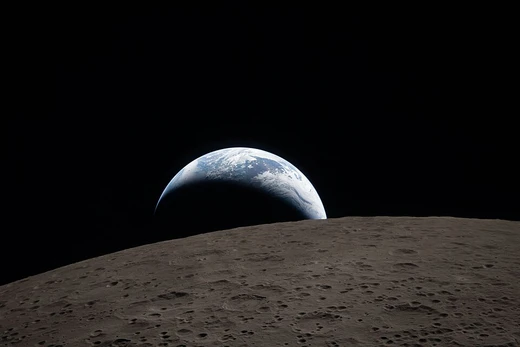
Apollo 12
Second crewed Moon landing; precise landing near Surveyor 3.

NASA / Buzz Aldrin · Public domain
Apollo 12, which flew from November 14 to 24, 1969, was the sixth crewed mission of the U.S. Apollo program and the second to touch down on the Moon. NASA launched it from Florida’s Kennedy Space Center, and it landed in a lunar region known as the Ocean of Storms on November 19. Commander Charles "Pete" Conrad and Lunar Module Pilot Alan L. Bean spent just over a day and seven hours working on the lunar surface, while Command Module Pilot Richard F. Gordon stayed in orbit around the Moon.
If Apollo 11 had failed, Apollo 12 would have been the first landing attempt. But after Apollo 11 succeeded, Apollo 12 was delayed by two months, and other missions were put on a more relaxed schedule. Conrad and Bean received more geologic training than the Apollo 11 crew, going on several field trips to prepare. Their spacecraft and rocket were nearly identical to Apollo 11’s, with one addition: hammocks inside the Lunar Module for more comfortable rest during their stay.
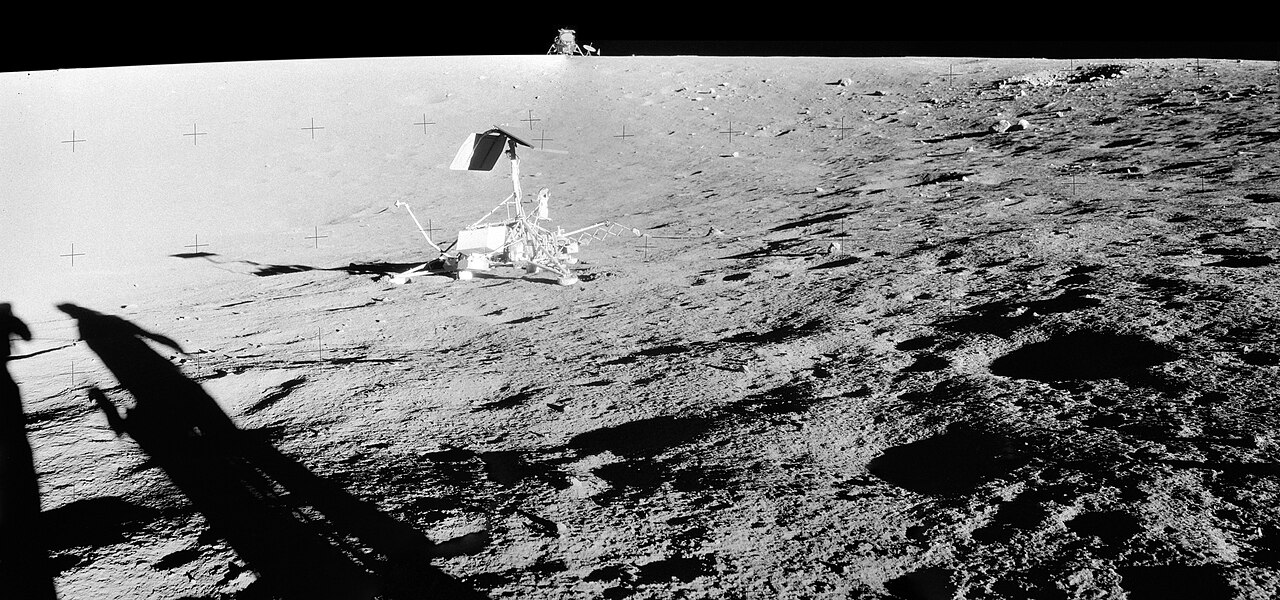
Shortly after launch on a rainy day at Kennedy Space Center, Apollo 12 was hit twice by lightning. This caused instrumentation problems but little damage. The crew fixed the data relay issue by switching the Signal Conditioning Equipment (SCE) to auxiliary, saving the mission. The rest of the trip to the Moon had few problems. On November 19, Conrad and Bean landed precisely at their target, within walking distance of the Surveyor 3 robotic probe, which had arrived on April 20, 1967. This pinpoint landing showed NASA could plan future missions expecting astronauts to land near scientifically interesting sites. They deployed the Apollo Lunar Surface Experiments Package, a set of nuclear-powered instruments, and brought the first color television camera to the Moon. However, transmission was lost when Bean accidentally pointed the camera at the Sun, burning out its sensor. During their second moonwalk, they visited Surveyor 3 and removed parts to bring back to Earth.
The Lunar Module, named Intrepid, lifted off from the Moon on November 20 and docked with the command module, which then headed back to Earth. The mission ended with a splashdown on November 24.
The all-Navy crew was led by 39-year-old Charles "Pete" Conrad. He earned a degree in aeronautical engineering from Princeton in 1953, became a naval aviator, and graduated from the U.S. Naval Test Pilot School at Patuxent River. Selected as an as
- Mission
- Apollo 12
- Launch date
- November 14, 1969
- Landing date
- November 19, 1969
- Splashdown date
- November 24, 1969
- Crew
- Charles 'Pete' Conrad (Commander), Richard F. Gordon (Command Module Pilot), Alan L. Bean (Lunar Module Pilot)
- Nationality
- United States
- Known for
- Second crewed lunar landing; pinpoint landing near Surveyor 3
Lore & Background
Apollo 12 would have attempted the first lunar landing had Apollo 11 failed, but after the success of the earlier mission, Apollo 12 was postponed by two months, and other Apollo missions also put on a more relaxed schedule. More time was allotted for geologic training in preparation for Apollo 12 than for Apollo 11, Conrad and Bean making several geology field trips in preparation for their mission. Apollo 12's spacecraft and launch vehicle were almost identical to Apollo 11's. One addition was a set of hammocks, designed to provide Conrad and Bean with a more comfortable resting arrangement inside the Lunar Module during their stay on the Moon.
Shortly after being launched on a rainy day at Kennedy Space Center, Apollo 12 was twice struck by lightning, causing instrumentation problems but little damage. The crew found that switching to the auxiliary power supply resolved the data relay problem, which helped save the mission. On November 19, Conrad and Bean achieved a precise landing at their expected location within walking distance of the Surveyor 3 robotic probe, which had landed on April 20, 1967. In making a pinpoint landing, they showed that NASA could plan future missions in the expectation that astronauts could land close to sites of scientific interest.
Reader's Guide
Apollo 12 demonstrated the feasibility of precise lunar landings, a critical capability for future scientific exploration. By landing within walking distance of the Surveyor 3 probe, the mission proved that astronauts could reliably reach sites of scientific interest, enabling more ambitious later missions. The crew's recovery from a lightning strike shortly after launch also highlighted the importance of quick problem-solving and redundant systems. The mission carried the first color television camera to the lunar surface, though transmission was lost when Bean accidentally pointed it at the Sun. The removal of parts from Surveyor 3 for return to Earth provided valuable data on the effects of long-term exposure to the lunar environment. Apollo 12's success, coming just months after Apollo 11, solidified NASA's ability to conduct sustained lunar exploration and set the stage for more complex geological investigations on later flights.
Did You Know?
- Apollo 12 was twice struck by lightning shortly after launch, but switching to the auxiliary power supply resolved the data relay problem and saved the mission.
- The mission landed within walking distance of the Surveyor 3 probe, which had been on the Moon since April 20, 1967.
- The first color television camera taken by an Apollo mission to the lunar surface was carried on Apollo 12, but transmission was lost after Bean accidentally pointed it at the Sun.
- Apollo 12 would have attempted the first lunar landing had Apollo 11 failed.
Place in the Lunar Landing Sequence
Following the first crewed landing achieved by Apollo 11 in the Sea of Tranquility in July 1969, the program pressed forward with five additional missions that carried astronauts to various sites across the lunar surface. Apollo 12 was one of these follow-on flights, part of a sequence that ultimately delivered twelve men to walk on the Moon and returned 842 pounds of rocks and soil samples to Earth. Those samples became a cornerstone for understanding the Moon's composition and geological history. The entire program ran from 1961 to 1972 under NASA, relying on Saturn IB and Saturn V launch vehicles to loft the Command/Service Module and Lunar Module into space. By the time these landing missions were flying, the spacecraft had already been proven through uncrewed test flights beginning in 1966 and four crewed flights starting in October 1968, establishing the demonstrated capability to execute a full lunar landing mission.
The Engineering Foundation
The hardware that carried Apollo 12 and its sister missions to the Moon was the product of years of iterative testing. The Saturn V super heavy-lift rocket, which launched the CSM and LM toward the lunar surface, was developed under a radical all-up philosophy championed by George Mueller beginning in 1963. Rather than testing one stage at a time, Mueller insisted on flying all three live stages plus the spacecraft on every uncrewed test. This aggressive approach cut the planned production lot from twenty rockets down to fifteen and required only three uncrewed flights to human-rate the vehicle, with the third ultimately cancelled after the second flight's qualified success. The Lunar Module itself was validated through a single uncrewed test flight on the Saturn IB, whose success led to the cancellation of a planned second test. The launch escape system was separately proven through pad-abort simulations and Little Joe II rocket flights at White Sands between 1963 and 1966.
Mission Architecture and Evolution
The Apollo program's mission sequence was organized through an alphabetical classification system proposed by Owen Maynard in September 1967, designed to ensure sequential testing of each major element before committing astronauts to a lunar landing. A-type missions handled uncrewed CSM and Saturn V tests, B-type covered the Lunar Module, and C-type brought the first crewed CSM flight in Earth orbit, accomplished by Apollo 7. The plan evolved dynamically: George Low's proposal to send humans to lunar orbit ahead of schedule reclassified Apollo 8 from a D-type Earth-orbit test into a C-prime mission, which in turn eliminated the need for a planned E-type medium Earth orbital test. Apollo 9 then performed the D-type objective, and Apollo 10 executed the F-type mission, flying the full CSM/LM stack to the Moon for final rehearsal without landing. Each of these steps built the confidence and operational knowledge that underpinned the landing missions that followed.
A Program Forged by Adversity
The path to the lunar landing missions that included Apollo 12 was marked by two devastating failures that tested the program's resolve. In 1967, a cabin fire during a ground test killed the entire crew of what would become Apollo 1, the flight originally slated to be the first crewed mission. This tragedy forced a pause in crewed operations while uncrewed flights resumed to validate the Saturn V and Lunar Module. Later, during the third lunar landing attempt, Apollo 13 suffered an oxygen tank explosion en route to the Moon, which crippled the CSM Odyssey's electrical power, life support, and rendered its propulsion system unsafe. The crew circled the Moon and returned safely to Earth. These incidents underscored the extreme risks inherent in the program and the importance of the extensive uncrewed testing, launch escape system validation, and sequential mission architecture that had been built into the program from the start.
Gallery




Frequently Asked Questions
What is Apollo 12?
Apollo 12 was the sixth crewed flight in NASA's Apollo program and the second mission to put humans on the Moon. It launched from Kennedy Space Center on November 14, 1969, and touched down in the Ocean of Storms on November 19.
Who flew on Apollo 12?
The three-person crew was Commander Charles 'Pete' Conrad, Lunar Module Pilot Alan L. Bean, and Command Module Pilot Richard F. Gordon. Conrad and Bean performed the surface work while Gordon orbited the Moon in the command module.
Where exactly did Apollo 12 land on the Moon?
The Lunar Module set down in the Ocean of Storms region, deliberately aiming for a spot very close to the Surveyor 3 probe that had been sitting there for over two years. The crew's precision landing near that probe was a major technical first.
Why is Apollo 12 important in the history of spaceflight?
It proved the first lunar landing wasn't a one-time fluke by hitting a far tighter target zone than Apollo 11 had. It also demonstrated that a crew could rendezvous with and recover a previously landed spacecraft, a capability no one had shown before.
How long did the Apollo 12 crew stay on the lunar surface?
Conrad and Bean spent just over a day and seven hours conducting three moonwalks, collecting samples, and testing equipment. The full mission, from launch to Pacific splashdown, stretched across ten days.
More in Successful space missions 1-24
Spotted an error? Know more?
This is a living reference — every entry is fact-audited, and reader corrections feed straight into our audit queue. Suggest an edit · See this site's audit record