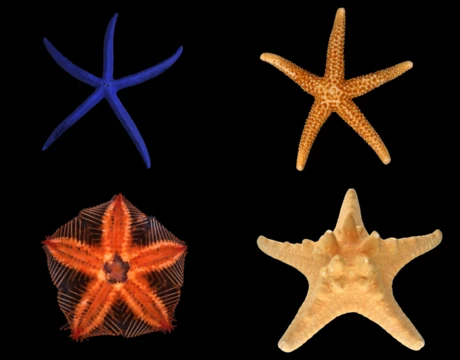
Xyloplax turnerae
A sea daisy living on deep-sea timber in the Bahamas.

Xyloplax turnerae is a sea daisy, part of a peculiar group of marine animals within the phylum Echinodermata. It inhabits sunken wood on the seafloor in a deep oceanic trench in the Bahamas.
The first species in this genus, Xyloplax medusiformis, was discovered near New Zealand and described in 1986. Later, researchers using a submersible placed pieces of timber at a depth of 2,066 meters in the Tongue of the Ocean, a trench between Andros and New Providence islands. When retrieved nearly two years later, the wood held over two hundred specimens of Xyloplax turnerae. In 2004, a third species, Xyloplax janetae, was collected similarly from 2,675 meters deep in the northeast Pacific.
In appearance, Xyloplax turnerae closely resembles Xyloplax medusiformis. It has a flattened, disc-shaped body bordered by a row of short spines, each 300–400 micrometers long. The upper (aboral) surface is covered with concentric plates, each bearing three spines. Its tube feet end in rounded, bulbous tips. On the lower (oral) side, the mouth opens into an eversible stomach, but there is no gut or anus. A single ring of tube feet surrounds the mouth; X. turnerae has up to 110 of these, while X. medusiformis has fewer than 65. Females reach about 12 millimeters in diameter, males about 7 millimeters. All embryos found inside females were small—less than 180 micrometers across—suggesting this species does not brood its young like X. medusiformis does. The marginal spines are mobile and proportionally longer in smaller individuals than in larger ones, leading researchers to think juveniles may use them to “parachute,” aiding their dispersal.
Quick Facts
- Genus
- Xyloplax
- Species
- turnerae
Facts from the source article.
Lore & Background
Xyloplax turnerae was discovered after pieces of timber were deposited at a depth of 2,066 metres in an oceanic trench known as the Tongue of the Ocean, between the Bahamian islands of Andros and New Providence. When recovered nearly two years later, they yielded more than two hundred specimens. The species was described by the same team that had earlier discovered Xyloplax medusiformis in the South Pacific near New Zealand in 1986. Another species in this genus, Xyloplax janetae, was later collected from a depth of 2,675 metres in the north east Pacific Ocean in 2004.
In appearance, Xyloplax turnerae is very much like Xyloplax medusiformis. It is shaped like a flattened disc and fringed by a row of short spines of approximately equal length (300–400 μm). The aboral (upper) surface is clad in a series of concentric plates each bearing three spines. The tube feet have rounded bulbous tips. On the oral (lower) side, the mouth leads to an eversible stomach but there is no gut or anus. There is a single row of tube feet circling the mouth, numbering up to 110, while X. medusiformis has fewer than 65. Females grow to about 12 mm in diameter and males to 7 mm. All embryos found in females were small, less than 180 μm in diameter, and it seems unlikely that this species broods its young in the same way that X. medusiformis does. The marginal spines are mobile and are disproportionally longer in smaller individuals than in larger ones, and it is thought that juveniles may use them to 'parachute' and that this may aid in their dispersal.
Reader's Guide
Xyloplax turnerae is notable as a member of the sea daisies, an unusual group of marine taxa within the phylum Echinodermata. Its discovery on decaying timber in a deep oceanic trench highlights the specialized ecological niches of deep-sea organisms. The species was found in large numbers (over two hundred specimens) on timber deposited at 2,066 metres, suggesting a reliance on sunken wood as a habitat. Its morphology—a flattened disc, eversible stomach, lack of gut and anus, and mobile marginal spines—reflects adaptations to this environment. The comparison with Xyloplax medusiformis (fewer tube feet, different brooding behavior) and the later discovery of Xyloplax janetae in the north east Pacific indicate a broader distribution of the genus in deep-sea wood-fall communities. The potential use of marginal spines by juveniles for 'parachuting' dispersal adds to understanding of life history strategies. The species contributes to knowledge of echinoderm evolution and deep-sea biodiversity, though uncertainties remain about its reproductive mode.
Did You Know?
- Xyloplax turnerae was found on decaying timber in the Tongue of the Ocean at a depth of 2,066 metres.
- More than two hundred specimens were recovered from timber deposited nearly two years earlier.
- Females grow to about 12 mm in diameter, while males reach 7 mm.
- Juveniles may use their mobile marginal spines to 'parachute' for dispersal.
More in Starfish 1-24
Spotted an error? Know more?
Reader corrections go straight into our review queue. Suggest an edit · How this site is sourced