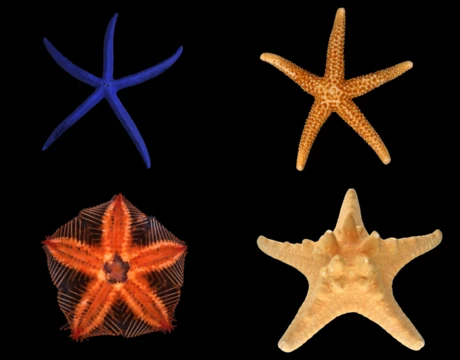
Sea star wasting disease
A sporadic disease causing mass starfish mortality and ecosystem disruption.

Wikimedia Commons · Public domain
Sea star wasting disease (SSWD), also called starfish wasting syndrome, is a condition that strikes starfish and some other echinoderms in unpredictable outbreaks, often killing large numbers of them. The disease has been recorded in more than 20 species of sea stars, many living along the western coast of North America. In some areas, higher water temperatures seem to play a role, but not everywhere. The illness begins with lesions, then the body breaks apart, leading to death. By 2025, the outbreak that started in 2013 had killed over 5 billion sea stars, causing some species to lose more than 90% of their population. Along the Pacific Northwest coast, this collapse has thrown ecosystems out of balance: with far fewer sea stars to prey on them, sea urchin numbers have surged, and these urchins are devouring local kelp forests unchecked. In 2014, researchers suggested a single-stranded DNA virus called sea star-associated densovirus (SSaDV) might be the cause, but later studies in 2018 and 2020 disproved that idea. Then, in 2025, a paper in *Nature Ecology and Evolution* showed that a bacterium, *Vibrio pectenicida* strain FHCF-3, could produce SSWD-like symptoms in the sunflower star (*Pycnopodia helianthoides*).
**Symptoms** The first sign is usually that the sea star stops eating. It becomes sluggish for weeks, then white lesions appear on its surface and spread quickly. The tissue around the lesions decays. Next, the animal goes limp as its water vascular system fails, and it can no longer hold its internal hydrostatic balance. The sea star loses its grip on the seafloor. Its body structure starts to fall apart—arms may stretch, twist, and drop off—and the star dies. Even after being shed, the arms can keep crawling for a while. The whole process can be fast, killing the animal in just a few days. A deflated look may appear before other signs. However, these symptoms also occur in unhealthy stars for ordinary reasons, like being stranded too high in the intertidal zone and drying out. "True" wasting disease is diagnosed when such symptoms appear in stars found in suitable habitat, often near other affected individuals. The end result is a disintegrated, white, mushy blob that no longer resembles a sea star.
**1972 Plague** The first notable outbreak of sea star wasting disease happened in 1972.
- Species affected
- over 20 species of sea stars
- Total loss since 2013
- more than 5 billion sea stars
- Population decline
- over 90% in some species
- First notable plague year
- 1972
- 2013 plague geographic range
- from Alaska to the border of Mexico
- Causative agent as of 2025
- Vibrio pectenicida strain FHCF-3
Lore & Background
The first notable case of sea star wasting disease occurred in 1972, when common starfish (Asterias rubens) off the east coast of the United States became limp, lost limbs, and melted into a white mucus-like paste. In 1978, large numbers of Heliaster kubiniji succumbed to a wasting disease in the Gulf of California, with high water temperatures suspected as a causal factor; this species became locally extinct in some parts of the gulf. In July 2013, populations declined rapidly on the east coast of the US between New Jersey and Maine, and on the Pacific coast the disease was first found in ochre stars and sunflower stars in Howe Sound, British Columbia. By late August 2013, the disease stretched from Alaska to the border of Mexico, affecting more than 20 species. Symptoms typically begin with refusal to accept food and listlessness, followed by white lesions, decay of tissue, failure of the water vascular system, loss of grip on the substrate, body fragmentation, and death. The final result is a disintegrated, white, mushy blob. The disease appears to be associated with increased water temperatures in some locales but not others. In 2014, a single-stranded DNA virus known as sea star-associated densovirus (SSaDV) was suggested as the cause, but this hypothesis was refuted by research in 2018 and 2020. In 2025, a study showed that the bacterium Vibrio pectenicida strain FHCF-3 caused a SSWD-like condition in Pycnopodia helianthoides.
Reader's Guide
The significance of sea star wasting disease lies in its massive scale and ecological consequences. As of 2025, more than 5 billion sea stars have been lost from the 2013 plague, resulting in population declines of over 90% in some species. The decimated numbers of sea stars on the Pacific Northwest coast have led to major ecosystem imbalance: rising sea urchin populations, due to the lack of sea star predation, uncontrollably feed on local kelp forests. The disease has affected over 20 species of sea stars, many found on the western coast of North America. In the Channel Islands off California, ten species of sea star were recorded as affected, along with three species of sea urchins, two brittle stars, and a sea cucumber, all experiencing large population declines. The 1978 plague caused Heliaster kubiniji to become locally extinct in parts of the Gulf of California, with some populations not recovered by the year 2000. As of 2021, the outbreak is regarded as a record-breaking marine epizootic. Some recovery of ochre sea star populations has been observed, with higher numbers of juveniles, but biomass and ecological function remain lower than pre-disease levels. The 2025 identification of Vibrio pectenicida strain FHCF-3 as a causative agent in Pycnopodia helianthoides fulfills Koch's postulates, though it is unclear whether this applies to other species or to the 2013-2015 mass mortality.
The Clinical Unraveling
The disease announces itself quietly. An infected sea star first stops eating, then drifts into weeks of listlessness before the visible damage begins. White lesions erupt across the body surface and race outward, dragging the surrounding tissue into decay. As the water vascular system collapses, the animal can no longer hold its internal hydrostatic pressure. It sags, releases its grip on the rock, and the structural integrity of the body starts to fail. Stretching appears between the arms; the arms themselves twist, detach, and in some cases keep crawling across the substrate for a time after they have been shed. The whole cascade can be over in a matter of days. What remains is a deflated, disintegrated, white, mushy mass that bears little resemblance to the creature it once was. Distinguishing true wasting from ordinary desiccation—what happens when a star is simply stranded too high in the intertidal zone—requires context: genuine cases typically appear in suitable habitat, often clustered among other affected individuals.
Earlier Warnings: The 1972 and 1978 Plagues
Long before the 2013 catastrophe, sea star wasting disease had already struck twice in well-documented episodes. In 1972, scientists along the eastern seaboard of the United States watched common starfish (Asterias rubens) collapse in numbers. The animals went limp, shed their limbs one by one, and ultimately dissolved into a white, mucus-like paste. The event was the first notable recorded instance of what would later be named SSWD. A decade later, in 1978, the Gulf of California saw a devastating die-off of Heliaster kubiniji. Elevated water temperatures were suspected as a trigger at the time. The species was pushed to local extinction in parts of the gulf, and some populations still had not recovered by the year 2000. Because Heliaster kubiniji occupied the role of top-level predator, its vanishing rippled through the food web. The Channel Islands off California recorded losses across ten sea star species, three sea urchin species, two brittle stars, and a sea cucumber, all suffering significant population declines.
The 2013 Onset and a Continent-Scale Die-Off
The modern plague erupted in July 2013 on the Atlantic coast between New Jersey and Maine, where sea star numbers had actually surged three years earlier. Almost simultaneously, on the Pacific side, ochre stars and sunflower stars in Howe Sound, British Columbia, began showing wasting symptoms. By late August the affected zone stretched from Alaska to the Mexican border, encompassing more than twenty species. In early September the seafloor off British Columbia was littered with disintegrating sunflower stars, their detached arms and central discs scattered across the substrate. The morning sun star was another species hit hard. Throughout the rest of 2013, reports spread through Vancouver, southern and central California, and Washington, while Oregon's intertidal zone was not affected until spring 2014. Marine researchers had been tracking populations before the outbreak, giving them a baseline. Their data showed proportionate declines were steepest in the south, though absolute death counts were often higher in the north where populations were denser. Citizen scientists also played a vital role, uploading observations to an online log database that helped map the spread. By 2025, more than five billion sea stars had been lost, with some species down over ninety percent.
Ecosystem Collapse and the Search for a Cause
The ecological fallout from the Pacific Northwest's sea star losses has been severe. With the primary predator of sea urchins gone, urchin populations have surged, feeding without restraint on the kelp forests that once thrived beneath them. This cascade represents a major ecosystem imbalance. The 1978 Gulf of California event showed a similar pattern: the disappearance of a top-level predator sent shockwaves through the local food web. On the question of what actually causes SSWD, the scientific record has been contentious. In 2014, researchers proposed that a single-stranded DNA virus, later named the sea star-associated densovirus (SSaDV), was responsible. That hypothesis was refuted by follow-up studies published in 2018 and 2020. The link to elevated water temperatures remains inconsistent—observed in some locales but not others. In 2025, a study in Nature Ecology and Evolution demonstrated that the bacterium Vibrio pectenicida, strain FHCF-3, could produce an SSWD-like condition in the sunflower star (Pycnopodia helianthoides), offering the most concrete causal agent identified to date.
Gallery


More in Starfish 1-24
Spotted an error? Know more?
Reader corrections go straight into our review queue. Suggest an edit · How this site is sourced