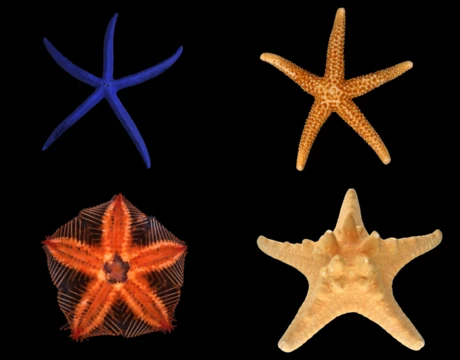
Choriaster
A monotypic genus of large, pale pink sea star.

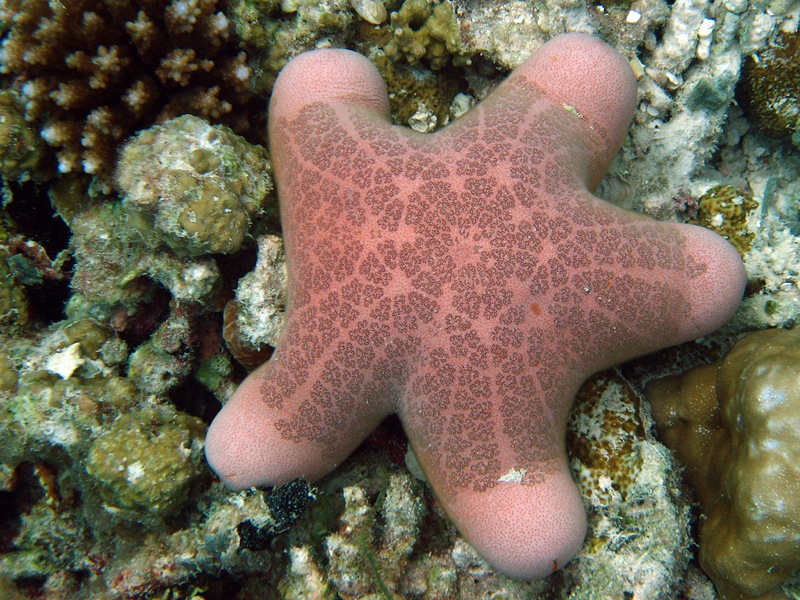
Albert Kok at Dutch Wikipedia ( Original text: Albert Kok ) · Public domain
Choriaster is a genus in the family Oreasteridae that contains just one species, *Choriaster granulatus*. Its common names include the granulated sea star, big-plated sea star, hunter-five sea star, and doughboy starfish.
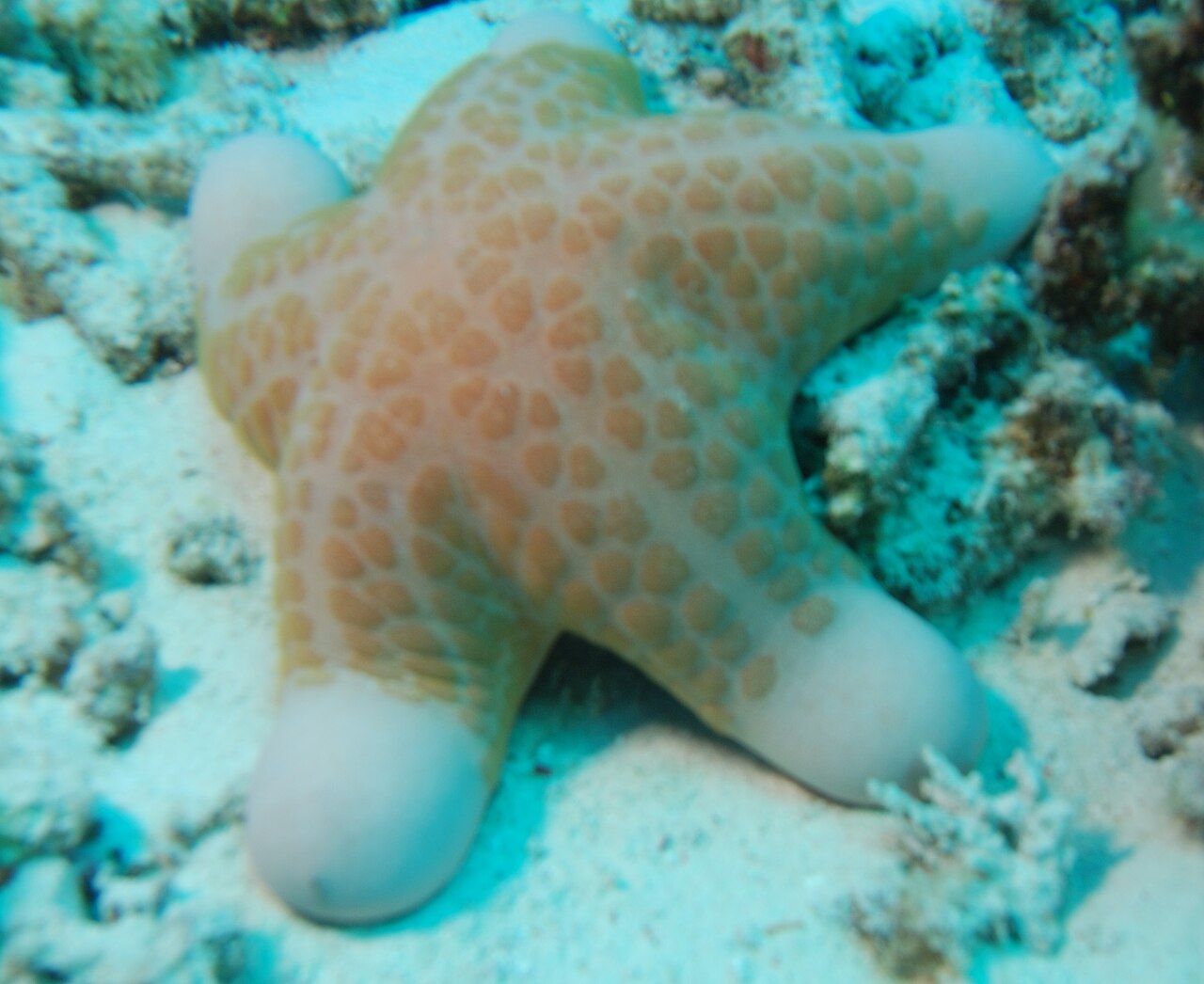
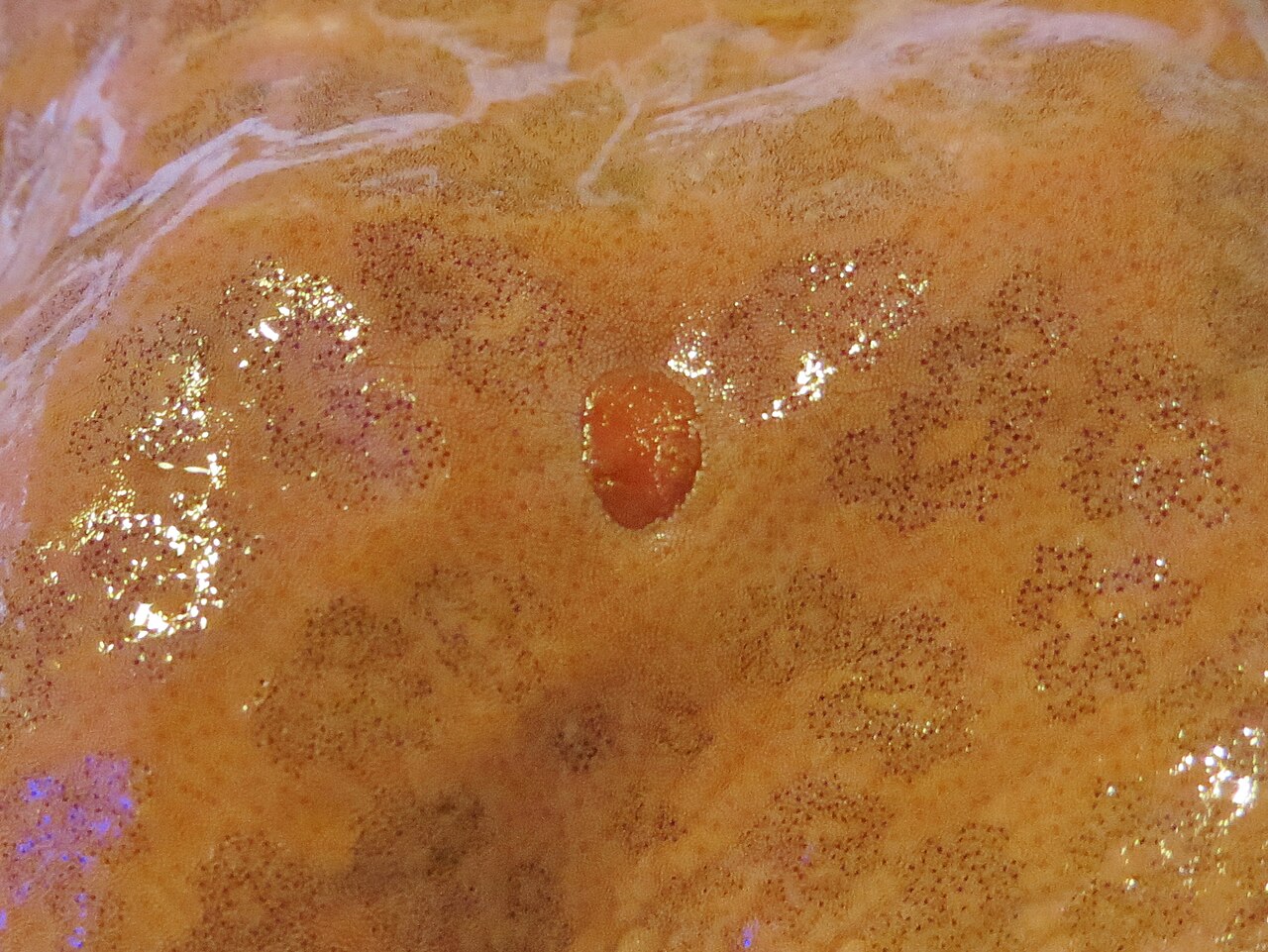
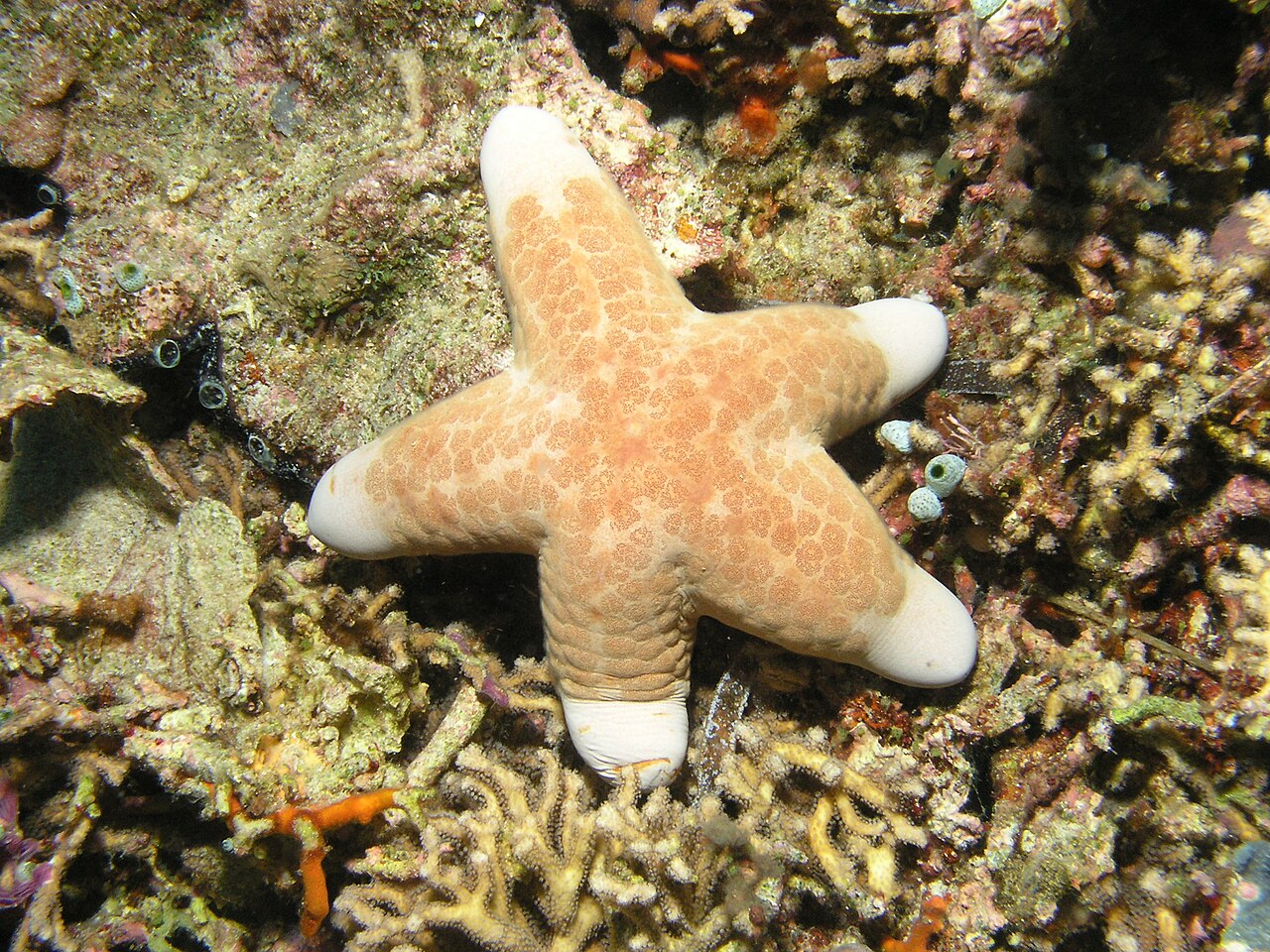
This sea star has a rounded, convex body and five short arms with blunt tips. It is relatively large, reaching a maximum radius of about 27 cm (11 in). Its usual color is pale pink, with brown papillae spreading outward from the center, though it can also appear in shades of gray, yellow, or red.
*Choriaster granulatus* lives in tropical waters across a wide area, including East Africa, the Indo-Pacific region, the Great Barrier Reef, the Red Sea, Vanuatu, Fiji, and Papua New Guinea. It inhabits shallow waters from 1.5 to 53 m (5 to 174 ft) deep, with temperatures between 24 and 29 °C (75 to 84 °F). The species prefers sandy habitats with rubble slopes and detritus, and it is also found among corals and sea sponges. Individuals live alone or in groups.
As a carnivore, it feeds on small invertebrates like coral polyps and carrion. Like other sea stars, its mouth is on its underside, and it digests food outside its body by extruding its stomach over the prey.
Sea star embryos develop into planktonic larvae before becoming five-armed juveniles. The class Asteroidea reproduces both sexually and asexually.
Threats to *Choriaster granulatus* include small parasitic limpets that attach to its underside, which can deform its arms. Ocean acidification, leading to coral bleaching, also threatens its habitat.
Quick Facts
- Genus
- Choriaster
- Species
- granulatus
Facts from the source article.
Lore & Background
Choriaster granulatus has a convex body and five short arms with rounded tips. It is relatively large in comparison with other sea stars, with a maximum radius of about 27 cm (11 in). It is most commonly pale pink in colour with brown papillae radiating out from the centre but can also be colours ranging from grey to yellow and even red. This species is found in numerous tropical waters, including East Africa, the Indo-Pacific region, the Great Barrier Reef, the Red Sea, Vanuatu, Fiji, and Papua New Guinea. It lives individually or in groups along coral reefs in the Indo-West Pacific region, from East Africa all the way to Fiji. The sandy habitat where it tends to live is characterized by rubble slopes and detritus, also being found living among corals and sea sponges. It prefers shallow waters ranging from 1.5 to 53 m (5 to 174 ft) deep and above average temperatures of 24 to 29 °C (75 to 84 °F).
Reader's Guide
Choriaster granulatus is a carnivore that, like other sea stars, has its mouth on the underside of its body. Food is digested and absorbed outside of its body by forcing its stomach out of its mouth onto the food. Its food includes small invertebrates such as coral polyps as well as carrion. Sea star embryos hatch into planktonic larvae before becoming juvenile sea stars with five arms. The Asteroidea class of organisms reproduce both asexually and sexually. The arms of Choriaster granulatus can become deformed when small parasitic limpets attach to their underside. They are also threatened by habitat loss due to ocean acidification which can lead to coral bleaching. The species is known under several common names, reflecting its distinctive appearance and wide distribution across tropical waters.
Did You Know?
- Choriaster is a monotypic genus, containing only the single species Choriaster granulatus.
- Its maximum radius is about 27 cm (11 in).
- It is most commonly pale pink with brown papillae, but can also be grey, yellow, or red.
- It is found in tropical waters including the Red Sea, Great Barrier Reef, and Fiji.
Physical Form and Coloration
Choriaster stands alone as a monotypic genus within the Oreasteridae family, housing a single species known as Choriaster granulatus. This creature goes by several evocative common names—granulated sea star, big-plated sea star, hunter-five sea star, and doughboy starfish—each capturing a different facet of its striking appearance. Its body is distinctly convex, supported by five notably short arms that end in soft, rounded tips. In terms of size, it is a considerable specimen among its sea star relatives, reaching a maximum radius of roughly 27 centimetres, or about eleven inches. The most frequently observed colouration is a soft pale pink, with brown papillae fanning outward from the central disc in a radiating pattern. Yet the species is far from uniform: individuals have been recorded in shades of grey, yellow, and even a deeper red, suggesting a broader palette than the classic pink form implies. This variety in hue, combined with its robust build, makes the granulated sea star one of the more visually memorable echinoderms in tropical reef systems.
Geographic Range and Preferred Habitat
The granulated sea star enjoys an impressively wide tropical distribution, stretching from the coastal waters of East Africa across the Indian Ocean and through the Indo-Pacific to as far as Fiji, Vanuatu, and Papua New Guinea. It is a familiar presence on the Great Barrier Reef, in the Red Sea, and throughout the broader Indo-West Pacific region. Rather than occupying a single microhabitat, Choriaster granulatus is flexible in where it settles. It can be found living solitarily or in loose groups along coral reef structures, but it also shows a clear preference for sandy substrates marked by rubble slopes and accumulated detritus. Individuals are regularly encountered nestled among living corals and sea sponges as well. Depth-wise, the species favours relatively shallow environments, typically ranging from about 1.5 metres to 53 metres below the surface. Water temperature is another key factor: it thrives in waters averaging between 24 and 29 degrees Celsius, a range that aligns with the warm, sunlit zones of the tropics where most of its documented populations reside.
Feeding Strategy and Life Cycle
As a carnivore, Choriaster granulatus employs a feeding method shared across the sea star lineage: its mouth sits on the ventral, or underside, of the body, and digestion takes place entirely outside the organism. The animal everts its stomach through the oral opening, draping it over its prey so that nutrients are broken down and absorbed externally before the stomach is retracted. Its menu includes small invertebrates such as coral polyps, as well as carrion—dead organic matter drifting through the reef environment. The reproductive and developmental pathway follows the broader pattern seen in the Asteroidea class. Embryos first emerge as free-swimming planktonic larvae, drifting in the water column before metamorphosing into recognizable juvenile sea stars bearing the characteristic five arms. Members of this class are notable for their dual reproductive capacity, being able to propagate both sexually and asexually, a flexibility that likely contributes to their persistence across such a vast tropical range.
Threats and Ecological Vulnerability
Despite its broad distribution, the granulated sea star faces a growing set of pressures that threaten both individual health and the integrity of its habitat. At the organism level, small parasitic limpets can attach to the underside of its arms, causing visible deformation and potentially impairing mobility or feeding efficiency. These parasites represent a persistent, low-level stressor that accumulates over the animal's lifetime. At the ecosystem level, the picture is more alarming. Ocean acidification is driving habitat degradation across the tropical reefs where Choriaster granulatus lives, and one of its most visible consequences—coral bleaching—directly undermines the structural complexity the species relies on for shelter and foraging. Because the granulated sea star inhabits sandy rubble slopes, coral formations, and sponge gardens, the loss of living coral reduces the diversity of microhabitats available to it. The combination of parasitic pressure and large-scale environmental change places this already monotypic genus in a precarious position, with no close relatives to buffer any population decline.
Gallery
More in Starfish 1-24
Spotted an error? Know more?
Reader corrections go straight into our review queue. Suggest an edit · How this site is sourced