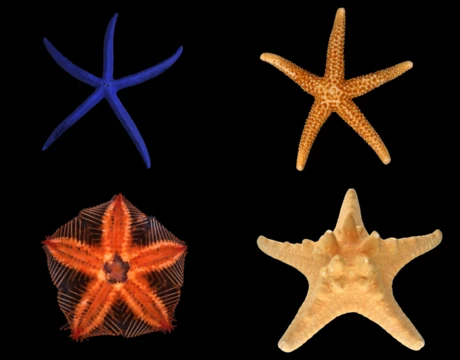
Asteroidea
Echinoderm class with star-shaped body and hydraulic tube feet.

stephen davis · CC BY 2.0
Starfish, or sea stars, are a class of echinoderms generally shaped like a star polygon, forming the taxonomic class Asteroidea. They are notable for their ecological roles, with some species serving as keystone species or invasive aliens, and for their ancient fossil record dating back to the Ordovician period.
Quick Facts
- Taxon
- Asteroidea
- Diversity
- 1,900+ species
Facts from the source article.
Lore & Background
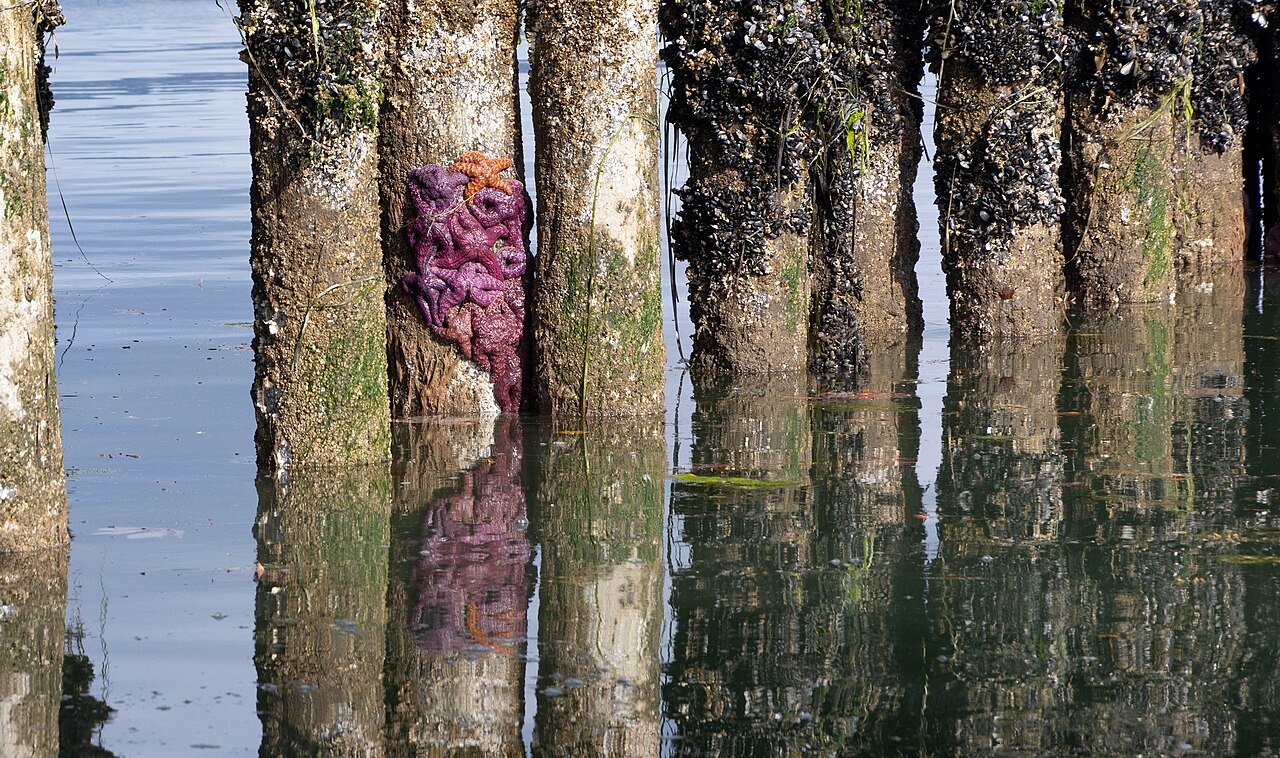
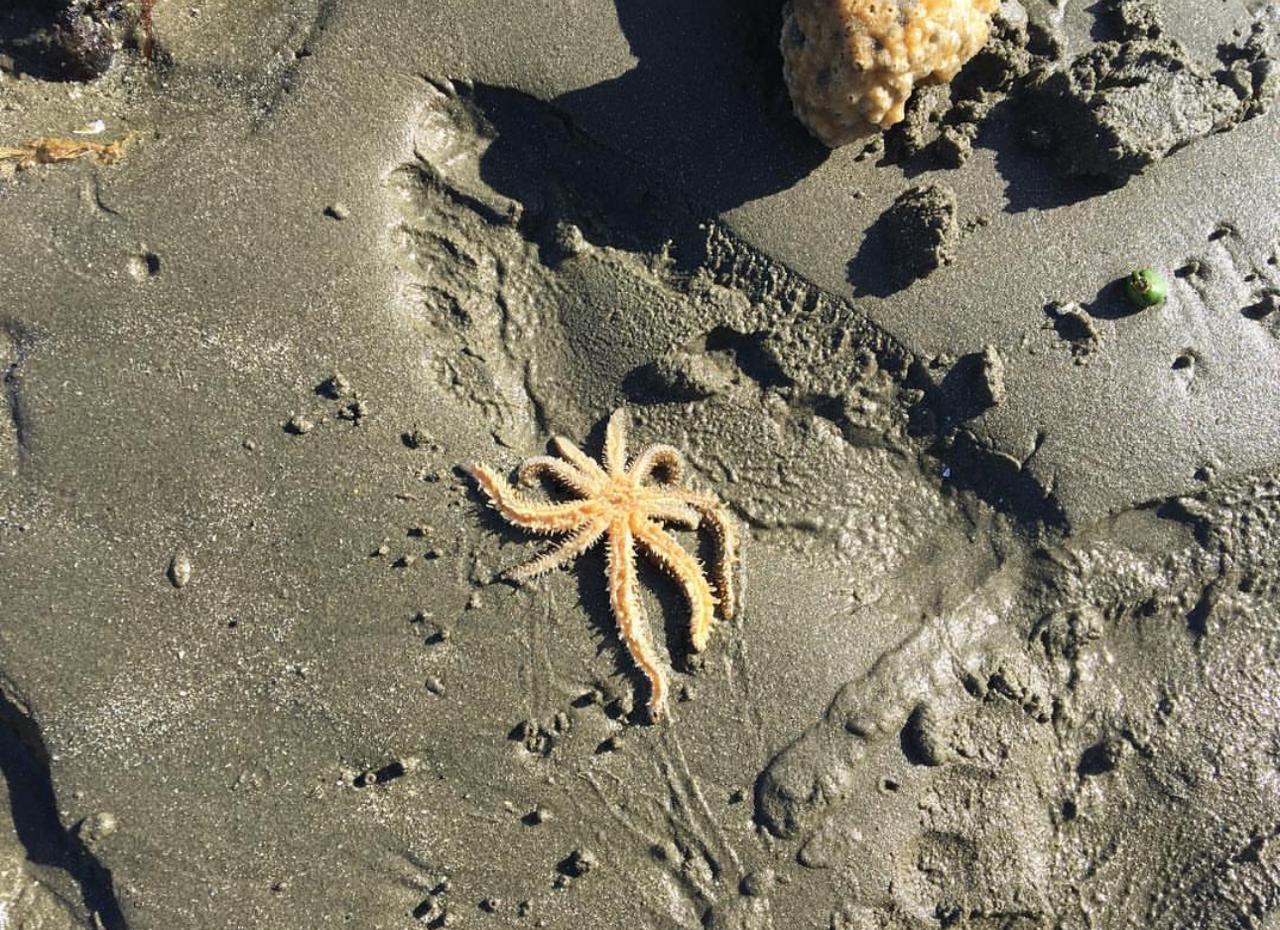
Starfish have a central disc and usually five arms, though some species have six, seven, 10–15, or even over fifty arms (as in Antarctic Labidiaster annulatus). The aboral surface may be smooth, granular, or spiny, covered with overlapping plates. Many species are brightly colored in red, orange, blue, grey, or brown. They possess tube feet operated by a hydraulic water vascular system, with a mouth at the center of the oral surface. Evidence from gene expression suggests the starfish body corresponds to a head externally and a torso internally.
The body wall includes a thin cuticle, epidermis, thick dermis with calcium carbonate ossicles, a coelomic myoepithelial layer, and a peritoneum. Ossicles vary from flat plates to spines, and some are specialized as madreporite, pedicellariae, or paxillae. Pedicellariae are scissor-like ossicles that displace organisms or catch prey. Papulae serve a respiratory function. The water vascular system is hydraulic, with water entering through the madreporite and flowing through canals to tube feet, which use adhesive chemicals for gripping. Starfish can move in a bilateral fashion and turn over by using two adjacent arms and an opposite arm.
The digestive system includes an eversible cardial stomach and a pyloric stomach with pyloric caeca. Primitive species swallow prey whole; advanced species evert the cardial stomach to engulf food. The main nitrogenous waste product is ammonia, removed via diffusion through tube feet and papulae. Coelomocytes engulf waste and are ejected through papulae tips.
Reader's Guide
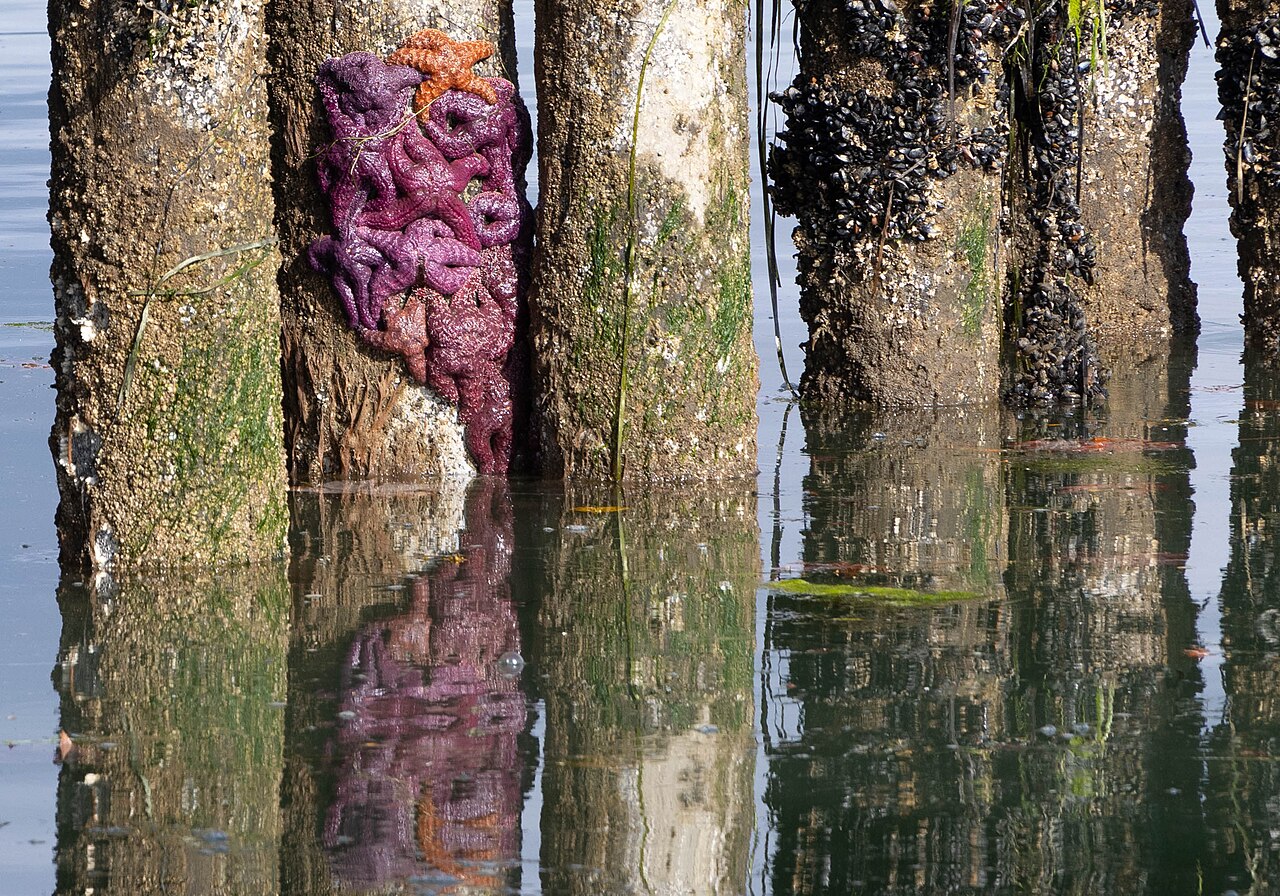
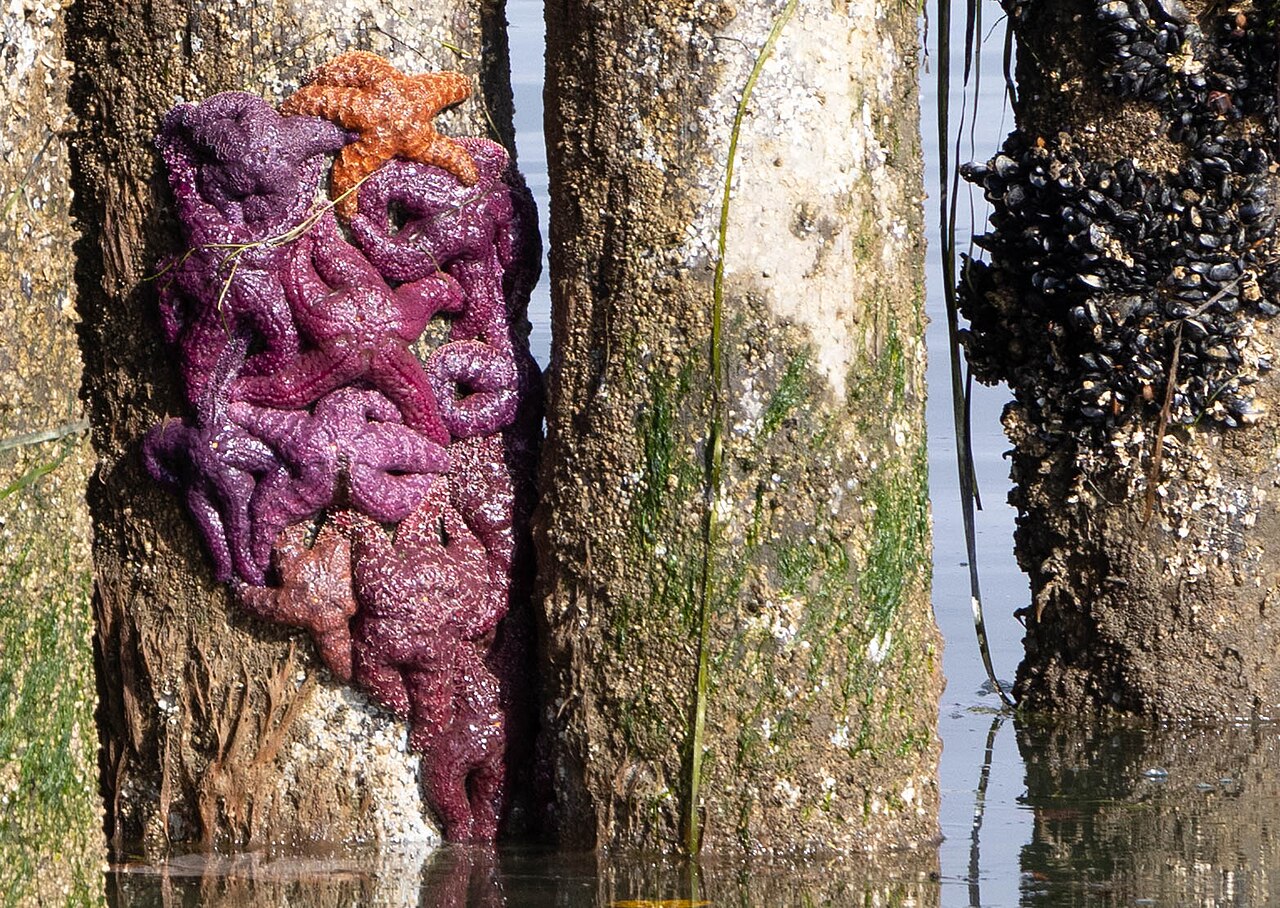
The Asteroidea occupy several significant ecological roles. Some, such as the ochre sea star (Pisaster ochraceus) and the reef sea star (Stichaster australis), serve as keystone species, with an outsize impact on their environment. The tropical crown-of-thorns starfish (Acanthaster planci) is a voracious predator of coral throughout the Indo-Pacific region, and the Northern Pacific seastar is on a list of the Worst Invasive Alien Species. The fossil record for starfish is ancient, dating back to the Ordovician period around 450 million years ago, but it is rather sparse, as starfish tend to disintegrate after death; only ossicles and spines are likely preserved. With their appealing symmetrical shape, starfish have played a part in literature and legend. They are sometimes collected as curios, used in design or as logos, and in some cultures they are eaten. Starfish are opportunistic feeders and mostly predators on benthic invertebrates, with several species having specialized feeding behaviors including stomach eversion and suspension feeding. They have complex life cycles, reproduce both sexually and asexually, and most can regenerate damaged parts or lost arms, shedding arms as a defense mechanism.
Did You Know?
- Starfish are also known as asteroids because they form the taxonomic class Asteroidea.
- The water vascular system is a hydraulic system used for locomotion, adhesion, food manipulation, and gas exchange.
- Some starfish, like Labidiaster annulatus, can have over fifty arms.
- The cardial stomach can be everted from the body to engulf and digest food.
Anatomy & Body Architecture
Starfish possess a layered body wall that begins with a thin cuticle and single-cell epidermis before transitioning into a thick dermis packed with connective tissue. Embedded within this dermis is an endoskeleton of calcium carbonate structures called ossicles—honeycomb-like lattices of calcite microcrystals that range from flat plates to granules to spines. Even ossicles that project externally remain anchored beneath the epidermal layer. The collagen fibres supporting the body are arranged at right angles in a three-dimensional web, interlacing with ossicles and papulae in the interstices. This architecture allows arms to flex easily yet stiffen rapidly under stress. Gene expression evidence suggests the starfish body corresponds externally to a head, with lips attached to the tube feet, and internally to a torso. Most species display five radiating arms, though some bear six or seven, others ten to fifteen, and the Antarctic Labidiaster annulatus can exceed fifty. The animal also maintains two separate vascular systems—one hydraulic for locomotion and one for blood circulation.
Water Vascular System & Locomotion
The starfish's water vascular system is a hydraulic network of fluid-filled canals responsible for locomotion, adhesion, food manipulation, and gas exchange. Water enters through the madreporite, a porous sieve-like ossicle on the upper surface, then travels via a calcareous stone canal to a ring canal encircling the mouth. From there, radial canals extend along the ambulacral groove of each arm, with short lateral canals branching alternately to either side, each terminating in a bulb-shaped ampulla connected to an external tube foot. The entire canal interior is lined with cilia. When longitudinal muscles in the ampullae contract and shut the lateral canal valves, water is forced into the tube feet, stretching them to contact the substrate. Contrary to their suction-cup appearance, the gripping mechanism relies on adhesive chemicals rather than vacuum; release is triggered by different chemicals and ampullae relaxation. Tube feet move in a coordinated wave, one arm section attaching as another releases. Having descended from bilateral ancestors, starfish can also move in a bilateral fashion, particularly when hunting or feeling threatened.
Ecological Roles & Feeding Strategies
Starfish occupy several ecologically significant positions across the world's oceans. Species like the ochre sea star (Pisaster ochraceus) and the reef sea star (Stichaster australis) function as keystone organisms, exerting an outsized influence on their surrounding communities. At the other extreme, the tropical crown-of-thorns starfish (Acanthaster planci) is a voracious coral predator throughout the Indo-Pacific, while the Northern Pacific seastar has been listed among the Worst Invasive Alien Species. As opportunistic feeders, most starfish are predators on benthic invertebrates, though several species have evolved specialized strategies including eversion of their stomachs over prey and suspension feeding. The mouth sits at the centre of the lower oral surface, and the hydraulic tube feet assist in food manipulation. Starfish reproduce both sexually and asexually through complex life cycles, and most can regenerate damaged or lost arms. Shedding an arm also serves as a defensive mechanism, allowing the animal to escape a predator while the detached limb regenerates over time.
Fossil Record & Cultural Presence
The fossil record of starfish stretches back to the Ordovician period, approximately 450 million years ago, making them among the older animal lineages. However, this record is notably sparse because starfish tend to disintegrate after death, leaving only their ossicles and spines as potential remains—structures that are small, scattered, and difficult to locate in sediment. This preservation bias means much of the group's evolutionary history remains obscured. Despite their ancient origins, starfish have left a distinct mark on human culture. Their appealing symmetrical shape has made them a recurring motif in literature and legend. They are collected as curios, incorporated into design and logos, and in some cultures they are consumed as food. In common usage, the names starfish and sea star are often loosely applied to ophiuroids as well, though those animals are more accurately called brittle stars or basket stars. The taxonomic class Asteroidea encompasses roughly 1,900 species inhabiting every ocean, from warm tropical shallows to frigid polar abyssal depths at 6,000 metres.
Gallery
More in Starfish 1-24
Spotted an error? Know more?
Reader corrections go straight into our review queue. Suggest an edit · How this site is sourced