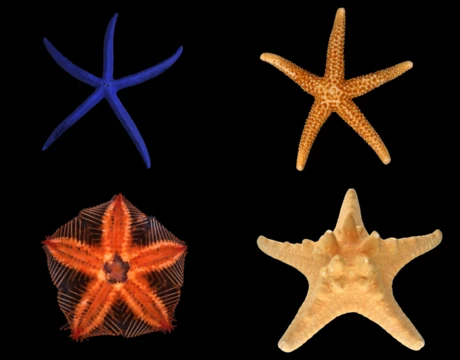
Asterias
A genus of five-armed sea stars native to cold Holarctic waters.

りなべる · CC BY 4.0
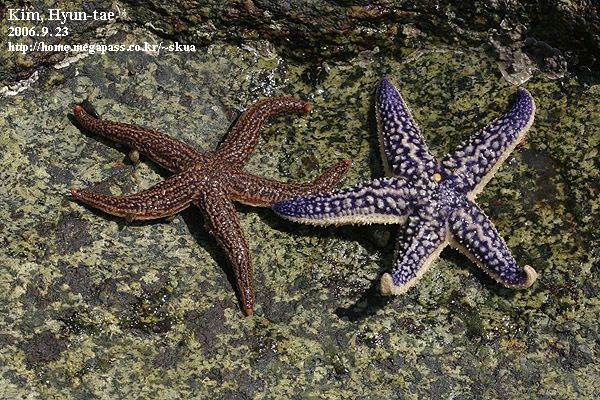
Asterias is a genus within the starfish family Asteriidae, made up of eight species. It contains some of the most familiar sea stars, like the Atlantic common starfish (Asterias rubens) and the northern Pacific seastar (Asterias amurensis). All members have five arms and live in shallow, cold to temperate waters of the Holarctic region’s littoral zone. Their larvae are planktonic. *Asterias amurensis* is invasive in Australia and can become a pest in Japanese mariculture during certain years.
The genus was first named by Carl Linnaeus in 1758 in the 10th edition of *Systema Naturae*, where he described *A. rubens*. For a time, that was the only species, but by the early 1800s several dozen taxa had been added. In 1825, Thomas Say listed six species from the U.S. coasts (then the east coast from Maine to Florida), but none are now accepted as *Asterias*. In 1840, Johannes Peter Müller and Franz Hermann Troschel renamed the genus *Asteracanthion* and split off new genera. William Stimpson rejected that name in a paper presented on 4 December 1861, naming 16 new species, none of which remain in *Asterias*. Edmond Perrier formally made *Asteracanthion* a synonym in 1875. Francis Jeffrey Bell listed 78 species in 1881, grouping them into about 16 unranked categories. In 1889, Percy Sladen counted 48 or 49 species, splitting the genus into at least six subgenera; his subgenus *Asterias*, section β of the Pentactinid group, held at least four species, three still accepted today. In the early 1900s, Addison Emery Verrill added new species from the U.S. east coast (none still in *Asterias*) and moved most current *Asterias* species into his new genus *Allasterias*; he accepted six Pacific coast species, none now in *Asterias*. Soon after, Walter Kenrick Fisher synonymised or removed all of Verrill’s *Asterias* species and synonymised *Allasterias* and *Parasterias* with *Asterias*, leaving four species, all still recognised. Ryori Hayashi synonymised one Japanese species in 1940, leaving three species known since the previous century, all still recognised. Alexander Michailovitsch Djakonov added two new species from Far East Russia in 1950 and reinstated the three species Fisher and Hayashi had synonymised, bringing the total to eight—though it took until the 2000s for some U.S. zoologists to accept his new species.
Quick Facts
- Taxon
- Asterias
- Type Species
- Asterias rubens
- Type Species Authority
- Linnaeus, 1758
Facts from the source article.
Lore & Background
The genus Asterias was first described by Carl Linnaeus in the 10th edition of Systema Naturae in 1758 when he published A. rubens. It was for a time the only species, but by the early 1800s a few dozen taxa had been described in this genus. In 1825 Thomas Say listed six species native to the coasts of the United States, none of which are accepted or recognised as Asterias today. Johannes Peter Müller and Franz Hermann Troschel renamed the genus Asteracanthion in 1840, splitting a number of new genera from it. William Stimpson rejected that name in a paper presented on 4 December 1861, and named 16 new species, none of which are retained in Asterias at present. In 1875 Edmond Perrier formally reduced Asteracanthion to a synonym. Francis Jeffrey Bell listed 78 species in the genus in 1881, arranging them in some 16 unranked groupings. Percy Sladen counted 48 or 49 species in 1889, splitting the genus into at least six subgenera, with subgenus Asterias containing at least four species, three of which are still accepted today. Addison Emery Verrill added new species in the early 1900s, none still in Asterias, and moved almost all recognised species to his new genus Allasterias. Walter Kenrick Fisher later synonymised or removed all of Verrill's species and synonymised Allasterias and Parasterias with Asterias, leaving four species. Ryori Hayashi synonymised one further Japanese species in 1940, leaving three species. Alexander Michailovitsch Djakonov added two new species from Far East Russia in 1950 and reinstated the three synonymised species, bringing the genus to eight species, though it took until the 2000s for some US zoologists to accept his new species.
Reader's Guide
Asterias is notable for containing several of the best-known species of sea stars, including the Atlantic common starfish (Asterias rubens) and the northern Pacific seastar (Asterias amurensis). The latter is an invasive species in Australia and can in some years become a pest in the Japanese mariculture industry. The genus has a complex taxonomic history, with many species described over time that were later moved or synonymised. The current eight-species count was established by Djakonov in 1950, though acceptance by some US zoologists was delayed until the 2000s. Externally, Asterias species are recognisable by their pedicellariae—tiny jaw-like structures on the skin—of two types: major (straight) pedicellaria scattered across the skin, and minor (crossed) pedicellaria in tufts around large dorsal spines. Internally, the dorsal plates bear only a single spine in their centre. Sladen distinguished Asterias from Uniophora by the presence of spines on its abactinal plates instead of large spherical tubercles, and from Anasterias by its well-developed, reticulate abactinal skeleton. All species have planktonic larvae.
Did You Know?
- Asterias was first described by Carl Linnaeus in 1758 with the single species A. rubens.
- Asterias amurensis is an invasive species in Australia and a pest in Japanese mariculture.
- The genus contains eight species, all with five arms and planktonic larvae.
- Asterias has two types of pedicellariae: major (straight) and minor (crossed).
Physical Form and Colouration
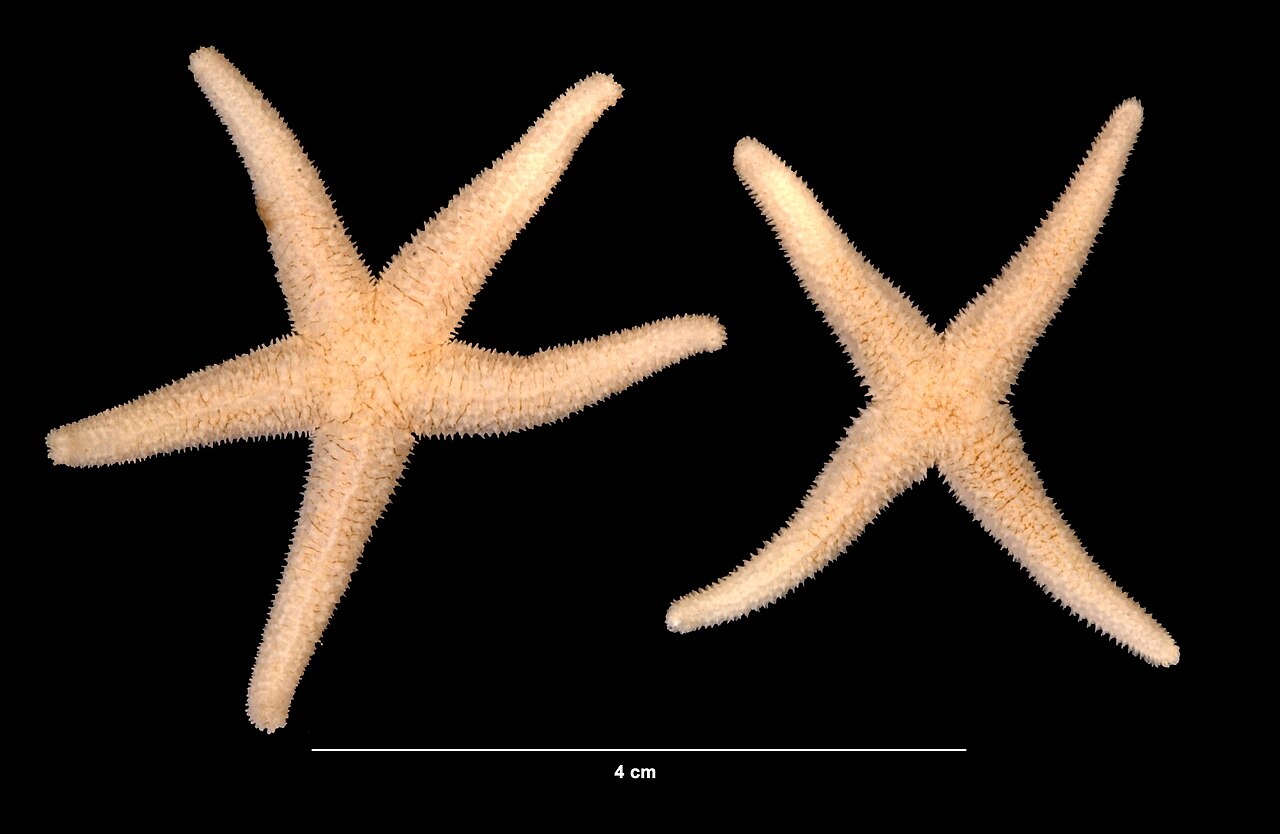
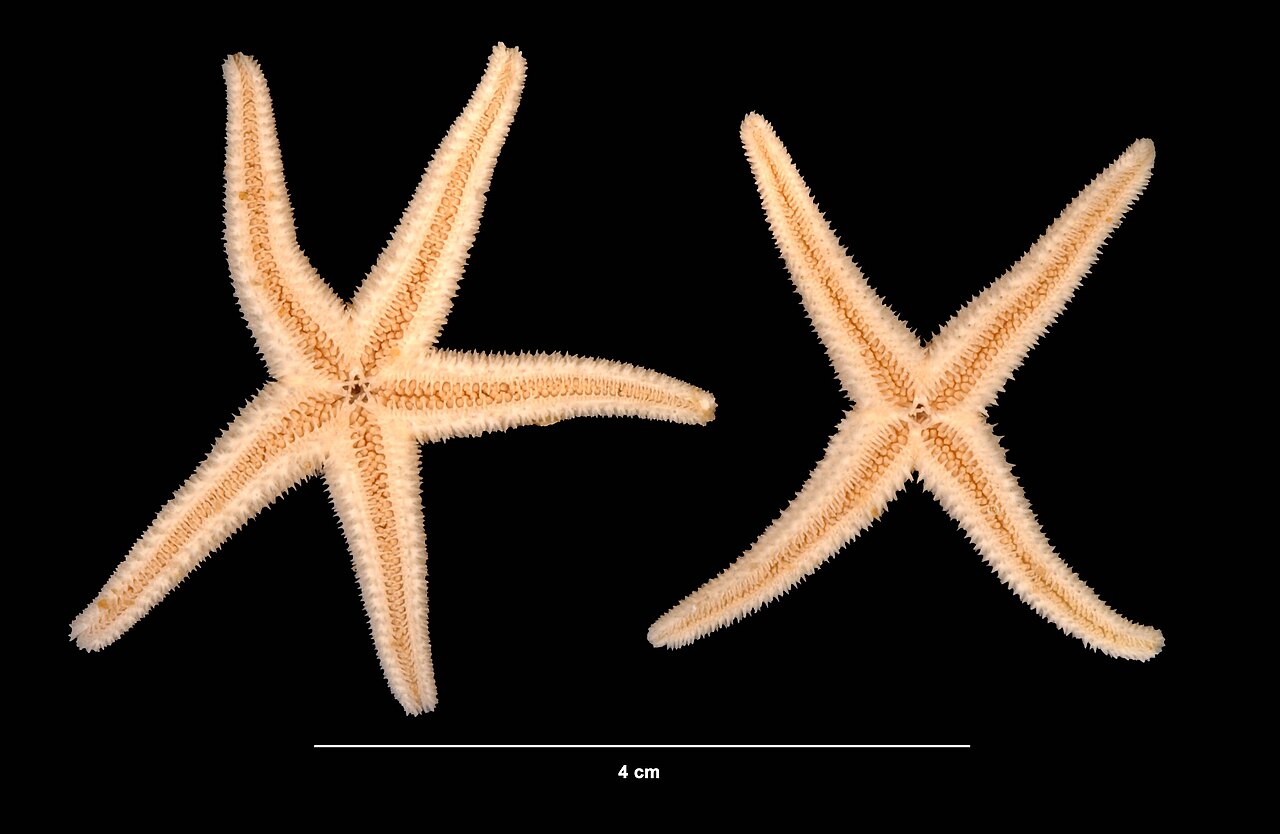
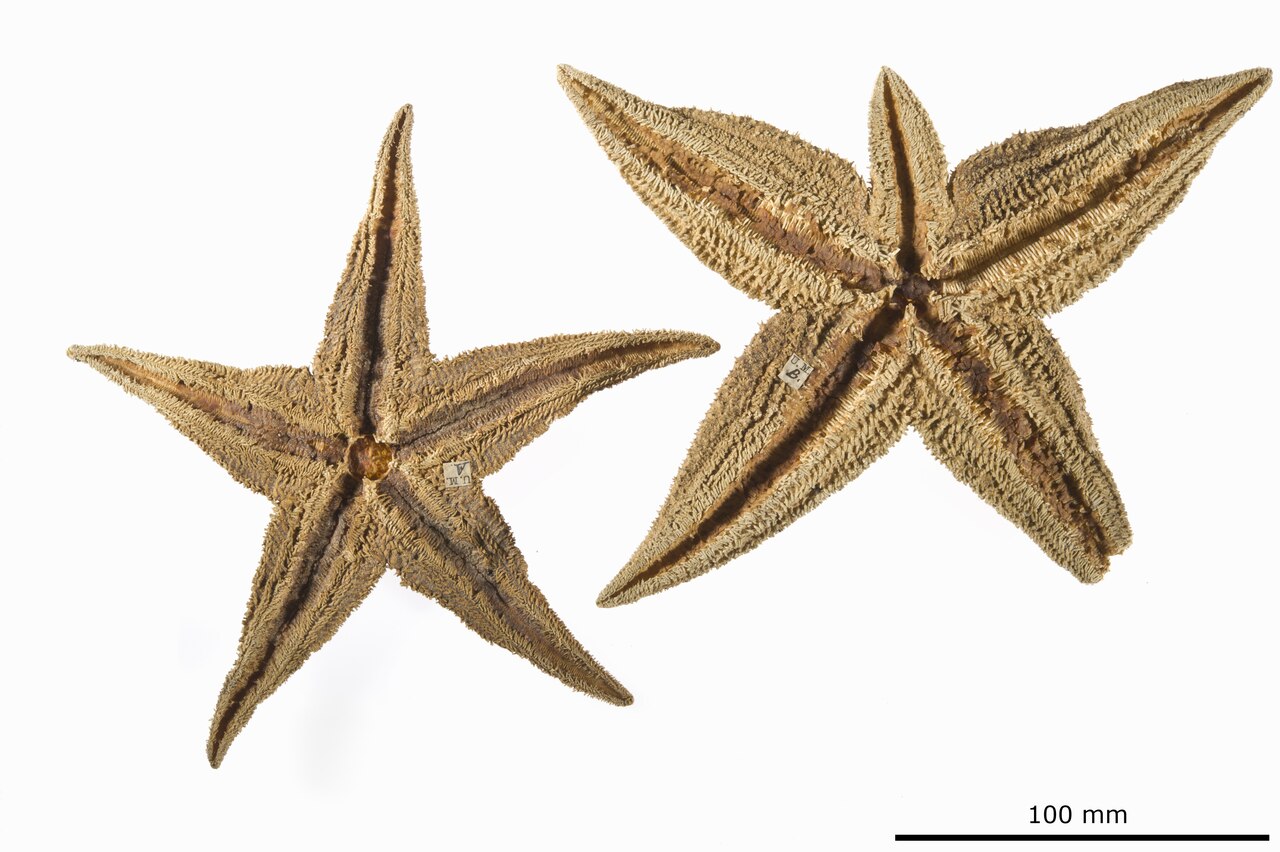
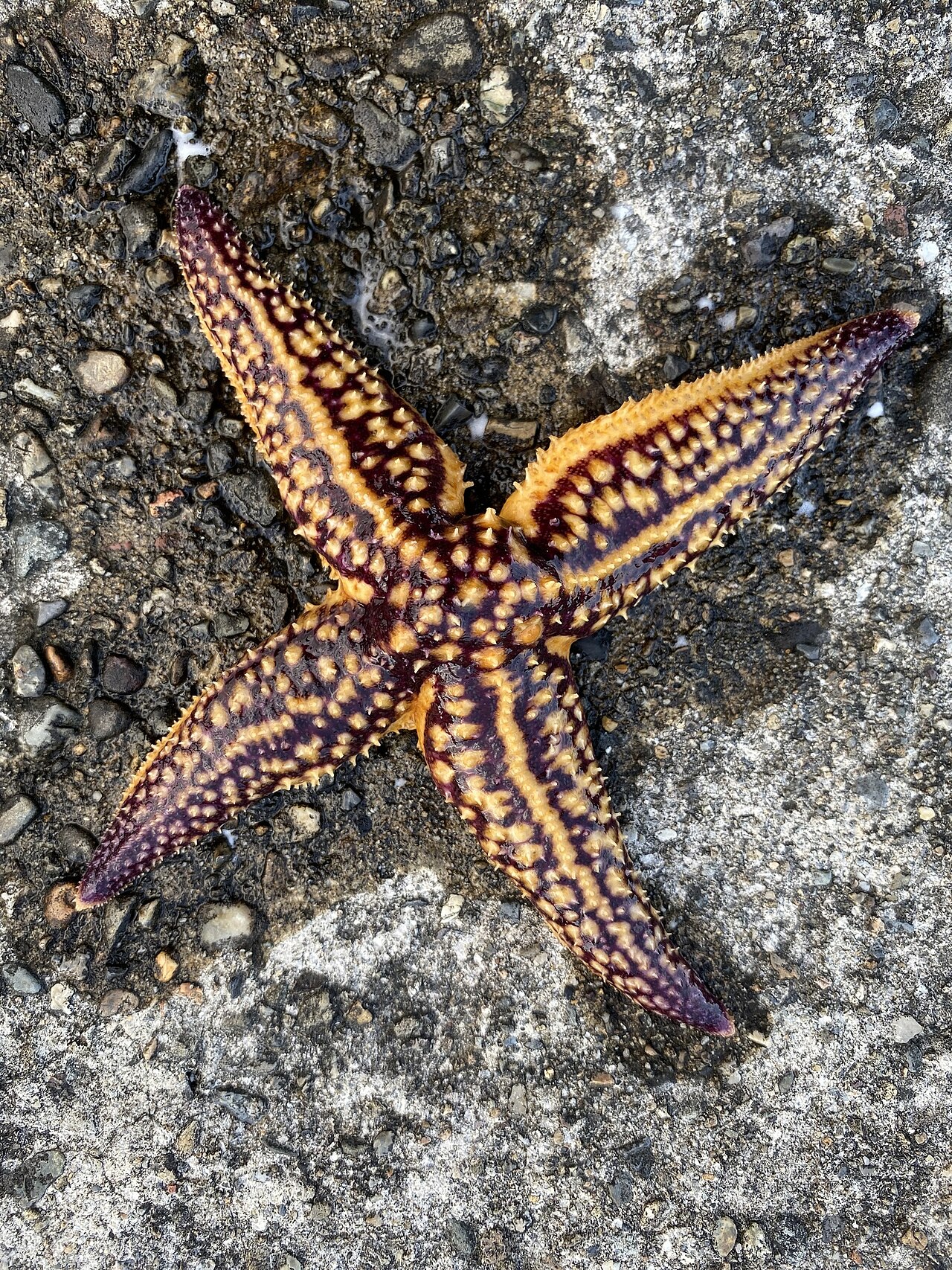
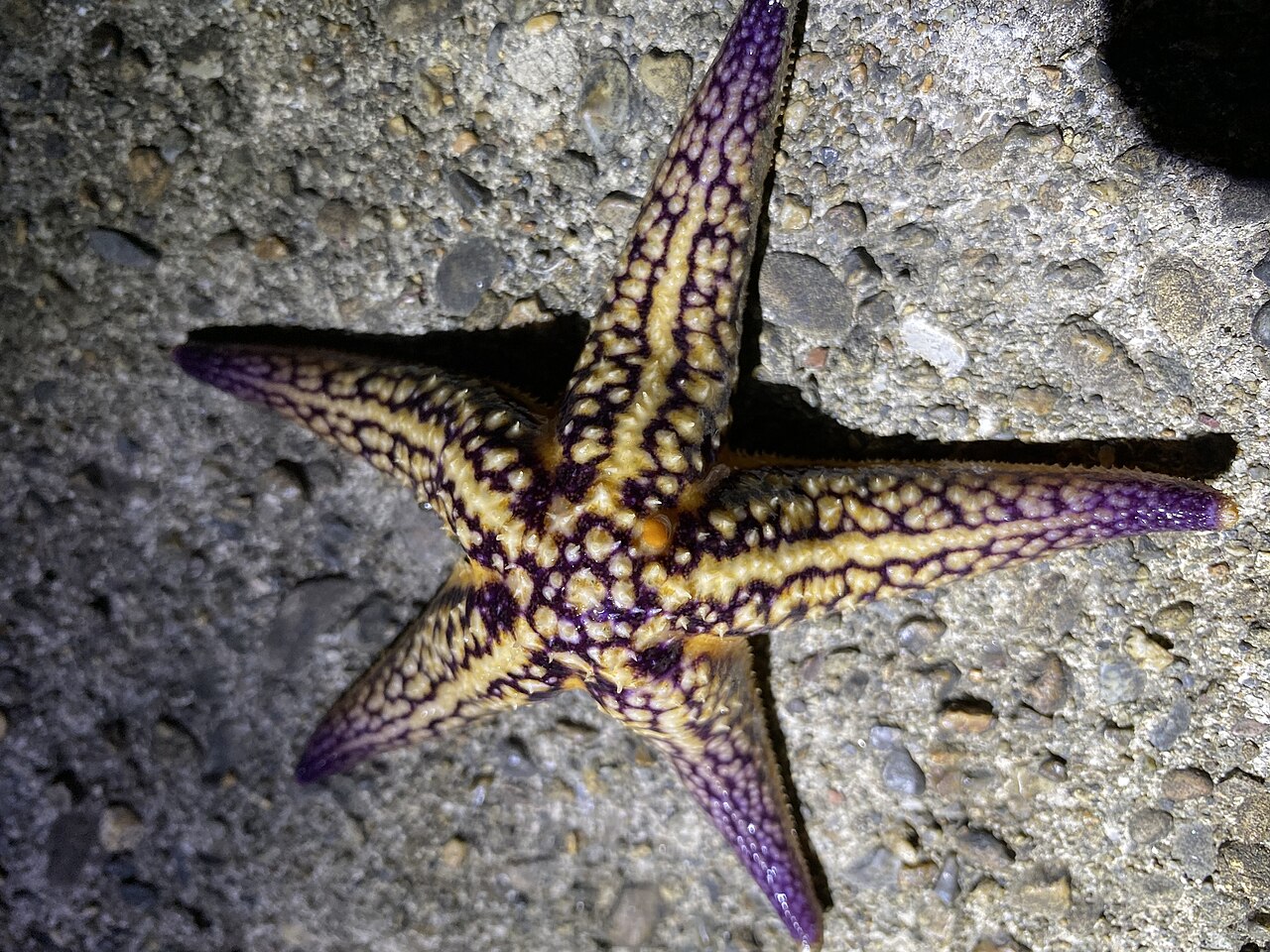
The common starfish, a member of the family Asteriidae, is the most familiar echinoderm along the north-east Atlantic coast. Its body plan is deceptively simple: five broad-based arms that taper gradually toward slightly upturned tips. Running down the centre of each upper surface is a ridge of short white spines, flanked on both sides by low, soft mounds known as papulae. The underside carries rows of tiny tube feet that serve dual purposes in movement and feeding. In terms of colour, the species is typically orange or brick red on its upper surface with a noticeably paler underside, though purple and pale brown individuals do occur. Starfish recovered from deeper waters tend to be washed-out in hue. Most specimens measure between ten and thirty centimetres across, but the species can reach an impressive fifty-two centimetres in diameter, making it one of the larger sea stars in its range.
Feeding Strategy and Chemical Defence
Feeding on the common starfish is a slow, methodical process that belies its unassuming appearance. When targeting a bivalve such as a mussel, the animal anchors its tube feet to each shell valve and applies steady force until a gap of just one millimetre opens. Through that tiny opening it everts a fold of its stomach, bathes the soft tissue in digestive enzymes, and waits until the contents liquefy before retracting the stomach back into its body. Its diet is broad, encompassing polychaete worms, barnacles, gastropods, other echinoderms, and even carrion. Beyond its mechanical feeding, the starfish possesses a remarkably acute sense of smell. It can track the odour of a common mussel across the seabed and crawl directly toward it. Equally important, it detects the scent of the predatory common sunstar and retreats. The species also synthesises a saponin-like chemical that deters predators; in the common whelk, dilute concentrations trigger evasive behaviour while stronger doses provoke convulsions.
Reproduction, Growth, and Lifespan
Each common starfish is either male or female, and reproduction is entirely external. In spring, a moderately sized female can release an estimated two and a half million eggs directly into the surrounding water, where sperm released by males completes fertilisation in the open water column. The resulting larvae are planktonic, drifting for roughly eighty-seven days before settling onto the seabed and metamorphosing into recognisable juveniles. Growth is seasonal: a well-fed young starfish can extend its radius by just over ten millimetres per month through summer and autumn, slowing to under five millimetres in the colder months. Adults are thought to live seven to eight years. Remarkably, the species tolerates prolonged food scarcity. One documented specimen lost nearly a third of its radius—shrinking from six centimetres to three and a half—after five months without food, yet survived the ordeal. This metabolic resilience, combined with its enormous egg output, underpins the species' dominance across its wide Atlantic range.
Parasitism by Orchitophrya stellarum
The ciliate protozoan Orchitophrya stellarum presents one of the most striking examples of parasitism in the echinoderm world. Under normal conditions it lives harmlessly on the starfish's outer surface, grazing on shed epidermal cells. However, when a male host's testes ripen—possibly signalled by a pheromone—the ciliate changes its behaviour entirely, entering the animal through the gonopores, the same orifices used for gamete release. Once inside the gonad it engulfs sperm cells, effectively sterilising the host. The parasite is not loyal to a single species: because different starfish breed at different times of year, Orchitophrya may shift between Asterias forbesi and Asterias rubens during the warmer months and switch to Leptasterias species in winter. Infected populations show a marked skew in sex ratio, with fewer males present and those that remain consistently smaller than their female counterparts—a quiet but measurable signature of the parasite's reproductive sabotage.
Gallery
More in Starfish 1-24
Spotted an error? Know more?
Reader corrections go straight into our review queue. Suggest an edit · How this site is sourced