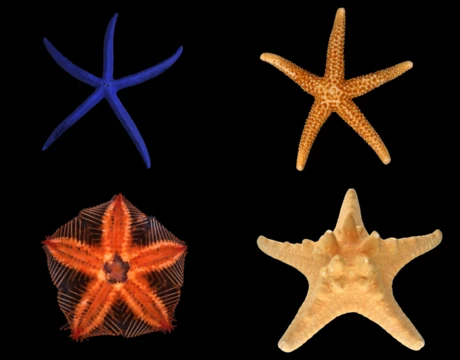
Xyloplax medusiformis
A sea daisy first described in 1986 from deep New Zealand waters.

Xyloplax medusiformis is a sea daisy, an unusual marine echinoderm found at bathyal depths in waters around New Zealand. It is notable as the type taxon of the genus Xyloplax and was first described in 1986 by Baker, Rowe and Clark, initially considered distinct enough from starfish to warrant its own class, the Concentricycloidea.
Quick Facts
- Genus
- Xyloplax
- Species
- medusiformis
Facts from the source article.
Lore & Background
Specimens of Xyloplax medusiformis were first discovered by accident when a submersible craft collected samples of wood on the deep sea bed in the South Pacific near New Zealand. Nine individuals were found from five locations, puzzling researchers due to their lack of close affiliations to other echinoderms. Its generic name derives from the Greek 'xylo' meaning wood, and its specific name was chosen because its morphology superficially resembles that of a cnidarian medusa.
Xyloplax medusiformis is a small, flattened disc or umbrella-shaped invertebrate growing to about 9 mm in diameter. The aboral surface is covered with flat plates arranged in concentric rings, with short marginal spines projecting from the periphery. Internally, the water vascular system consists of two super-oral rings and no radial canals. It has no stomach, gut or anus; the velum covering the oral surface is thought to be equivalent to an everted stomach. There are five pairs of gonads, each associated with a fluid-filled sac.
It is found on pieces of decaying timber that have sunk to the seabed at depths of at least 1,000 metres. It may feed on bacteria or the products of wood decay, but very little is known of its biology. Similar numbers of males and females have been discovered, and females brood embryos in their ovaries until they are nearly ready to undergo metamorphosis into juveniles.
Reader's Guide
Xyloplax medusiformis holds significance as the first sea daisy described and the type taxon of the genus Xyloplax. Initially, its unique morphology—including a water vascular system with two ring canals surrounding the mouth linked by five inter-ring canals, a concentric arrangement of plates, and a single row of podia—led researchers to place it in a new class, the Concentricycloidea, separate from starfish (class Asteroidea). However, DNA sequencing involving X. medusiformis and about twenty other echinoderm species later demonstrated that it is indubitably a member of class Asteroidea, specifically a sister taxon to Rathbunaster in the order Forcipulatida. It is considered possibly paedomorphic, retaining larval characteristics into adulthood, and was later confidently placed in the order Velatida. Its discovery also prompted the subsequent identification of other Xyloplax species on wood at bathyal depths: Xyloplax turnerae in the Atlantic Ocean off the Bahamas and Xyloplax janetae in the central Pacific Ocean. The species thus illustrates both the challenges of classifying unusual echinoderms and the resolving power of molecular phylogenetics.
More in Starfish 1-24
Spotted an error? Know more?
Reader corrections go straight into our review queue. Suggest an edit · How this site is sourced