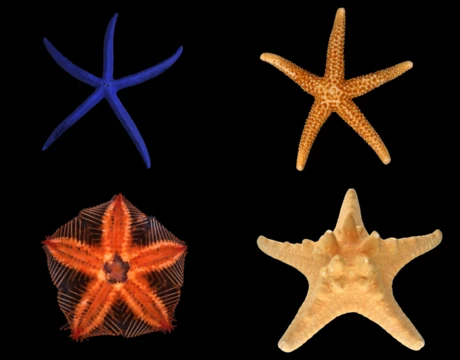
Valvatida
An order of starfish with conspicuous marginal ossicles and tube feet.

Valvatida is an order of starfish within the class Asteroidea. It is notable for containing both very small species, only a few millimetres in diameter, and larger species that can reach up to 75 cm.
Quick Facts
- Taxon
- Valvatida
Facts from the source article.
Lore & Background
The order Valvatida encompasses both tiny species, only a few millimetres in diameter (e.g., genus Asterina), and species up to 75 cm (e.g., genus Thromidia). Almost all species have five arms with tube feet. The order is primarily identified by the presence of conspicuous marginal ossicles, which characterize most species. Most members have five arms and two rows of tube feet with suckers. Some species have paxillae, and in some, the main pedicellariae are clamp-like and recessed into the skeletal plates. This group includes the cushion star and the leather star.
Reader's Guide
The Valvatida order is significant within the class Asteroidea for its diversity in size and morphology, ranging from minute species to those reaching 75 cm. Its defining feature—conspicuous marginal ossicles—helps distinguish it from other starfish orders. The order includes well-known forms such as the cushion star and the leather star. The World Register of Marine Species lists 17 families within Valvatida, including both extant and extinct groups (Sphaerasteridae and Stauranderasteridae are marked as extinct). The order contains 695 species across 172 genera, reflecting a substantial portion of starfish biodiversity. Its tube feet with suckers and typical five-arm plan are common traits, though some species exhibit paxillae or specialized pedicellariae. The inclusion of families such as Acanthasteridae (which includes the crown-of-thorns starfish) and Oreasteridae highlights its ecological and taxonomic importance.
Did You Know?
- The order Valvatida contains 695 species in 172 genera.
- Species range from a few millimetres (genus Asterina) to 75 cm (genus Thromidia).
More in Starfish 1-24
Spotted an error? Know more?
Reader corrections go straight into our review queue. Suggest an edit · How this site is sourced