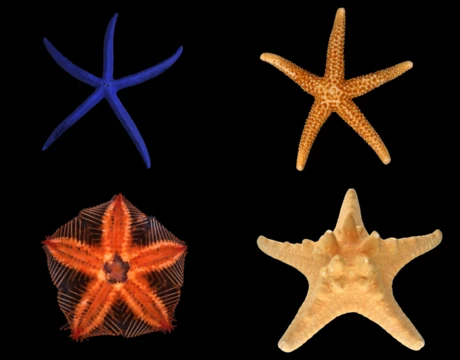
Sclerasterias
A starfish genus with six-armed juveniles and five-armed adults.

Sclerasterias is a genus of starfish belonging to the family Asteriidae. A key feature is the difference between adults and juveniles: mature individuals have five arms, while small, immature ones have six. This discrepancy once led scientists to give the young a separate genus name, Hydrasterias, before they realized only one genus was involved. These juveniles often reproduce by fissiparity, where the central disc splits into two halves, each with three arms, and each half then grows new arms to reach the full set. This splitting can happen repeatedly and may be an adaptation to the cold, deep-sea environments where most species live. The World Register of Marine Species lists the following accepted species: Sclerasterias alexandri, S. contorta, S. dubia, S. eructans, S. euplecta, S. eustyla, S. guernei, S. heteropaes, S. mazophora, S. mollis, S. neglecta, S. parvulus, S. richardi, S. satsumana, and S. tanneri.
Quick Facts
- Taxon
- Sclerasterias
Facts from the source article.
Lore & Background
The genus Sclerasterias belongs to the family Asteriidae. A notable characteristic is that adult individuals have five arms, but small, immature individuals have six. This discrepancy led to the separate generic name Hydrasterias being given to the juveniles before it was realized that only one genus was involved. Young individuals often undergo fissiparity, a process in which the disc splits into two parts, each bearing three arms, and new arms develop on each part to complete the complement of arms. This splitting sometimes happens repeatedly and may be an adaptation to life in cold, deep seas, where most of the species are found.
Reader's Guide
The significance of Sclerasterias lies in its unusual developmental pattern and its reproductive strategy. The fact that immature individuals have six arms while adults have five caused historical taxonomic confusion, with juveniles initially classified under a separate genus, Hydrasterias. This highlights the importance of studying life stages in taxonomy. The frequent fissiparity observed in young individuals—where the disc splits into two three-armed halves that regenerate into complete individuals—may be an adaptation to the cold, deep-sea environments where most species live. This repeated splitting could enhance survival and reproduction in harsh conditions. The genus includes 15 accepted species, as recognized by the World Register of Marine Species, reflecting a moderate diversity within the family Asteriidae. The legacy of Sclerasterias is thus tied to its role in illustrating how morphological changes during development can mislead classification, and how reproductive strategies can be shaped by environmental pressures.
Did You Know?
- Juveniles were once given the separate generic name Hydrasterias before the connection was realized.
- Young individuals often undergo fissiparity, splitting into two three-armed parts that regenerate.
- Most species of Sclerasterias are found in cold, deep seas.
More in Starfish 1-24
Spotted an error? Know more?
Reader corrections go straight into our review queue. Suggest an edit · How this site is sourced