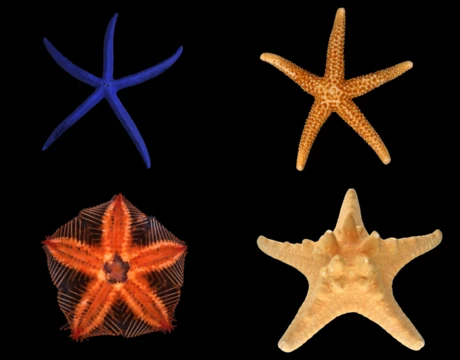
Rathbunaster
A deep-sea starfish with pincer-covered arms and detachable rays.

Rathbunaster is a genus of sea stars with just one species, *Rathbunaster californicus*, commonly called the California sun star. It belongs to the family Asteriidae. The genus was named by Walter Kenrick Fisher in honor of Richard Rathbun, a biologist and administrator at the Smithsonian Institution. Earlier classifications placed it in the Labidiasteridae family, but that grouping turned out to be artificial; molecular evidence now firmly places it within the Asteriidae.
The California sun star reaches a maximum diameter of about 45 centimeters and averages 35 grams in weight. It lives on muddy seafloor substrates at depths between 60 and 1,000 meters. Its body is covered with spikes that have pincers, which it uses to capture prey.
The original description notes that *Rathbunaster* closely resembles *Pycnopodia* but has a smaller central disk, with arms that are constricted at the base and easily break off. It lacks rudimentary annular or calcareous ridges at the arm base, and beyond that base, alternate supermarginal plates are absent. Its inferomarginal plates are small and widely spaced, each bearing a slender spine. The adambulacral plates are more prominent and sit level with the inferomarginals, each with a single spine like in *Pycnopodia*. The ambulacral ossicles are less crowded. On the abactinal surface of the arms, circular isolated plates are more numerous than in *Pycnopodia*, and each bears a wreathed spine; in *Pycnopodia*, spines on these plates are rare. There are no large bivalved pedicellariae. Tube feet are quadriserial except at the arm tips and base, where they are biserial, giving an arrangement intermediate between biserial and quadriserial. Mouth plates are more prominent than in *Pycnopodia* and resemble those common in the Brisingidae. The actinostome is wide, also like the Brisingidae.
*Rathbunaster californicus* lives along the west coast of North America from southern California to southern Alaska. It inhabits muddy substrates in deep ocean environments, found at depths of 60 to 1,000 meters off California and from 99 to 768 meters off the coast from Puget Sound to Alaska.
The California sun star has pentaradial symmetry as an adult, with 8 to 20 arms all centered around a central disk. In its larval stage, it shows bilateral symmetry.
Quick Facts
- Genus
- Rathbunaster
- Species
- californicus
Facts from the source article.
Lore & Background
Rathbunaster californicus lives on muddy benthic substrates along the west coast of North America from southern California to southern Alaska, at depths between 60 and 1,000 m. It has 8–20 arms centered around a small disk, with rays constricted at the base and easily detachable. The body is covered in spikes with pincers used to capture prey. Its endoskeleton is made of calcareous ossicles covered in ciliated tissue, and it possesses a water vascular system with tubular feet used for locomotion, feeding, gas exchange, and attachment. The nervous system is decentralized with no cerebral ganglion but can respond to touch, light, and water currents.
Reader's Guide
Rathbunaster californicus is a carnivore and detritivore, feeding on crustaceans, worms, detritus, and fish using pincers on its aboral side. It is one of the main decomposers in the deep ocean and has been observed assisting in the decomposition of whale carcasses in the Monterey Canyon. Its stomach has strong digestive enzymes, allowing it to begin digesting food before it enters the digestive system. The species is one of the most abundant sea stars along the west coast of the United States and the most abundant star in the Monterey Canyon, playing important ecological roles by controlling populations of various organisms and recycling nutrients. In Monterey Canyon, it has been found infected with an endoparasitic gastropod, Asterophila rathbunasteri, seen as round swellings on the arm. The reproductive biology of Rathbunaster californicus is poorly understood.
Did You Know?
- Rathbunaster californicus has 8–20 arms, all centered around a central disk.
- It can start digesting food before it enters its digestive system.
- The genus was named by Walter Kenrick Fisher to honor Richard Rathbun of the Smithsonian Institution.
More in Starfish 1-24
Spotted an error? Know more?
Reader corrections go straight into our review queue. Suggest an edit · How this site is sourced