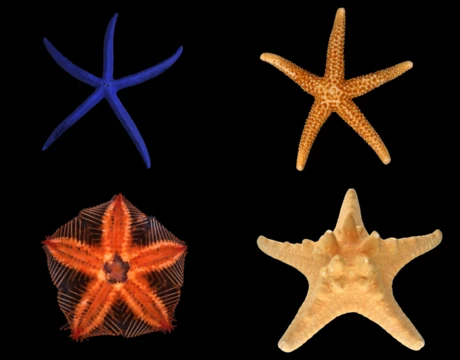
Paulasterias tyleri
First starfish found at a hydrothermal vent community.

Paulasterias tyleri is a seven-armed starfish with a whitish or pale pink body. Its upper surface is covered in a thick, fleshy skin with spongy tissue beneath, and the skin is rough with short spines. This species belongs to the family Paulasteriidae and is the type species of the genus Paulasterias, which also includes only one other species, Paulasterias mcclaini.
Discovered during a deep-sea research cruise organized by the National Oceanography Centre, it was the first starfish found living in a hydrothermal vent community. It was not closely related to any known starfish, so it was placed in a new family. Its closest living relative lives in the Ross Sea, about two thousand miles away on the opposite side of Antarctica.
Paulasterias tyleri is found at thermal vents on the East Scotia Ridge, east of the southern tip of South America, at a depth of about 2,500 meters (8,200 feet). The starfish cannot tolerate the hot, sulphurous, and toxic conditions of the vent itself, but it lives in the cooler, cleaner water nearby. In the surrounding community, Hoff crabs live next to the vent chimneys, with gastropod molluscs and goose barnacles in zones farther out. Beyond them, an area dominated by sea anemones provides the starfish with its likely prey, along with goose barnacles. Other vent community members include limpets in the genus Eclipidrilus and sea spiders in the genus Sericosura. Giant tube worms (Riftia pachyptila), which dominate other hydrothermal vents, are absent here.
Quick Facts
- Genus
- Paulasterias
- Species
- tyleri
Facts from the source article.
Lore & Background
Paulasterias tyleri was discovered during a deep sea research cruise organized by the National Oceanography Centre. It was the first starfish to be found living as part of a hydrothermal vent community and was not closely related to any known starfish species, so it was placed in a new family. Its nearest living relative lives in the Ross Sea on the other side of the Antarctic continent some two thousand miles away.
Paulasterias tyleri is a seven-armed starfish and is whitish or pale pink. It has a thick fleshy skin on the aboral (upper) surface, with spongy tissue underneath it. The skin is rough, being clad with short spines. It is found at thermal vents in the East Scotia Ridge to the east of the southern tip of South America where the depth is about 2,500 m (8,200 ft).
Starfish are unable to cope with the hot, sulphurous, toxic environment of the hydrothermal vent itself but they are present in the cooler, cleaner water nearby. Hoff crabs live adjacent to the hydrothermal vent chimneys, with gastropod molluscs and then goose barnacles occupying zones further out. Beyond this is an assemblage dominated by sea anemones, and it is on these and on the goose barnacles that the starfish probably feed. Other members of the community surrounding the vents include limpets in the genus Eclipidrilus and sea spiders in the genus Sericosura. However absent from these vents are the giant tube worms (Riftia pachyptila) which dominate other hydrothermal vents.
Reader's Guide
Paulasterias tyleri holds significance as the first starfish discovered living as part of a hydrothermal vent community, marking a notable expansion of known vent fauna. Its discovery during a deep sea research cruise organized by the National Oceanography Centre led to the erection of a new family, Paulasteriidae, because it was not closely related to any known starfish species. The only other member of the genus Paulasterias is Paulasterias mcclaini. Its nearest living relative is located in the Ross Sea, approximately two thousand miles away on the other side of the Antarctic continent. The species is found at thermal vents on the East Scotia Ridge at a depth of about 2,500 m. It is a seven-armed, whitish or pale pink starfish with a thick, rough skin clad in short spines. Ecologically, it inhabits cooler, cleaner water near vents and probably feeds on sea anemones and goose barnacles. The vent community also includes Hoff crabs, gastropod molluscs, goose barnacles, limpets in the genus Eclipidrilus, and sea spiders in the genus Sericosura, but notably lacks giant tube worms (Riftia pachyptila) that dominate other hydrothermal vents.
Did You Know?
- Paulasterias tyleri is the first starfish found living as part of a hydrothermal vent community.
- It is the type species of the newly erected genus Paulasterias.
- It has seven arms and a rough skin clad with short spines.
More in Starfish 1-24
Spotted an error? Know more?
Reader corrections go straight into our review queue. Suggest an edit · How this site is sourced