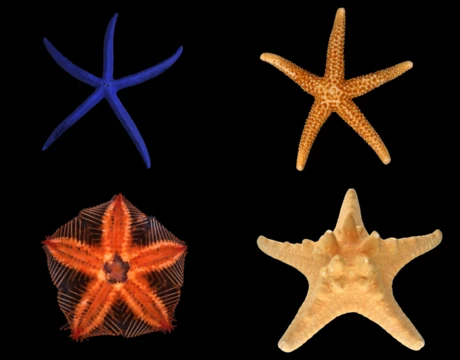
Meyenaster
Monotypic starfish genus with six arms, dominant in Chilean kelp forests.

Meyenaster is a monotypic genus of starfish in the family Asteriidae, containing only the species Meyenaster gelatinosus. It is notable as a dominant predator in kelp forests along the coasts of Chile and for its specialized predatory behaviors, including the ability to force autotomy in the multiarmed starfish Heliaster helianthus.
Quick Facts
- Genus
- Meyenaster
- Species
- gelatinosus
Facts from the source article.
Lore & Background
Meyenaster gelatinosus was first described in 1834 by the Prussian botanist and zoologist Franz Julius Ferdinand Meyen. It is a white starfish with six arms and a mean radius ranging from 150 to 210 mm. It is found in the southeastern Pacific Ocean on the coasts of Chile, where it inhabits kelp forests in the subtidal zone, as well as sand and gravel bottoms and seagrass meadows, typically in areas with strong surge away from quiet locations.
In kelp forests, Meyenaster gelatinosus is one of the dominant predators, alongside other starfish, fish, and the Chilean abalone. It has a notable interaction with the multiarmed starfish Heliaster helianthus: if Meyenaster traps its prey, it everts its stomach over several arms, causing them to autotomize; Meyenaster feeds on the shed arms while Heliaster escapes. In one study, up to 76% of Heliaster helianthus were found with regenerating arms.
In Tongoy Bay, Meyenaster gelatinosus was found to be a generalist predator in sand and gravel habitats but showed a marked preference for the Peruvian scallop in seagrass meadows. When scallops were heavily harvested commercially, the starfish increased its preference for scallops in both habitats but broadened its diet in seagrass areas. It preys on scallops of all sizes from 4 to 14 cm, particularly larger specimens. In another study, its main prey was the Chilean sea urchin, which it often selected and pursued with care; the sea urchin could detect a foraging starfish from at least a meter away and flee, an effective response in areas with vigorous wave action.
Reader's Guide
Meyenaster gelatinosus holds significance as a dominant predator in the kelp forests of Chile, playing a key role in the ecosystem alongside other starfish, fish, and molluscs. Its predatory behavior is notable for forcing autotomy in Heliaster helianthus, a strategy that allows Meyenaster to feed while the prey escapes. This interaction is documented in studies where up to 76% of Heliaster individuals showed regenerating arms, indicating frequent predation. In Tongoy Bay, Meyenaster demonstrated dietary flexibility: it preferred the Peruvian scallop in seagrass meadows but shifted to a broader diet when commercial scallop harvesting reduced prey availability. This adaptability highlights its role as a generalist predator that can adjust to environmental changes. Additionally, its ability to prey on all sizes of scallops, with a preference for larger specimens, creates competition with local fishermen who harvest the same resource. The starfish also exhibits sophisticated hunting behavior toward the Chilean sea urchin, which can distinguish between foraging and non-foraging starfish and flee accordingly. These ecological interactions underscore Meyenaster's importance in shaping community structure and its responsiveness to human activities such as fishing.
Did You Know?
- Meyenaster gelatinosus is the only species in the genus Meyenaster.
- It was first described in 1834 by Prussian botanist and zoologist Franz Julius Ferdinand Meyen.
- Up to 76% of Heliaster helianthus individuals were found with regenerating arms due to predation by Meyenaster.
- In Tongoy Bay, Meyenaster increased its preference for Peruvian scallops after heavy commercial harvesting reduced scallop numbers.
More in Starfish 1-24
Spotted an error? Know more?
Reader corrections go straight into our review queue. Suggest an edit · How this site is sourced