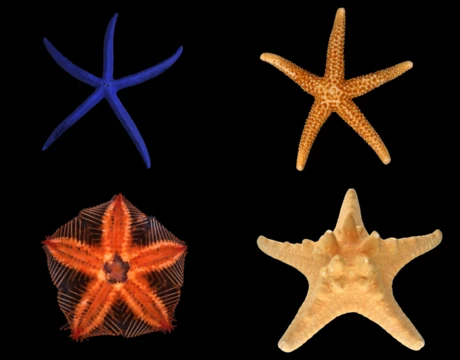
Menerbesaster
Extinct Miocene sea star from France, family Echinasteridae.

Menerbesaster (meaning "Ménerbes star") is an extinct genus of sea star from the family Echinasteridae. Its fossils come from the Early Miocene Calcaire de Ménerbes Formation in France. The genus contains only one species, *Menerbesaster bongrainae*, known from a single well-preserved specimen on a limestone slab. This starfish is part of an unusually diverse group of sea stars—also including *Astropecten*, *Cruciformaster*, and *Lacosteaster*, each from a different family—that together provide the first such "biological snapshot" of Miocene sea stars in Western Europe.
The fossil material was found at the Soubeyran quarry, in outcrops of the Calcaire de Ménerbes Formation near the village of Ménerbes in southeastern France. These rocks belong to the Lacoste plateau, north of the Lesser Luberon Massif. Only one individual is known, preserved with its abactinal (upper) side facing upward on a limestone slab. The specimen is housed at the Musée des Confluences in Lyon, France, under accession number MDC.20062679.
In 2026, Anaïs Travers and colleagues described *Menerbesaster bongrainae* as a new genus and species of echinasterid sea star, designating MDC.20062679 as the holotype. The genus name combines Ménerbes (the type locality) with the Latin *aster* ("star"), a common suffix for sea star genera. The species name *bongrainae* honors Madelaine Bongrain, who published the first paleoecological study of the echinoderm and bivalve accumulations in the Calcaire de Ménerbes Formation in 2013. *Menerbesaster* is the second fossil member of the family Echinasteridae ever described, after *Echinaster jacobseni*, an extinct species from the Eocene of Denmark.
The body of *Menerbesaster* has five arms, though their full length is not preserved in the holotype. The spaces between the arms are wide and angular. In the holotype, the distance from the center of the disc to the tip of an arm (large radius, R) exceeds 3.7 centimeters (1.5 inches), while the distance from the disc center to an interbrachial area (small radius, r) is 1.5 centimeters (0.59 inches).
The fossil assemblage containing *Menerbesaster* dates to the late Burdigalian age of the early Miocene (Neogene period), about 16 million years ago.
Quick Facts
- Genus
- Menerbesaster
- Species
- bongrainae
Facts from the source article.
Lore & Background
The Menerbesaster fossil material was discovered in the Soubeyran quarry, representing outcrops of the Calcaire de Ménerbes Formation near the village of Ménerbes in southeastern France. One individual is known, preserved with the abactinal face up on a limestone slab, housed in the Musée des Confluences in Lyon under specimen number MDC.20062679. In 2026, Anaïs Travers and colleagues described Menerbesaster bongrainae as a new genus and species, establishing MDC.20062679 as the holotype. The generic name combines a reference to Ménerbes with the Latin aster ('star'), and the specific name honors Madelaine Bongrain for her 2013 palaeoecological research on the formation's echinoderm and bivalve accumulations. Menerbesaster is the second fossil member of Echinasteridae described, following Echinaster jacobseni from the Eocene of Denmark.
Menerbesaster has five arms, the full extent of which is not preserved in the holotype. The area between each arm is wide and angular. In the holotype, the distance from the center of the disc to the end of an arm (large radius, R) is more than 3.7 cm, while the distance from the center of the disc to an interbrachial area (small radius, r) is 1.5 cm. The fossil assemblage dates to about 16 million years ago, representing a shallow marine depositional environment with abundant well-preserved invertebrates. These accumulations are interpreted as a sudden, massive mortality event, possibly from episodic storms. The ossicles are almost always in anatomical position, indicating exceptional preservation.
Reader's Guide
Menerbesaster is significant as part of the first described diverse assemblage of Miocene fossil sea stars in Western Europe, alongside three other sea stars from different families: Lacosteaster lauerorum (Solasteridae), an unnamed Astropecten species (Astropectinidae), and Cruciformaster pedicellarius (Oreasteridae). This co-occurrence is remarkable because extant members of these families inhabit different environments and have distinct lifestyles—oreasterids, solasterids, and echinasterids are epibenthic, while astropectinids are endobenthic—and do not generally overlap in modern habitats. The article suggests these sea stars were transported together by a natural event before rapid burial. Menerbesaster itself is the second fossil echinasterid described, following Echinaster jacobseni. The preservation style—flattened rather than folded—indicates rapid burial, as sea stars typically fold if buried slowly. The fossil also provides a window into possible predator-prey relationships: modern echinasterids are detrivores and predators of small prey, and the article speculates that Cruciformaster may have preyed on the sea urchin Tripneustes planus, while the Astropecten species may have fed on juvenile Gigantopecten restitutensis bivalves.
Did You Know?
- The genus name Menerbesaster combines a reference to the type locality Ménerbes with the Latin aster, meaning 'star'.
- The fossil assemblage containing Menerbesaster is dated to about 16 million years ago, during the late Burdigalian age of the early Miocene.
More in Starfish 1-24
Spotted an error? Know more?
Reader corrections go straight into our review queue. Suggest an edit · How this site is sourced