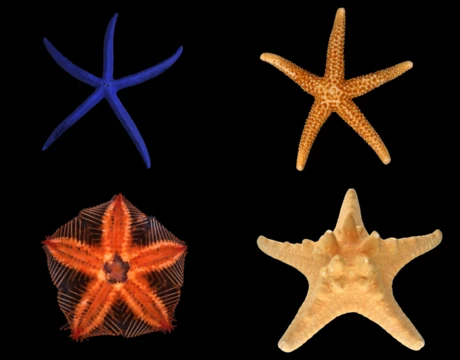
Marthasterias
A genus of two spiny starfish species in the family Asteriidae.

Marthasterias is a genus of starfish belonging to the family Asteriidae. The two species within this genus are both referred to as the spiny starfish.
The species *Marthasterias glacialis* is a relatively large starfish, characterized by a small central disc and five slender, tapering arms. Each arm features three longitudinal rows of conical, whitish spines, typically with purple tips, and each spine is encircled by a wreath of pedicellariae. Its background color varies, ranging from brownish or greenish-grey, sometimes with yellow or red hues, and occasionally purple at the arm tips. This starfish can reach up to 70 cm (28 in) in length, though a more common size is 25 to 30 cm (10 to 12 in). It is occasionally mistaken for the northern starfish *Leptasterias muelleri*.
*Marthasterias glacialis* is found in the Eastern Atlantic Ocean, from Iceland and Macaronesia in the north, while *M. capensis* occurs off Angola and South Africa in the south. Its range also includes the Baltic and Mediterranean seas. Around the British Isles, it is restricted to the western coasts of Scotland, Wales, southern England, and most of Ireland. It lives from the subtidal zone down to about 200 m (656 ft) deep, on both sheltered muddy substrates and rocky surfaces.
Like other members of the Asteriidae family, *Marthasterias glacialis* is a predator, primarily feeding on bivalve molluscs and other invertebrates. Saponins, secondary metabolites found in the starfish's tissues, strongly affect the whelk *Buccinum undatum*: low concentrations cause the mollusc to retreat, while higher concentrations trigger convulsions in its muscles. The sea urchins *Strongylocentrotus droebachiensis* and *Psammechinus miliaris* are also affected by these chemicals—*S. droebachiensis* flees, but *P. miliaris* can defend itself using its toxic pedicellariae.
The reproductive biology of this starfish is not well studied, but off the coast of Ireland, individuals gather in very shallow water during July and August. A few days later, on a warm afternoon, they have been observed arching their bodies and releasing spawn into the sea, with a rise in water temperature apparently triggering the event. Male starfish as small as 2.5 cm (1 in) have been seen spawning, as have females at least 9 cm (3.5 in) in diameter.
Quick Facts
- Taxon
- Marthasterias
Facts from the source article.
Lore & Background
Marthasterias glacialis is a fairly large starfish with a small central disc and five slender, tapering arms. Each arm has three longitudinal rows of conical, whitish spines, usually with purple tips, each surrounded by a wreath of pedicellariae. The background colour is variable and may be brownish or greenish-grey, tinged with yellow or red and sometimes with purple at the tips of the arms. This species can grow to 70 cm (28 in) but a more usual size is 25 to 30 cm (10 to 12 in). It is sometimes confused with the northern starfish Leptasterias muelleri.
Marthasterias glacialis is native to the Eastern Atlantic Ocean (from Iceland and Macaronesia in the North Atlantic, while M. capensis is known from Angola and South Africa in the South Atlantic), and the Baltic and Mediterranean seas. Around the British Isles it is limited to the western side of Scotland, Wales, the western part of southern England and most of Ireland. Its depth range is subtidal down to about 200 m (656 ft) and it is found on both sheltered muddy substrates and on rocks.
Like other starfish in the family Asteriidae, Marthasterias glacialis is a predator and feeds mostly on bivalve molluscs and other invertebrates. It has been found that secondary metabolites known as saponins, found within the starfish's tissues, have a dramatic effect on the whelk Buccinum undatum. At low concentrations they cause the mollusc to withdraw from the vicinity of the starfish and at higher concentrations they cause convulsions in the mollusc's musculature. The sea urchins Strongylocentrotus droebachiensis and Psammechinus miliaris are also affected by the chemicals. S. droebachiensis flees but P. miliaris has toxic pedicellariae and is able to defend itself. The reproductive biology of this starfish has been little studied but off the coast of Ireland, individuals gather together in very shallow water in July and August. A few days later, on a warm afternoon, they have been observed to arch their bodies and release spawn into the sea. A rise in the water temperature seems to have triggered the spawning. Male starfish as small as 2.5 cm (1 in) were observed to spawn, and females of at least 9 cm (3.5 in) diameter.
Reader's Guide
The genus Marthasterias is notable for containing two species, both known as spiny starfish, and for the chemical defenses of Marthasterias glacialis. Its tissues contain saponins that affect predators and prey, causing avoidance or convulsions in the whelk Buccinum undatum and influencing the behavior of sea urchins such as Strongylocentrotus droebachiensis and Psammechinus miliaris. The reproductive behavior of M. glacialis has been little studied, but observations off the coast of Ireland show that individuals gather in very shallow water in July and August, and spawning is triggered by a rise in water temperature. The species is ecologically significant as a predator of bivalve molluscs and other invertebrates, and its distribution spans the Eastern Atlantic, Baltic, and Mediterranean seas. Its size, coloration, and spiny armature make it a distinctive member of the family Asteriidae, though it is sometimes confused with Leptasterias muelleri.
Did You Know?
- Both species in the genus Marthasterias are commonly known as the spiny starfish.
- Saponins in Marthasterias glacialis tissues cause the whelk Buccinum undatum to withdraw at low concentrations and convulse at higher concentrations.
- Off the coast of Ireland, spawning in Marthasterias glacialis has been observed in July and August, triggered by a rise in water temperature.
More in Starfish 1-24
Spotted an error? Know more?
Reader corrections go straight into our review queue. Suggest an edit · How this site is sourced