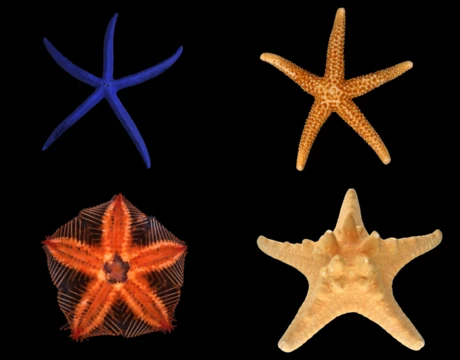
Luidia
Genus of starfish with long arms, no anus, and larval cloning.

Luidia is a genus of starfish that is the sole member of the family Luidiidae. Its species are found worldwide. These starfish have long, pointed arms edged with spines. Their upper surfaces are covered with paxillae—pillar-like spines with flattened tops bearing tiny spinules. The upper marginal plates are replaced by paxillae, while the lower marginal plates are large and also covered with paxillae. Their tube feet lack suckers and instead have two swollen sections. They possess a mouth, esophagus, and cardiac stomach, but no pyloric stomach or anus. The gonads lie beneath the sides of each arm. During early development, Luidia larvae reach the bipinnarial stage but do not progress to a brachiolar stage before metamorphosis. However, they can reproduce asexually through larval cloning, a process observed both in the wild and in laboratory settings, and studied via mitochondrial tRNA sequencing to identify the species involved.
Quick Facts
- Taxon
- Luidia
Facts from the source article.
Lore & Background
Luidia is a genus of starfish in the family Luidiidae, where it is the only genus. Species of the family have a cosmopolitan distribution. Members of the genus are characterized by having long arms with pointed tips fringed with spines. Their upper surfaces are covered with paxillae, which are pillar-like spines with flattened summits covered with minute spinules. The upper marginal plates are replaced by paxillae, but the lower marginal plates are large and covered with paxillae. The tube feet do not have suckers but have two swollen regions. A mouth, esophagus, and cardiac stomach are present, but no pyloric stomach or anus is present. The gonads are underneath the sides of each arm.
The early larval stages of starfish are known as bipinnarial larvae, and members of this genus do not continue their development after this stage into a brachiolar stage before undergoing metamorphosis. However, they are capable of larval cloning, with asexual reproduction taking place while they are larvae. This has been shown to take place both in the field and in laboratory cultures and has been studied by molecular analysis of sequences of mitochondrial tRNA to identify the taxa involved.
As of 2024, the following species are recognized by the World Register of Marine Species.
Reader's Guide
Luidia is significant as the sole genus in the family Luidiidae, with a cosmopolitan distribution. Its anatomical features are distinctive: long arms fringed with spines, paxillae covering the upper surface and replacing the upper marginal plates, and tube feet lacking suckers but having two swollen regions. Notably, Luidia lacks both a pyloric stomach and an anus, a rare condition among starfish. Its reproductive biology is also unusual: larvae remain at the bipinnarial stage and do not develop into a brachiolar stage before metamorphosis. Instead, they are capable of asexual reproduction through larval cloning, a phenomenon documented both in the field and in laboratory cultures. Molecular analysis of mitochondrial tRNA sequences has been used to identify the taxa involved in this cloning. The genus thus provides insight into alternative developmental pathways and reproductive strategies within starfish. Its recognition by the World Register of Marine Species as of 2024 underscores its taxonomic stability.
Did You Know?
- Luidia is the only genus in the family Luidiidae.
- Members of Luidia have no pyloric stomach and no anus.
- Luidia larvae can reproduce asexually through cloning, observed in both field and laboratory settings.
More in Starfish 1-24
Spotted an error? Know more?
Reader corrections go straight into our review queue. Suggest an edit · How this site is sourced