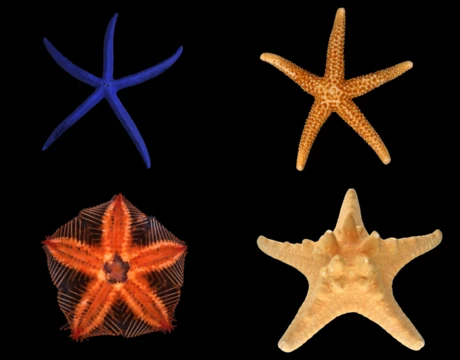
Leptasterias
A genus of six-armed starfish with cryptic species and brooding behavior.

Leptasterias is a genus of starfish belonging to the family Asteriidae and the order Forcipulatida. While these starfish usually have six arms, individuals with five arms are occasionally found. Their classification is quite tangled, and the species known as *Leptasterias hexactis* is thought to be a group of closely related, look-alike species. Some members of this genus care for their eggs by brooding them.
These starfish are generally small, measuring less than six centimeters from the tip of one ray to the opposite tip. They reach maturity at about two years old. Females produce yolky eggs and provide no extra nutrition to the developing embryos. After spawning, a female uses her tube feet to gather her eggs and arches her arms to form a protective brood pouch. She keeps her young there for five to six months, until they develop their first three pairs of tube feet and can crawl away on their own. Because they skip a free-swimming larval stage, *Leptasterias* do not easily spread to new areas. When they do travel farther distances, it is usually by hitching a ride on floating algae or other debris, though this does not happen often.
Their limited mobility makes them useful as indicator species. Since they cannot easily move away from local problems, they are sensitive to pressures like algal blooms and disease outbreaks. To accurately track changes in their distribution, numbers, and overall health, it is important to identify which specific species of *Leptasterias* is being studied. Their cryptic species complexes also help scientists interpret data on the ecological effects of disasters and other environmental stresses.
*Leptasterias* live in intertidal and subtidal rocky habitats, ranging from Alaska down to central California. In fall, they are often found under rocks, which provide shelter during reproduction. In spring, they move to rock pools and the surfaces of rocks. The algae covering these rocks helps keep the starfish moist and prevents dehydration. Young individuals stay in shallow, rocky areas, while adults may venture into deeper water, down to depths of 800 meters. They are also found in the North Sea near Norway, the North Atlantic between Iceland and Greenland, and along the northeast and Pacific coasts of the United States.
The breeding season runs from October or November through January.
Quick Facts
- Taxon
- Leptasterias
Facts from the source article.
Lore & Background
Leptasterias is a genus of starfish in the family Asteriidae and order Forcipulatida. Members are often noted for having six arms, though five-armed specimens occasionally occur. They are characterized by several cryptic species complexes. They are typically small, measuring less than 6 cm from ray tip to ray tip, and mature around the age of two. They are lecithotrophic, providing the embryo with no nutrition other than the yolk in its egg. Females brood their young under their rays until they are fully developed and capable of crawling away. Because of their brooding and small size, dispersal to new areas is difficult; they sometimes attach to macroalgae or other floating organisms to be carried farther, though this does not happen frequently.
Reader's Guide
Leptasterias can be used as an indicator species because they are not very able to move far from their habitat and are susceptible to local selection pressures such as algal blooms and disease outbreaks. To use them as indicators, it is important to identify the certain species of Leptasterias in order to accurately observe changing distributions, abundances, and population health. The cryptic complexes also play a part in determining data for monitoring ecological effects of disastrous events and other environmental stressors. The genus is found in intertidal waters, often under rocks or in rock pools where the shore is fairly exposed. During fall months they are typically under rocks, where they reproduce; during spring months they can be found in rock pools on the surface of rocks. The rocks they inhabit are covered in algae, which helps protect the starfish from dehydration. Young are found in rocky substrates in shallow water, while adults venture to greater depths, up to 800 meters. They occur globally in the North Sea below Norway, the North Atlantic between Iceland and Greenland, and the northeast coast and Pacific coast of the United States.
Did You Know?
- Leptasterias muelleri is the type species of the genus.
- Leptasterias hexactis appears to be a species complex.
- Females brood their young under their rays for five to six months.
- They do not go through a larval stage; embryos develop and leave the mother after the first three pairs of tube feet appear.
More in Starfish 1-24
Spotted an error? Know more?
Reader corrections go straight into our review queue. Suggest an edit · How this site is sourced