Cruciformaster
Extinct oreasterid sea star from Early Miocene France.

Cruciformaster, meaning "cruciform star," is an extinct genus of sea star from the family Oreasteridae. It is known only from the Early Miocene Calcaire de Ménerbes Formation in France. The genus contains a single species, *Cruciformaster pedicellarius*, represented by two individuals preserved together on one limestone slab. This genus is part of an unusually diverse assemblage of sea stars—also including *Astropecten*, *Lacosteaster*, and *Menerbesaster*, each from a different family—that provides the first such "biological snapshot" of Miocene sea stars in Western Europe.
The fossil material was discovered in outcrops of the Calcaire de Ménerbes Formation near the village of Ménerbes in southeastern France, on the Lacoste plateau north of the Lesser Luberon Massif. The two individuals are preserved on a single slab: the larger one is nearly complete and preserved with its abactinal (upper) face exposed, while the smaller one preserves only part of one arm and is preserved with its actinal (mouth-side) face up. The fossils were initially part of the private collection of Nicolas Tourment in Marseille and are now housed at the Natural History Museum of Geneva in Switzerland, under accession number MHNG-GEPI-87379. In 2026, Anaïs Travers and colleagues described *Cruciformaster pedicellarius* as a new genus and species, designating the larger individual (MHNG-GEPI-87379a) as the holotype and the smaller (MHNG-GEPI-87379b) as a paratype. The generic name refers to the cross-like shape of the superomarginal plates, distinct from the rectangular shape in other oreasterids, combined with the Latin *aster* for "star." The species name *pedicellarius* refers to notches on the actinal and adambulacral ossicles that correspond to insertions for pedicellariae. At the time of its description, Cruciformaster was the first and only fossil member of the family Oreasteridae.
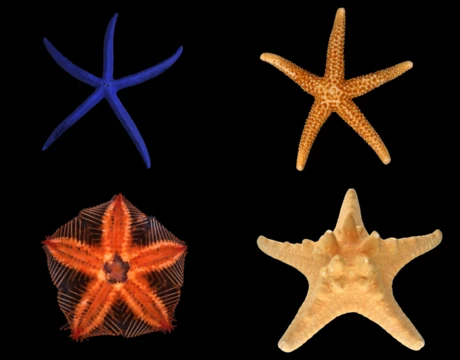
Cruciformaster has a broad, pentagonal central disc and five short, tapered arms, with rounded areas between each arm. In the holotype, the distance from the disc center to the arm tip (large radius, R) is 9 cm, and the distance from the disc center to an interbrachial area (small radius, r) is 4 cm.
The Calcaire de Ménerbes Formation is dated to the late Burdigalian age of the early Miocene, about 16 million years ago.
Quick Facts
- Genus
- Cruciformaster
- Species
- pedicellarius
Facts from the source article.
Lore & Background
The Cruciformaster fossil material was discovered in outcrops of the Calcaire de Ménerbes Formation near the village of Ménerbes in southeastern France, on the Lacoste plateau north of the Lesser Luberon Massif. Two individuals are known, preserved together on a single limestone slab. The larger one is nearly complete and preserved with the abactinal face up, while the smaller one preserves only part of one arm and is preserved with the actinal face up. These fossils were initially held in the private collection of Nicolas Tourment in Marseille and are now housed in the Natural History Museum of Geneva, Switzerland, under specimen number MHNG-GEPI-87379. In 2026, Anaïs Travers and colleagues described Cruciformaster pedicellarius as a new genus and species based on these remains, designating the larger individual as the holotype and the smaller as a paratype. The generic name references the distinctly cruciform shape of the superomarginal plates, combined with the Latin aster meaning 'star'. The specific name pedicellarius alludes to the notched actinal and adambulacral ossicles corresponding to insertions for pedicellariae. Cruciformaster has a broad, pentagonal central disc and five short, tapered arms with rounded interbrachial areas. The holotype has a large radius of 9 cm and a small radius of 4 cm.
Reader's Guide
Cruciformaster is significant as the first fossil member of the family Oreasteridae to be described, and it is part of a unique fossil assemblage from the Calcaire de Ménerbes Formation, dated to about 16 million years ago. This assemblage includes three other sea stars—Lacosteaster lauerorum (Solasteridae), an unnamed species of Astropecten (Astropectinidae), and Menerbesaster bongrainae (Echinasteridae)—each from a different family, representing the first described diverse Miocene sea star fauna in Western Europe. The preservation is exceptional: ossicles are almost always in anatomical position, and the flattened preservation style contrasts with the folded preservation typical of sea stars that escape slow burial. The co-occurrence of these four families, whose modern members inhabit different environments (oreasterids in warm, shallow waters; solasterids in shallow to upper bathyal; astropectinids in cold to tropical waters; echinasterids in various habitats) and have different lifestyles (epibenthic vs. endobenthic), suggests they were transported by a natural event and rapidly buried. The deposit is interpreted as a sudden, massive mortality event, possibly from episodic storms. Modern analogs suggest Cruciformaster may have preyed on the sea urchin Tripneustes planus, similar to modern Oreaster reticulatus preying on Tripneustes ventricosus.
Did You Know?
- Cruciformaster is the first—and only, at the time of its description—fossil member of the family Oreasteridae to be described.
- The two known individuals are preserved together on a single limestone slab, with the larger one showing the abactinal face and the smaller only part of one arm showing the actinal face.
- The generic name Cruciformaster references the cruciform shape of the superomarginal plates, unlike the rectangular shape in other oreasterids.
- The fossil assemblage includes four sea stars from different families, representing the first described diverse Miocene sea star fauna in Western Europe.
More in Starfish 1-24
Spotted an error? Know more?
Reader corrections go straight into our review queue. Suggest an edit · How this site is sourced