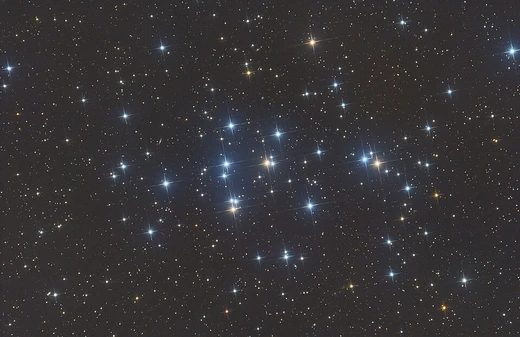
Stellar association
Loose, gravitationally unbound star groups sharing common origin and motion.

A stellar association is a type of star cluster that is even more loosely bound than an open cluster or a globular cluster. These groups typically contain between 10 and 100 or more stars that are visible. Astronomers identify an association by looking for shared characteristics among its stars, such as similar movement through space, comparable ages, and matching chemical compositions. These common traits point to a single origin for all the stars in the group. Unlike true star clusters, however, the stars in an association are not held together by gravity. Over the course of millions of years, they will drift apart and scatter through their galactic neighborhood, eventually forming what is known as a moving group.
Victor Ambartsumian first identified stellar associations in 1947. The standard naming convention for an association uses the name or abbreviation of the constellation (or constellations) where it is found, along with the type of association and, occasionally, a number.
**Types**
Ambartsumian originally divided stellar associations into two categories, OB and T, based on the types of stars they contain. A third category, R, was later proposed by Sidney van den Bergh for associations whose stars illuminate reflection nebulae. These OB, T, and R associations form a continuous range of young stellar groupings, but it is not yet clear whether they represent an evolutionary sequence or are caused by some other factor. Some groups show characteristics of both OB and T associations, making the classification ambiguous.
**OB associations**
Young associations that contain 10 to 100 massive stars of spectral types O and B are called OB associations. These stars are thought to form together within a small region inside a giant molecular cloud. After the surrounding dust and gas are blown away, the remaining stars become gravitationally unbound and begin to drift apart. It is believed that most stars in the Milky Way originated in OB associations. O-class stars have short lifespans, ending as supernovae after roughly one to fifteen million years, depending on their mass. Consequently, OB associations are typically only a few million years old or younger; the O and B stars within them exhaust their fuel within 10 million years.
- Discovered by
- Victor Ambartsumian
- Year discovered
- 1947
- Typical star count
- 10 to 100 or more visible stars
- Nearest ob association
- Scorpius–Centaurus association, about 400 light-years from the Sun
- Nearest t association
- Taurus-Auriga T association, at a distance of 140 parsecs from the Sun
- Example r association
- Monoceros R2, located 830 ± 50 parsecs from the Sun
Lore & Background
Stellar associations were discovered by Victor Ambartsumian in 1947. The conventional name for an association uses the names or abbreviations of the constellation (or constellations) in which they are located; the association type, and, sometimes, a numerical identifier. Ambartsumian first categorized stellar associations into two groups, OB and T, based on the properties of their stars. A third category, R, was later suggested by Sidney van den Bergh for associations that illuminate reflection nebulae. The OB, T, and R associations form a continuum of young stellar groupings, but it is currently uncertain whether they are an evolutionary sequence, or represent some other factor at work. Some groups also display properties of both OB and T associations, so the categorization is not always clear-cut.
OB associations are young associations containing 10–100 massive stars of spectral class O and B, believed to form within the same small volume inside a giant molecular cloud. Once the surrounding dust and gas is blown away, the remaining stars become unbound and drift apart. It is believed that the majority of all stars in the Milky Way were formed in OB associations. O class stars are short-lived, expiring as supernovae after roughly one to fifteen million years. The Hipparcos satellite located a dozen OB associations within 650 parsecs of the Sun. T associations are sparse populations of up to a thousand infant T Tauri stars still entering the main sequence, often found near the molecular cloud from which they formed. R associations are groups of stars that illuminate reflection nebulae, containing main sequence stars not sufficiently massive to disperse the interstellar clouds in which they formed.
Reader's Guide
Stellar associations are significant because they represent the earliest stages of star cluster evolution, where stars born together have become gravitationally unbound and are drifting apart. The article notes that the majority of all stars in the Milky Way are believed to have formed in OB associations, highlighting their fundamental role in galactic star formation. The Hipparcos satellite's measurements located a dozen OB associations within 650 parsecs of the Sun, demonstrating their prevalence in our local neighborhood. The three types—OB, T, and R—form a continuum of young stellar groupings, though whether this represents an evolutionary sequence remains uncertain. R associations are more plentiful than OB associations and can be used to trace the structure of galactic spiral arms. The Ursa Major Moving Group is cited as one example of a stellar association, with all but two stars in the Plough/Big Dipper belonging to it. Other young moving groups listed include the Local Association (Pleiades moving group), Hyades Stream, IC 2391 supercluster, Beta Pictoris moving group, Castor moving group, AB Doradus moving group, Zeta Herculis moving group, Alpha Persei moving cluster, and Cameleopardis OB1 association.
Did You Know?
- The nearest OB association is the Scorpius–Centaurus association, about 400 light-years from the Sun.
- The nearest T association is the Taurus-Auriga T association, located at a distance of 140 parsecs from the Sun.
- The Ursa Major Moving Group includes all stars in the Plough/Big Dipper except α Ursae Majoris and η Ursae Majoris.
Frequently Asked Questions
What is a stellar association?
A stellar association is a very loosely grouped collection of stars that share a common birth, similar velocities, ages, and chemical makeup. Unlike true clusters, the stars in an association are not gravitationally bound to one another.
Who discovered stellar associations and when?
Victor Ambartsumian is credited with identifying stellar associations in 1947. His work established that these loose groupings could be recognized through shared kinematic and chemical signatures rather than gravitational cohesion.
How does a stellar association differ from an open or globular cluster?
Open and globular clusters are held together by mutual gravity, whereas association members drift apart over millions of years because no gravitational binding keeps them intact. Astronomers instead rely on matching motion, age, and composition to confirm the group shares a single origin.
What is the nearest stellar association to the Sun?
The Scorpius–Centaurus OB association lies roughly 400 light-years away, making it the closest known OB association. Among T associations, the Taurus-Auriga T association is the nearest at about 140 parsecs from the Sun.
How many stars are typically in a stellar association?
A stellar association generally contains somewhere between 10 and 100 or more visible stars. Because the grouping is so diffuse, the exact count can vary depending on how far out an observer is willing to trace the shared motion and chemistry.
More in Star Clusters 1-24
Spotted an error? Know more?
Reader corrections go straight into our review queue. Suggest an edit · How this site is sourced