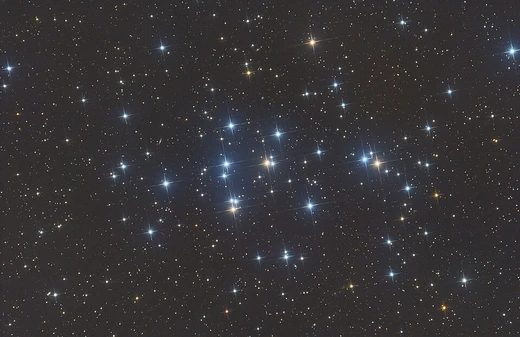
Open cluster
Open clusters are loose groups of young stars formed from the same cloud.

An open cluster is a group of stars, ranging from a few dozen to a few thousand members, all born from the same giant molecular cloud and sharing a similar age. Within the Milky Way, over 1,100 such clusters have been cataloged, and astronomers suspect many more exist. These clusters are only loosely held together by gravity. As they orbit the galaxy’s center, they get disrupted by close passes with other clusters or gas clouds, and internal encounters can fling stars out, scattering them into the broader galaxy. Most open clusters last only a few hundred million years, though the heaviest ones can survive for a few billion years. By contrast, globular clusters—which are much more massive—hold their stars more tightly and live far longer. Open clusters appear exclusively in spiral and irregular galaxies, places where stars are actively forming.
Young open clusters sometimes remain embedded in the molecular cloud that gave them birth. The stars’ radiation lights up the surrounding gas, creating an H II region. Over time, that same radiation pressure pushes the leftover gas away. Typically, only about 10% of the cloud’s mass actually turns into stars before the rest is blown off.
Open clusters are crucial for studying how stars evolve. Because all the stars in a cluster formed at roughly the same time and from the same material, it’s much easier to determine their distance, age, chemical makeup, and motion than it is for isolated stars. Some open clusters, like the Pleiades, the Hyades, and the Alpha Persei Cluster, are bright enough to see with the naked eye. Others, such as the Double Cluster, are barely visible without help, and many more require binoculars or a telescope. The Wild Duck Cluster, M11, is a well-known example.
**Historical observations**
The Pleiades, a prominent open cluster in Taurus, has been recognized as a group since ancient times. The Hyades, also in Taurus, is one of the oldest known clusters. Early astronomers saw other open clusters as fuzzy, unresolved patches of light. In his *Almagest*, the Roman astronomer Ptolemy listed the Praesepe Cluster, the Double Cluster in Perseus, the Coma Star Cluster, and the Ptolemy Cluster. The Persian astronomer Al-Sufi wrote about the Omicron Velorum cluster. But it took the invention of the telescope to break these “nebulae” into individual stars.
- Number discovered in milky way
- more than 1,100
- Typical lifespan
- a few hundred million years
- Maximum lifespan of most massive
- a few billion years
- Percentage of gas cloud mass that coales
- about 10%
- First telescopic observer
- Galileo Galilei in 1609
- First to use telescope to find new open
- Giovanni Hodierna in 1654
- First to calculate probability of physic
- John Michell in 1767
Lore & Background
The prominent open cluster the Pleiades has been recognized as a group of stars since antiquity, while the Hyades is one of the oldest open clusters. Other open clusters were noted by early astronomers as unresolved fuzzy patches of light. In his Almagest, Ptolemy mentions the Praesepe Cluster, the Double Cluster in Perseus, the Coma Star Cluster and the Ptolemy Cluster, while Al-Sufi wrote of the Omicron Velorum cluster. The first person to use a telescope to observe the night sky and record his observations was Galileo Galilei in 1609. When he turned the telescope toward some of the nebulous patches recorded by Ptolemy, he found they were groupings of many stars. For Praesepe, he found more than 40 stars. In 1654, Giovanni Hodierna identified the objects now designated Messier 41, Messier 47, NGC 2362 and NGC 2451. It was realized as early as 1767 that the stars in a cluster were physically related, when John Michell calculated that the probability of even just one group of stars like the Pleiades being the result of a chance alignment was just 1 in 496,000. Between 1774 and 1781, Charles Messier published a catalogue including 26 open clusters. In the 1790s, William Herschel began an extensive study and conceived the idea that stars were initially scattered but later became clustered due to gravitational attraction. Hundreds of open clusters were listed in the New General Catalogue, first published in 1888 by J. L. E. Dreyer, and the two supplemental Index Catalogues. Telescopic observations revealed two distinct types: globular clusters and open clusters, the latter occasionally referred to as galactic clusters, a term introduced in 1925 by Robert Julius Trumpler.
Reader's Guide
Open clusters are key objects in the study of stellar evolution. Because the cluster members are of similar age and chemical composition, their properties (such as distance, age, metallicity, extinction, and velocity) are more easily determined than they are for isolated stars. A number of open clusters, such as the Pleiades, the Hyades and the Alpha Persei Cluster, are visible with the naked eye. Some others, such as the Double Cluster, are barely perceptible without instruments, while many more can be seen using binoculars or telescopes. The Wild Duck Cluster, M11, is an example. The first color–magnitude diagrams of open clusters were published by Ejnar Hertzsprung in 1911, giving the plot for the Pleiades and Hyades star clusters. He continued this work for the next twenty years, demonstrating a relationship between star colors and their magnitudes, and in 1929 noticed that the Hyades and Praesepe clusters had different stellar populations than the Pleiades, interpreted as a difference in ages. Micrometer measurements of positions of stars in clusters were made as early as 1877 by E. Schönfeld and further pursued by E. E. Barnard. In 1918, Adriaan van Maanen measured the proper motion of stars in part of the Pleiades cluster by comparing photographic plates. As astrometry became more accurate, cluster stars were found to share a common proper motion through space. Spectroscopic measurements revealed common radial velocities, showing that the clusters consist of stars bound together as a group.
Did You Know?
- More than 1,100 open clusters have been discovered within the Milky Way galaxy.
- Galileo Galilei first used a telescope to observe open clusters in 1609, finding over 40 stars in Praesepe.
- John Michell calculated in 1767 that the probability of the Pleiades being a chance alignment was 1 in 496,000.
Born from the Same Cloud: Formation and Lifespan
An open cluster takes shape when a giant molecular cloud collapses, producing anywhere from a few dozen to several thousand stars that all share roughly the same age and chemical composition. In their earliest phase, these young stars still shine within the parent cloud, their radiation ionizing surrounding hydrogen and creating a luminous H II region. Yet that same radiation pressure ultimately works against the cluster, dispersing the leftover gas. In practice, only about one-tenth of a cloud's mass typically coalesces into stars before the remainder is blown away.
Once unshackled from its birth cloud, the group is held together merely by the modest mutual gravity of its members. As it circles the Galactic Center, encounters with other clusters or dense gas fields gradually peel off individual stars, while internal close encounters further thin the population. Most open clusters disintegrate within a few hundred million years; the most massive may last a couple of billion. Globular clusters, bound by far stronger gravity, survive considerably longer. Open clusters are found only in spiral and irregular galaxies—settings where active star formation is still taking place.
From Fuzzy Patches to Resolved Stars: A History of Discovery
The Pleiades have been recognized as a star group since ancient times, and the Hyades rank among the oldest known open clusters. Yet for centuries, most other clusters appeared merely as soft, unresolved smudges of light. Ptolemy listed the Praesepe, the Double Cluster in Perseus, the Coma Star Cluster, and the Ptolemy Cluster in his Almagest, while the Persian observer Al-Sufi recorded the Omicron Velorum group. As late as 1603, Johann Bayer assigned single-star designations to three of these objects, unaware they were multiple.
The telescope changed everything. In 1609, Galileo Galilei became the first to point an instrument at the sky and record what he saw. Turning it toward the Praesepe, he counted over forty stars; aimed at the Pleiades, he resolved nearly fifty where earlier observers had noted only six or seven. His 1610 treatise Sidereus Nuncius declared the Milky Way to be "a mass of innumerable stars planted together in clusters." Inspired by Galileo, the Sicilian astronomer Giovanni Hodierna went on to identify several previously unknown clusters in 1654, including the objects we now call Messier 41, Messier 47, NGC 2362, and NGC 2451.
A Natural Laboratory for Stellar Evolution
Because every member of an open cluster was born from the same cloud at essentially the same time, the stars share a common age and chemical composition. This uniformity makes open clusters invaluable for studying stellar evolution. Properties that are notoriously hard to pin down for an isolated star—distance, age, metallicity, interstellar extinction, and space velocity—become far more tractable when measured across a group of coeval stars.
The physical reality of these groupings was not always obvious. In 1767, Reverend John Michell calculated that the odds of even a single Pleiades-like grouping arising from a random line-of-sight alignment were roughly one in 496,000, offering early statistical evidence that the stars were physically associated. William Herschel later proposed that stars originally scattered through space could be drawn together by gravitational attraction to form clusters.
Proof came through astrometry. In 1918, Adriaan van Maanen compared photographic plates of the Pleiades taken at different epochs and measured the proper motion of stars. By 1943, a second comparison let him pick out stars whose motion matched the cluster's mean drift, identifying true members. Spectroscopic follow-up confirmed a shared radial velocity, cementing the conclusion that these stars are gravitationally bound as a system.
Seeing the Stars: Visibility and Place in the Galaxy
More than 1,100 open clusters have been catalogued within the Milky Way, and astronomers suspect many more remain hidden. Their visibility to the unaided eye varies enormously. The Pleiades, the Hyades, and the Alpha Persei Cluster are all bright enough to be spotted without any optical aid, while the Double Cluster in Perseus is only barely perceptible without instruments. A great many others, such as the Wild Duck Cluster (Messier 11), reward observers who use binoculars or small telescopes.
Open clusters occupy a distinctive niche in the galactic landscape. They are found only in spiral and irregular galaxies—environments where active star formation is still occurring—and they tend to lie in or near the galactic plane. This contrasts sharply with globular clusters, which are packed into dense, roughly spherical shapes and distributed across the entire sky with a preference for the galactic center. Because of their plane-hugging distribution, open clusters were sometimes called "galactic clusters," a term introduced in 1925 by the Swiss-American astronomer Robert Julius Trumpler. Telescopic surveys confirmed the structural difference: globular clusters contain thousands of stars in a regular spherical arrangement, while open clusters present a sparser, more irregular population.
Frequently Asked Questions
What is an Open cluster?
An Open cluster is a loosely bound family of young stars—anywhere from a few dozen to a few thousand—that all condensed out of the same giant molecular cloud and therefore share roughly the same age. Unlike tight globular clusters, these stars are only weakly tethered by gravity, making the group inherently fragile.
How long does an Open cluster survive?
Most Open clusters dissolve within a few hundred million years as stellar encounters and gravitational tugs from passing gas clouds or neighboring clusters fling their members apart. The heaviest, most massive examples can cling together for a few billion years, but even they eventually scatter into the general field of the galaxy.
Who first spotted Open clusters through a telescope?
Galileo Galilei was the first to point a telescope at the night sky and resolve what had looked like a single smudge into individual stars back in 1609. Giovanni Hodierna followed in 1654, becoming the first observer to use the instrument to discover entirely new open clusters that had never been cataloged.
How many Open clusters exist in the Milky Way?
Astronomers have cataloged more than 1,100 open clusters within our galaxy to date. However, because many are hidden behind dense dust lanes or lie at the far edges of the disk, the true count is believed to be significantly higher.
What fraction of the parent gas cloud actually becomes stars in an Open cluster?
Only about 10 percent of the original molecular cloud's mass manages to coalesce into stars; the rest is blown away by radiation and stellar winds before the cluster fully forms. This low efficiency is one reason the resulting group is so loosely bound and short-lived.
More in Star Clusters 1-24
Spotted an error? Know more?
Reader corrections go straight into our review queue. Suggest an edit · How this site is sourced