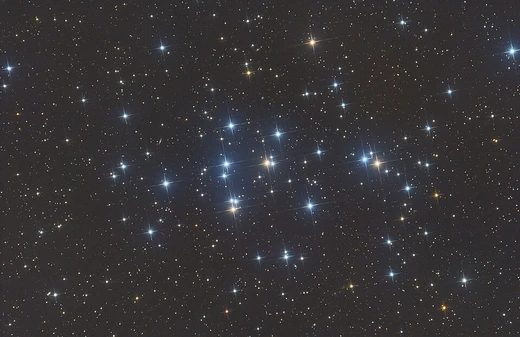
Sagittarius A* cluster
Stars orbiting the Milky Way's central supermassive black hole.

Surrounding Sagittarius A*—the supermassive black hole at the Milky Way’s core—is a dense grouping of stars known as the Sagittarius A* cluster. These stars are frequently referred to as “S-stars,” though their naming conventions remain unofficial, with the same star often appearing under different identifiers across various catalogs. Among the most closely examined is S2, a notably bright star that swings near the black hole during its orbit.
In 2026, astronomers reported S301 as the closest and fastest securely observed star ever detected around Sgr A*. At its closest approach, it comes within roughly 12 AU of the black hole and reaches about 8.5% of the speed of light. The previous record for these extremes had been held by S4714.
The cluster’s stellar orbits have been inferred primarily from Gillessen et al. (2017), with S2’s orbit updated by GRAVITY (2019) and those of S4711 through S4715 added by Peißker et al. (August 2020). Data for S62, initially reported by Peißker et al. (January 2020), later proved to be farther from Sgr A* than thought and is now attributed to a misidentification of S29. For S301, the orbital data come from Abd El Dayem et al. (2026); because its radial velocity remains unmeasured, two possible orbital orientations exist, and the first solution from that study is used here.
In the standard table, id1 refers to the star’s name in the Gillessen catalog, and id2 to its designation in the University of California, Los Angeles catalog. Orbital elements—a, e, i, Ω, and ω—are given in standard form, with a in arcseconds. Tp marks the epoch of pericenter passage, P is the orbital period in years, and Kmag is the star’s apparent magnitude in the K-band. Pericenter distance q is in AU, pericenter speed v is in percent of the speed of light, and Δ denotes the standard deviation of the associated quantities.
A binary star system, D9, was recently discovered within the S cluster.
- Central object
- Sagittarius A* (supermassive black hole)
- Location
- Galactic Center of the Milky Way
- Notable star
- S2
- Closest and fastest secure star as of 20
- S301
- Pericenter distance of s301
- 12 AU
- Pericenter speed of s301
- 8.5% of the speed of light
- Previous record holder
- S4714
Lore & Background
The cluster consists of stars in close orbit around Sagittarius A*. Their names are not formalized, and stars can have different numbers in different catalogues. Inferred orbits of stars are according to Gillessen et al. 2017, with the exception of S2 (from GRAVITY 2019) and S4711 through S4715 (from Peißker et al., Aug 2020). Data for S62, reported in Peißker et al. Jan 2020, was later found to be further than expected from Sagittarius A* and is now thought to be due to a mistaken observation of S29. Data for S301 are from Abd El Dayem et al. (2026); because its radial velocity has not yet been measured, two possible orbital orientations remain, and the first solution reported in the study is used here. Binary star system D9 was recently found in the S Cluster.
Reader's Guide
The Sagittarius A* cluster is significant as the stellar population immediately surrounding the supermassive black hole at the center of the Milky Way. Its stars, known as S-stars, provide a direct laboratory for testing general relativity and stellar dynamics in extreme gravitational fields. The most studied star, S2, is relatively bright and passes close by Sgr A*. In 2026, S301 was reported as the closest and fastest securely observed star, approaching to about 12 AU from the black hole and reaching approximately 8.5% of the speed of light at pericentre, surpassing the previous record holder S4714. The cluster's legacy includes ongoing refinements of orbital data, as seen with the correction of S62's observation to S29, and the recent discovery of the binary star system D9 within the S Cluster.
Did You Know?
- The individual stars in the cluster are often listed as 'S-stars', but their names and IDs are not formalized.
- S2 is one of the most studied stars in the cluster and is relatively bright.
From Radio Whispers to a Galactic Anchor
In the spring of 1933, Karl Jansky detected a faint radio signal emanating from the direction of Sagittarius, pointing toward the heart of our galaxy. Though his measurements fell short of the exact galactic center, the finding planted a seed. Years later, Jack Piddington and Harry Minnett, working with CSIRO telescopes in Sydney, isolated a discrete bright source they identified in a letter to Nature as the probable Galactic Center. The true compact core, however, eluded detection until February 1974, when Bruce Balick and Robert L. Brown, using the National Radio Astronomy Observatory's baseline interferometer, pinpointed an intensely bright, extremely compact radio emitter nested within the broader Sagittarius A source. Brown later christened it Sgr A* in a 1982 paper, choosing the asterisk because the source was "exciting" and excited atomic states carry that same symbol. From Earth, this object sits roughly 5.6 degrees south of the ecliptic, nestled near the border of Sagittarius and Scorpius, in the visual neighborhood of the Butterfly Cluster and Lambda Scorpii.
Capturing the Unseen: The 2022 Image
On May 12, 2022, the Event Horizon Telescope Collaboration unveiled the first-ever image of the region surrounding Sagittarius A*, built from radio interferometer data gathered in 2017. Processing that data consumed roughly five years of computation. The observation drew on eight radio observatories spread across six geographical sites, and the team produced the image through aperture synthesis. A major complication was that the radio emission from Sgr A* fluctuates on timescales of mere minutes, making the analysis far more demanding than for stable sources. What the image actually reveals is not the black hole itself—no light can escape its gravitational grip—but the glowing ring of gas and dust heated to millions of degrees as it spirals inward. The measured angular diameter of 51.8 ± 2.3 microarcseconds, at a distance of about 26,000 light-years, translates to roughly 51.8 million kilometres. This was the second confirmed black hole image, following Messier 87 in 2019, and the measurement tested Einstein's general relativity more rigorously than any prior observation, with results in perfect agreement.
Stellar Orbits and the Weight of Evidence
For decades, the case for a black hole at the galactic center grew through the motions of nearby stars. In 1994, a Berkeley team including Charles H. Townes and Reinhard Genzel used infrared and sub-millimetre spectroscopy to show that Sgr A*'s mass was tightly concentrated, on the order of three million solar masses. The definitive breakthrough came on October 16, 2002, when Genzel's international team at the Max Planck Institute for Extraterrestrial Physics published a ten-year tracking of star S2 as it swung close to the central object. The analysis used near-infrared interferometry at 2.1 micrometres, a wavelength chosen because interstellar extinction is lower there, and SiO masers helped align the infrared frames with radio observations. The rapid orbital motion of S2 and its companions stood out clearly against slower background stars, which could be subtracted. Crucially, the data excluded alternatives such as a cluster of dark stellar objects or a lump of degenerate fermions, leaving a supermassive black hole as the sole viable explanation. The current best mass estimate stands at 4.297 ± 0.012 million solar masses.
Nobel Recognition and the Physics of the Ring
The 2020 Nobel Prize in Physics recognized the decades-long effort to establish Sagittarius A* as a supermassive compact object. Reinhard Genzel and Andrea Ghez each received a quarter-share for demonstrating that a black hole was the only explanation for the observed stellar dynamics, while Sir Roger Penrose claimed the remaining half for proving that black hole formation is a robust prediction of general relativity. Beyond the prize, the physics surrounding Sgr A* continues to yield surprises. In 2019, measurements from the HAWC+ instrument aboard the SOFIA aircraft revealed that magnetic fields force the surrounding ring of gas and dust—spanning temperatures from roughly −280 to 17,500 °F—into a coherent orbit around the black hole, a configuration that helps keep its emissions comparatively subdued. Observing the object in visible light remains impossible from Earth because 25 magnitudes of dust and gas extinction absorb and scatter virtually all optical photons between us and the galactic center. The proper motion of Sgr A* is approximately −2.70 milliarcseconds per year in right ascension and −5.6 milliarcseconds per year in declination.
Frequently Asked Questions
What is the Sagittarius A* cluster?
It is a tight swarm of stars that orbit the supermassive black hole Sagittarius A* at the heart of the Milky Way. Fans and researchers commonly call its members "S-stars," although the naming is still informal and the same star can show up under different identifiers in various catalogs.
What is S2 and why is it so famous?
S2 is one of the brightest and most closely watched stars in the cluster, best known for its dramatic elliptical path that carries it very near the black hole. Each close pass gives astronomers a natural laboratory for stress-testing general relativity in an extreme gravitational field.
What is the closest and fastest star ever confirmed around Sagittarius A*?
As of 2026, that title goes to S301, which dips to a pericenter of just 12 astronomical units from the black hole. At closest approach it is racing at roughly 8.5 percent of the speed of light, making it the fastest securely observed star in the system.
Where exactly is the Sagittarius A* cluster located?
It sits at the very center of the Milky Way, gravitationally bound to the supermassive black hole Sagittarius A*. This makes it the densest known stellar neighborhood in our galaxy.
Why does the Sagittarius A* cluster matter to astronomy?
The extreme gravity around the black hole lets scientists watch stars being accelerated, their light bent, and their orbits warped in ways that probe the limits of current physics. Record-breaking detections like S301 keep sharpening our picture of how matter behaves in the most extreme environments we can observe.
More in Star Clusters 1-24
Spotted an error? Know more?
Reader corrections go straight into our review queue. Suggest an edit · How this site is sourced