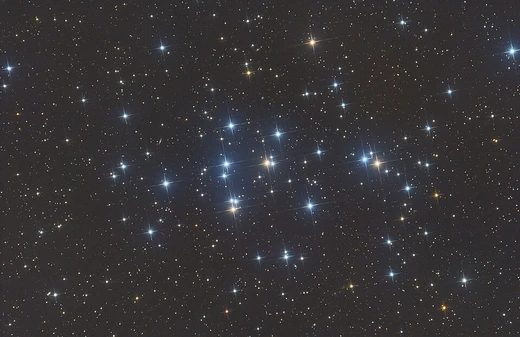
Infrared cluster
Star clusters visible only in infrared due to obscuring gas and dust.

An infrared cluster is a type of star cluster that is only visible in infrared light, because all visible light is obscured by gas and dust, usually in regions of high star formation. These clusters are notable for containing protostars and protoplanetary discs, and for being generally smaller than open clusters due to tidal forces in their dense environments.
- Earliest discovered example
- Quintuplet Cluster (1983)
- Catalogue year
- 2002
- True clusters identified
- 189
- Stellar associations included
- 87
- Examples
- Quintuplet Cluster, Arches Cluster, central star cluster of RCW 38
- Nebulae containing infrared clusters
- Sh 2-4, Sh 2-16, Sh 2-17, Sh 2-20
Lore & Background
Infrared clusters become visible only in infrared light because gas and dust block all visible light, a condition common in areas of high star formation. For instance, the Carina Nebula may contain as many as twelve such clusters, and nine have been identified in the Rosette Nebula. Due to being only visible in infrared, spectroscopy is nearly impossible, making measurements of movement and identification of features within these clusters difficult or impossible.
Infrared clusters are generally smaller than open clusters. This is explained by the strong tidal forces in the dense regions where infrared clusters are located, which can rip clusters apart before they become as massive as older examples in less dense regions. These clusters can contain protostars and protoplanetary discs.
Observation of infrared clusters was impossible until infrared astronomy advanced enough in the 1990s. One of the earliest discovered was the Quintuplet Cluster in 1983. In 2002, a catalogue of infrared clusters was assembled, identifying 189 true clusters and including 87 further stellar associations.
Reader's Guide
Infrared clusters represent a class of star clusters that are only detectable through infrared observations, as visible light is completely obscured by gas and dust in their high star-formation environments. Their significance lies in revealing stellar populations that would otherwise remain hidden, particularly in regions like the Carina Nebula, where up to twelve may exist, and the Rosette Nebula, where nine have been identified. The difficulty of spectroscopy and measurement of movement limits detailed study, but their smaller size compared to open clusters is attributed to tidal forces in dense regions. The 2002 catalogue, which identified 189 true clusters and 87 stellar associations, marks a key step in systematically documenting these objects. Infrared clusters also contain protostars and protoplanetary discs, offering insights into early stellar and planetary formation. Their legacy is tied to the advancement of infrared astronomy in the 1990s, which made their observation possible, and the early discovery of the Quintuplet Cluster in 1983.
Did You Know?
- Infrared clusters are only visible in infrared light because gas and dust obscure all visible light.
- The Quintuplet Cluster was one of the earliest discovered infrared clusters, in 1983.
- A 2002 catalogue identified 189 true infrared clusters and 87 stellar associations.
Defining the Infrared Cluster
A star cluster is a family of stars sharing a common origin, having formed around the same epoch and remaining bound to one another through mutual gravitational pull. Astronomers broadly divide these groupings into two structural categories: globular clusters, which pack ten thousand to several million ancient stars into a dense, tightly bound sphere, and open clusters, which are looser assemblies typically numbering in the hundreds. The infrared cluster, however, is not defined by its internal architecture or stellar population but by a condition of visibility. When interstellar material between the observer and the cluster produces enough extinction to render the stars invisible at optical wavelengths, yet the same group remains detectable through infrared radiation, it earns the designation of an infrared cluster. In practical terms, the classification is less about what the cluster is and more about what hides it—a veil of dust and gas that blocks shorter wavelengths while permitting longer infrared light to penetrate. The result is a category that overlaps heavily with embedded clusters and other dust-shrouded stellar nurseries, making infrared observation an essential tool for revealing stellar populations that would otherwise remain completely concealed from optical surveys.
The Dust Veil and the Limits of Optical Astronomy
The defining obstacle that creates an infrared cluster is extinction—the absorption and scattering of visible light by interstellar dust and gas. Embedded clusters, which are groups of very young stars partially or fully encased in such material, exemplify this problem perfectly. The surrounding cloud is often impervious to optical observations, rendering the stars within effectively invisible to conventional telescopes. These clusters form when molecular clouds begin to collapse under their own gravity, triggering the birth of new stars. During this embedded phase, which can persist for several million years, ongoing star formation continues, and the environment may host protostars and pre-main-sequence objects still in the process of maturing. Eventually, the gas reservoir is exhausted either through continued star formation or through dispersal driven by radiation pressure, stellar winds, outflows, or the shock waves of supernova explosions. Once the veil lifts, the cluster may transition into a visible open cluster or, if it cannot survive the loss of surrounding mass, it may disperse entirely. Infrared wavelengths, being less affected by dust extinction, offer the only reliable window into these otherwise hidden stellar populations during their formative years.
Windows into Stellar Nurseries
Because infrared light penetrates the dust that blocks visible wavelengths, infrared clusters serve as a unique observational window into the earliest stages of stellar life. Embedded clusters, the most natural candidates for this classification, are sites where star formation is actively underway. Their interiors may contain protostars still gathering mass, pre-main-sequence stars in the process of igniting fusion, and dense cores of molecular clouds where the next generation of stars is about to condense. Notably, the Trapezium Cluster within the Orion Nebula and the core region of the ρ Ophiuchi cloud (L1688) are recognized examples of embedded clusters where ongoing formation is evident. The efficiency of this process is modest: in general, less than thirty percent of a molecular cloud's total mass is converted into stars before the remaining gas is dispersed. This means that for every star visible in a young cluster, a substantial reservoir of raw material has been lost to the interstellar medium. The infrared window is therefore not merely a technical convenience but a fundamental requirement for studying stellar birth environments, since nearly all freely floating stars in the Galaxy, including our own Sun, were originally born into embedded clusters that later disintegrated.
From Hidden Nurseries to Open Skies
The lifecycle of a star cluster reveals why infrared observation is so critical to our understanding of stellar populations. Open clusters, confined to the galactic plane and typically found within spiral arms, are generally young objects—up to a few tens of millions of years old—with rare exceptions like Messier 67 reaching several billion years. They form in H II regions such as the Orion Nebula and typically span areas up to thirty light-years across, containing a few hundred members. Because they are far less densely populated and less tightly gravitationally bound than globular clusters, they are vulnerable to disruption by the gravitational pull of giant molecular clouds and other clusters. Close encounters between members can also eject stars in a process called evaporation. Over time, even clusters that are no longer gravitationally bound continue drifting in broadly the same direction, becoming what astronomers call stellar associations or moving groups. The open clusters we observe today are, in fact, former embedded clusters that survived their early evolution. Most young embedded clusters, however, disperse shortly after star formation ceases, meaning the infrared phase represents a brief but crucial chapter in the life of nearly every stellar group in the Galaxy.
Frequently Asked Questions
What is an infrared cluster?
It is a grouping of stars detectable only through infrared wavelengths because thick veils of gas and dust completely block their visible light. These groupings typically reside in regions where new stars are actively being born.
What was the first infrared cluster ever identified?
The Quintuplet Cluster holds that distinction, having been spotted back in 1983. It continues to serve as one of the most studied examples of this type of stellar grouping.
Why are infrared clusters generally smaller than typical open clusters?
They form in extremely dense surroundings where gravitational tidal forces from nearby massive objects restrict how far the cluster can expand. This keeps their overall size more compact than a standard open cluster.
What interesting objects can be found inside infrared clusters?
Because they are still very young and shrouded in dust, they often harbor protostars in the earliest stages of formation along with protoplanetary discs orbiting around them. This makes them prime targets for studying how stars and planetary systems come together.
Which nebulae are known to host infrared clusters?
Several H II regions contain them, including Sh 2-4, Sh 2-16, Sh 2-17, and Sh 2-20. These dusty nebulae provide the thick veils that hide the clusters from optical telescopes.
More in Star Clusters 1-24
Spotted an error? Know more?
Reader corrections go straight into our review queue. Suggest an edit · How this site is sourced