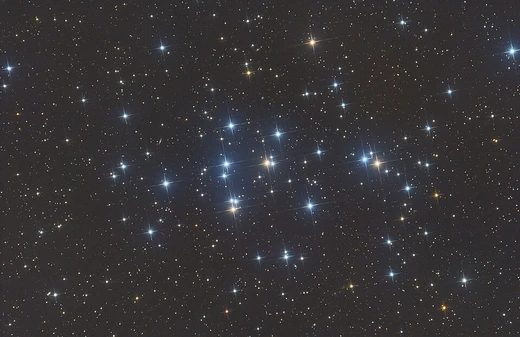
Star cluster
Groups of stars bound by gravity, formed at similar times.

A star cluster is a collection of stars that formed together at about the same time and are bound to each other by their combined gravity. There are two main types. Globular clusters are dense, spherical groupings of tens of thousands to millions of old stars. Open clusters are looser and smaller, usually with fewer than a few hundred members. If a cluster is hidden by dust in visible light but can be seen in infrared, it is called an infrared cluster. Open clusters lie in the flat plane of a galaxy, mostly within its spiral arms. They are typically young, from a few million to a few tens of millions of years old, though a few, like Messier 67, can be billions of years old. They form inside H II regions, such as the Orion Nebula. These clusters usually have a few hundred stars spread across an area up to 30 light-years wide. Because they are not tightly bound, they are easily broken apart by the gravity of giant molecular clouds or by close encounters that eject stars—a process called evaporation. Well-known open clusters include the Pleiades and Hyades in Taurus, and the Double Cluster in Perseus. They often contain hot, young blue stars, which die within tens of millions of years, but the clusters themselves usually break up before those stars fade. Some open clusters form binary or aggregate clusters; for example, Messier 25 may be part of a triple cluster with NGC 6716 and Collinder 394. Precise distances to open clusters help calibrate the period-luminosity relationship of Cepheid variable stars, which are used as standard candles to measure distances to remote galaxies and the expansion rate of the universe. The open cluster NGC 7790 contains three classical Cepheids important for this work. Embedded clusters are very young groups of stars still partly or fully wrapped in the gas and dust of their birth molecular clouds. They often contain protostars and pre-main-sequence stars, and star formation may still be happening. The Trapezium Cluster in the Orion Nebula and the cluster in the ρ Ophiuchi cloud are examples. This embedded phase lasts a few million years. Eventually, the gas is used up by star formation or blown away by radiation, stellar winds, or supernovae. Typically, less than 30% of the cloud’s mass turns into stars. Once the gas is lost, the cluster’s energy balance changes, often causing it to fall apart.
- Open cluster members
- fewer than a few hundred
- Globular cluster members
- 10 thousand to several million
- Globular cluster size
- 10 to 30 light-years across
- Milky way globular clusters
- about 150
- Age of universe
- about 13 billion years
- Age of oldest stars
- a few hundred million years less than the universe
Lore & Background
Open clusters are confined to the galactic plane and almost always found within spiral arms. They are generally young objects, up to a few tens of millions of years old, with rare exceptions as old as a few billion years. They form in H II regions such as the Orion Nebula. Over time, open clusters become disrupted by the gravitational influence of giant molecular clouds, and close encounters between members can result in the ejection of stars, a process known as "evaporation". The most prominent open clusters are the Pleiades and Hyades in Taurus. Globular clusters are roughly spherical groupings of very old Population II stars, mostly yellow and red with masses less than two solar masses.
Reader's Guide
Star clusters are important in many areas of astronomy because almost all stars in old clusters were born at roughly the same time. Various properties of all the stars in a cluster are a function only of mass, and so stellar evolution theories rely on observations of open and globular clusters. This is primarily true for old globular clusters. For young and intermediate-age clusters, factors such as age, mass, and chemical compositions may also play vital roles. Establishing precise distances to open clusters enables the calibration of the period-luminosity relationship shown by Cepheid variable stars, which are then used as standard candles. Cepheids are luminous and can be used to establish both the distances to remote galaxies and the expansion rate of the Universe (Hubble constant). The open cluster NGC 7790 hosts three classical Cepheids critical for such efforts. Until the mid-1990s, globular clusters caused a great mystery because theories gave ages for their oldest members greater than the estimated age of the universe. Improved distance measurements using the Hipparcos satellite and more accurate measurements of the Hubble constant resolved the paradox, giving an age for the universe of about 13 billion years and an age for the oldest stars a few hundred million years less.
Did You Know?
- Open clusters become disrupted by giant molecular clouds and are often young; their stars may continue moving together as stellar associations.
- The globular cluster M79 may have been the captured core of a small galaxy stripped of its outer stars by the Milky Way's tides.
- The open cluster NGC 7790 hosts three classical Cepheids used to calibrate the distance scale and Hubble constant.
- Embedded clusters form in molecular clouds, and nearly all freely floating stars, including the Sun, were originally born in such clusters that later disintegrated.
Two Families of Stellar Groupings
Star clusters represent stars born together from a common origin, held in proximity by their mutual gravitational pull. Astronomers divide them into two principal categories based on density, age, and composition. Globular clusters are compact, nearly spherical assemblies packing anywhere from ten thousand to several million stars into a region spanning roughly ten to thirty light-years. Their members are predominantly ancient Population II stars—yellow and red, with masses below two solar masses—because the hotter, more massive stars long ago exploded or shed their outer layers. Open clusters, by contrast, are looser gatherings of typically a few hundred stars spread across areas up to thirty light-years wide. They are confined to the galactic plane and spiral arms, and are generally young, rarely exceeding a few tens of millions of years, though rare exceptions like Messier 67 reach a few billion. A special classification, the infrared cluster, applies when a group is hidden by dust in visible wavelengths yet detectable through infrared radiation.
From Cradle to Dissolution
The earliest phase of a star cluster is the embedded stage, in which newborn stars are shrouded within collapsing molecular clouds of gas and dust. During this period, which can last several million years, ongoing star formation produces protostars and pre-main-sequence objects. The Trapezium Cluster in the Orion Nebula and the core region of the ρ Ophiuchi cloud (L1688) serve as well-known examples. Eventually, radiation pressure, stellar winds, outflows, or supernova explosions disperse the surrounding gas. Less than thirty percent of the cloud's mass typically becomes stars, and the loss of that mass alters the system's energy balance, often triggering the cluster's breakup. Open clusters that survive this early phase are the ones we observe today. Over longer timescales, gravitational encounters with giant molecular clouds and close stellar interactions—called evaporation—gradually strip members away. What remains is a stellar association or moving group: stars no longer gravitationally bound but still traveling in a broadly shared direction. Nearly all free-floating stars, including our own Sun, were once members of such transient groupings.
Ancient Spheres and the Age Paradox
Globular clusters orbit the Milky Way's center in highly elliptical paths, distributed roughly spherically throughout the galactic halo. Their stellar populations are among the oldest in existence, only a few hundred million years younger than the universe itself. Yet within their dense cores, a small number of anomalously blue stars—blue stragglers—appear, believed to be the product of stellar mergers in the crowded inner regions. For decades, these clusters posed a genuine crisis in cosmology: stellar evolution models suggested their oldest members were older than the universe, a contradiction that persisted until the mid-1990s. The Hipparcos satellite's precise distance measurements, combined with refined determinations of the Hubble constant, resolved the tension, yielding a cosmic age of roughly thirteen billion years. In 1917, Harlow Shapley leveraged the spatial distribution of globular clusters to produce the first credible estimate of the Sun's distance from the Galactic Center. The Milky Way hosts about 150 such clusters, some of which may be the stripped cores of smaller galaxies, as appears to be the case with M79.
Measuring the Cosmos and Seeing with the Eye
Beyond their intrinsic beauty, star clusters serve as indispensable tools in astrophysics. Because open clusters contain stars of the same age and distance, they provide natural laboratories for calibrating the period-luminosity relationship of Cepheid variable stars. Once calibrated, Cepheids function as standard candles capable of gauging distances to remote galaxies and constraining the Hubble constant—the expansion rate of the universe. The open cluster NGC 7790, for instance, hosts three classical Cepheids that are critical to these distance-ladder efforts. On a more personal scale, several clusters are visible without any optical aid. The Pleiades and Hyades in Taurus stand out as the most prominent open clusters, while the globular cluster 47 Tucanae is bright enough to be seen with the naked eye. Under dark skies, the Double Cluster of h and Chi Persei also reveals itself. These visible groups have captivated observers for millennia, yet their true significance lies in anchoring the cosmic distance scale that underpins modern cosmology.
Frequently Asked Questions
What is a star cluster?
A star cluster is a group of stars that all came into existence around the same era and remain gravitationally linked to one another. Their mutual pull keeps the members from simply drifting apart into the wider galaxy.
What are the two main types of star clusters?
Globular clusters are tight, spherical collections containing anywhere from ten thousand to several million older stars, while open clusters are much looser assemblies with typically fewer than a few hundred members.
How large are globular clusters?
A typical globular cluster spans roughly 10 to 30 light-years in diameter, making it a compact but enormous stellar grouping.
Where do open clusters sit within a galaxy?
Open clusters are found in the thin disk of a galaxy, concentrated along its spiral arms. They tend to be young, usually only a few million to a few tens of millions of years old.
How many globular clusters does the Milky Way host?
The Milky Way is home to approximately 150 globular clusters orbiting its core. Their oldest stars are a few hundred million years younger than the universe itself, which is about 13 billion years old.
More in Star Clusters 1-24
Spotted an error? Know more?
Reader corrections go straight into our review queue. Suggest an edit · How this site is sourced