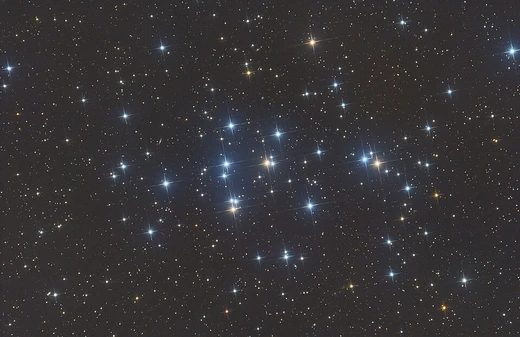
Open cluster family
Groups of coeval young open clusters in the Galactic disk.

An open cluster family is a group of approximately coeval young open star clusters located in a relatively small region of the Galactic disk. These families are identified when age, spatial distribution, and kinematics are considered together, and they are associated with the Galactic spiral structure. They are short-lived, dispersing on a relatively short timescale, and are considered progenitors of classical superclusters, moving groups, and stellar streams.
- Age range
- ~30 Myr
- Radius of region
- ~250 pc
- Number of families confirmed
- at least five
- Named families
- Orion, Scutum-Sagittarius, Cygnus, Scorpius, Cassiopeia-Perseus
- Distance of cassiopeia-perseus family
- 2 kpc from the Sun
- Diameter of cassiopeia-perseus family
- about 600 pc
- Member count of cassiopeia-perseus famil
- 10 to 20
- Formation age of cassiopeia-perseus fami
- 20 to 40 Myr ago
Lore & Background
Open clusters do not form in isolation but in complexes within star-forming regions. Piskunov et al. (2006) found evidence for four open cluster complexes of different ages containing up to a few tens of clusters. The existence of at least five dynamical families of young open clusters in the Milky Way disk was confirmed using statistical analysis by de la Fuente Marcos and de la Fuente Marcos (2008). These families are, in order of increasing distance: Orion, Scutum-Sagittarius, Cygnus, Scorpius, and Cassiopeia-Perseus.
The Cassiopeia-Perseus open cluster family is located 2 kpc from the Sun between the constellations of Cassiopeia and Perseus, embedded in the Perseus spiral arm. The structure roughly defines a plane inclined almost 30° with respect to the plane of the Milky Way. It has a diameter of about 600 pc and includes 10 to 20 members. Most candidate members are located below the galactic disk and moving away from it. It started to form about 20 to 40 Myr ago.
Reader's Guide
The concept of open cluster families is significant because it provides a framework for understanding how young open clusters are organized in the Galactic disk. By simultaneously considering age, spatial distribution, and kinematics, researchers have identified at least five such families, which are associated with the spiral structure of the Milky Way. These families are short-lived, dispersing on a relatively short timescale, and are considered progenitors of classical superclusters, moving groups, and stellar streams. The Cassiopeia-Perseus family, for example, is located 2 kpc from the Sun, has a diameter of about 600 pc, and contains 10 to 20 members, most of which are below the galactic disk and moving away from it. Its formation began 20 to 40 Myr ago. The existence of these families, confirmed through statistical analysis, helps trace the dynamical evolution of young clusters and their eventual dispersal into larger stellar structures.
Did You Know?
- Open cluster families are groups of approximately coeval young open clusters within a region of radius ~250 pc.
- At least five dynamical families of young open clusters have been confirmed in the Milky Way disk.
- The Cassiopeia-Perseus family is located 2 kpc from the Sun and has a diameter of about 600 pc.
- Most candidate members of the Cassiopeia-Perseus family are below the galactic disk and moving away from it.
Formation, Structure, and Cosmic Lifespan
Open clusters are loose assemblies of tens to a few thousand stars, all born from the same giant molecular cloud and sharing roughly the same age. They are held together only by their mutual gravitational pull, which is relatively weak compared to the far more massive globular clusters. As they orbit the Galactic Center, close encounters with other clusters and gas clouds gradually strip away members, eventually dispersing the group into the broader galactic population. Most open clusters endure for a few hundred million years, though the most massive ones can persist for several billion. During their youth, these clusters often remain embedded within their parent molecular cloud, their bright radiation illuminating the surrounding gas to produce H II regions. Over time, radiation pressure from the cluster's stars blows the remaining gas outward. Typically, only about 10% of the original cloud mass actually coalesces into stars before the rest is driven away. Open clusters have been identified exclusively in spiral and irregular galaxies—environments where active star formation is still taking place.
From Ancient Sightings to Telescopic Revelation
The Pleiades in Taurus have been recognized as a star group since antiquity, and the Hyades represent one of the oldest known open clusters. In his Almagest, Ptolemy listed the Praesepe, the Double Cluster in Perseus, the Coma Star Cluster, and the Ptolemy Cluster, while the Persian astronomer Al-Sufi described the Omicron Velorum cluster. Yet all of these remained unresolved fuzzy patches until the telescope arrived. In 1603, Johann Bayer even assigned three of them designations as though they were single stars. Galileo Galilei changed everything in 1609 when he pointed his telescope at these nebulous patches and revealed them as groupings of many stars—finding over 40 in Praesepe and nearly 50 in the Pleiades, where earlier observers had counted only six or seven. In his 1610 treatise Sidereus Nuncius, he declared that the Milky Way was nothing more than an immense collection of stars gathered together in clusters. Inspired by this breakthrough, Sicilian astronomer Giovanni Hodierna became the first to use a telescope to discover previously unknown open clusters, identifying what are now designated M41, M47, NGC 2362, and NGC 2451 in 1654.
A Cornerstone of Stellar Evolution Research
Open clusters occupy a uniquely important place in the study of stellar evolution. Because every member star formed from the same molecular cloud, they share a common age and chemical composition. This uniformity makes it far easier to determine properties such as distance, age, metallicity, extinction, and velocity than it is for an isolated star scattered across the galaxy. Researchers can isolate the effects of stellar mass and internal physics without the confounding variables that complicate the study of individual stars. The cluster's collective gravitational binding also allows astronomers to measure shared proper motions and radial velocities, confirming which stars truly belong to the group. This was demonstrated when Adriaan van Maanen compared photographic plates of the Pleiades taken in 1918 with images from 1943, identifying members by their common motion through space. Spectroscopic measurements further confirmed shared radial velocities, proving these stars are gravitationally bound as a group. The result is a natural laboratory where the full range of stellar lifecycles can be observed simultaneously, from the most massive, short-lived stars down to the faintest, longest-lived ones.
Classification, Distribution, and the Broader Galactic Context
More than 1,100 open clusters have been catalogued within the Milky Way, and many more are believed to exist. They are found exclusively in spiral and irregular galaxies—environments where active star formation is ongoing—which sets them apart from the more massive globular clusters that exert stronger gravitational attraction on their members and survive for far longer periods. Because open clusters tend to reside in or near the galactic plane, they were sometimes called galactic clusters, a term introduced in 1925 by Swiss-American astronomer Robert Julius Trumpler. The distinction between the two cluster types became clear through telescopic observations: globular clusters contain thousands of stars in a regular spherical distribution concentrated toward the Milky Way's center, while open clusters are sparser, more irregularly shaped, and aligned with the disk. In 1767, Reverend John Michell calculated that the probability of a grouping like the Pleiades arising by chance alignment was just one in 496,000, establishing for the first time that cluster stars were physically related rather than a random line-of-sight coincidence. This insight laid the groundwork for all subsequent cluster research.
Frequently Asked Questions
What is an open cluster family?
An open cluster family is a collection of young, roughly same-age open star clusters found grouped together in a compact region of the Milky Way's disk. Astronomers identify them by combining evidence of shared age, spatial proximity, and similar motion through space.
How old are open cluster families typically?
These families are very young, generally around 30 million years old. Their short lifespans mean they are transient structures that eventually break apart and disperse across the galaxy.
Which open cluster families have been confirmed?
At least five families have been identified: Orion, Scutum-Sagittarius, Cygnus, Scorpius, and Cassiopeia-Perseus. The Cassiopeia-Perseus family, for example, lies about 2 kiloparsecs from the Sun and spans roughly 600 parsecs in diameter.
How do open cluster families relate to the Milky Way's spiral arms?
Their spatial distribution and kinematic signatures tie them directly to the larger spiral structure of the Galactic disk. Member clusters tend to occupy a region only about 250 parsecs across, reflecting the local spiral-arm environment in which they formed.
What happens to an open cluster family as it ages?
Over time the family disperses and its member clusters drift apart. In doing so, these groups are considered the progenitors of classical superclusters, moving groups, and eventually long stellar streams.
More in Star Clusters 1-24
Spotted an error? Know more?
Reader corrections go straight into our review queue. Suggest an edit · How this site is sourced