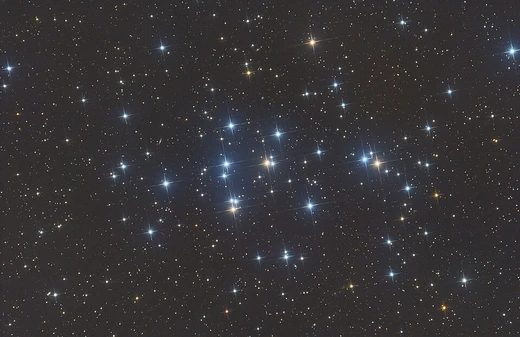
Blue straggler
Blue stragglers are luminous, hot stars defying standard stellar evolution.

A blue straggler is a star that shines brighter and appears bluer than what is typical for the stars around it. These stars are most often spotted in stellar clusters, where they have a hotter surface temperature than the cluster's main sequence turnoff point—the stage at which normal stars start moving toward the red giant branch. This goes against the usual rules of stellar evolution, which say that a star's place on the Hertzsprung–Russell diagram should depend almost entirely on its starting mass and age.
In a cluster, all the stars formed at roughly the same time, so on an H–R diagram they should line up along a single curve based on the cluster's age, with each star's position set by its initial mass. Blue stragglers, however, have masses two to three times greater than the other main-sequence stars in the cluster, making them exceptions. The likely explanation involves interactions between two or more stars in the dense environments where blue stragglers are found. They also exist among field stars, but detecting them there is harder because they can be confused with genuinely massive main-sequence stars. In the Galactic halo, though, field blue stragglers can be identified because all surviving main-sequence stars there are low mass.
Several ideas have been proposed for how blue stragglers form. One simple idea is that they formed later than the rest of the cluster's stars, but there is little evidence for this. Another is that they are not true cluster members but field stars that were captured or just happen to lie in the same line of sight. This seems unlikely because blue stragglers often sit right at the centers of their clusters. The most plausible explanation is that they result from stars that get too close to another star or similar-mass object and collide. The merged star ends up with a higher mass, placing it on the H–R diagram where young stars would normally be found.
The two leading explanations both involve interactions between cluster members. One is that blue stragglers are current or former binary stars that have merged or are in the process of merging. Merging two stars creates a single, more massive star, potentially heavier than the stars at the main-sequence turnoff point. A star born that massive would quickly leave the main sequence, but a merged star delays that evolution.
- Discoverer
- Allan Sandage
- Discovery year
- 1953
- Discovery location
- globular cluster M3
- Example rotation rate
- 75 times faster than the Sun (in 47 Tucanae)
Lore & Background
Blue stragglers were first discovered by Allan Sandage in 1953 while performing photometry of stars in the globular cluster M3. In a cluster where all stars formed at approximately the same time, blue stragglers have masses two to three times that of the rest of the main-sequence cluster stars, making them exceptions to the rule that stellar position on the H–R diagram is determined solely by initial mass. The resolution of this problem is likely related to interactions between two or more stars in the dense confines of clusters.
Several explanations have been put forth, but the most likely involve interactions between cluster members. One explanation is that blue stragglers are current or former binary stars that are in the process of merging or have already done so, creating a single more massive star. Another relies on mass transfer between two stars in a binary system, where the more massive star overflows its Roche lobe and transfers mass to its companion. Evidence for both mechanisms exists, with collisional blue stragglers often occupying cluster cores and mass transfer blue stragglers at the outskirts.
Blue stragglers are also found among field stars, though their detection is more difficult due to the mix of stellar ages and metallicities. Field blue stragglers can be identified in old stellar populations like the Galactic halo. Additionally, 'yellow stragglers' or 'red stragglers' are stars with colors between the turnoff and the red-giant branch but brighter than the subgiant branch, possibly representing former blue stragglers evolving toward the giant branch.
Reader's Guide
Blue stragglers are significant because they challenge standard stellar evolution models, which predict that all stars in a cluster of the same age should lie along a clearly defined curve on the H–R diagram. Their existence points to the importance of stellar interactions—collisions and binary mass transfer—in dense cluster environments. The two most viable explanations both involve interactions between cluster members: mergers of binary stars or mass transfer in binary systems. Evidence supports both mechanisms, with collisional blue stragglers found in cluster cores and mass transfer blue stragglers at the outskirts. Observations of variable blue stragglers and their asteroseismological properties may help distinguish between these formation channels, though such measurements are difficult due to scarcity and crowded fields. The discovery of low-mass white dwarf companions around two blue stragglers in the Kepler field suggests stable mass transfer as a formation route. Blue stragglers also appear among field stars, especially in metal-poor populations, but their identification is more challenging. Overall, blue stragglers provide a window into stellar dynamics and binary evolution, and their study continues to refine our understanding of how stars interact and evolve in clusters and the field.
Did You Know?
- One blue straggler in 47 Tucanae rotates 75 times faster than the Sun, consistent with formation by collision.
- Blue stragglers can be formed either by stellar collisions or by mass transfer in binary star systems.
- Low-mass white dwarf companions have been found around two blue stragglers in the Kepler field, suggesting stable mass transfer.
Discovery and the Defining Anomaly
In 1953, astronomer Allan Sandage was conducting photometric observations of stars within the globular cluster M3 when he noticed something that defied the prevailing model of stellar evolution. Among the population of stars that should have been following a predictable evolutionary track, certain individuals appeared noticeably brighter and bluer than their neighbors warranted. These outliers—stars whose effective temperatures exceeded the main-sequence turnoff point where ordinary cluster members begin their drift toward the red giant branch—would come to be known as blue stragglers. Their apparent masses, estimated at two to three times those of the surrounding main-sequence population, made them stand out as clear violations of the simple rule that a star's position on the Hertzsprung–Russell diagram is set almost entirely by its birth mass and age. Because cluster members all ignited at roughly the same epoch, the cluster's H–R diagram should trace a single, well-defined curve. Blue stragglers, perched above and to the left of that curve, forced astronomers to reconsider what processes might be reshaping a star's life story after formation.
The Evolutionary Paradox and Its Resolution
Under standard stellar evolution theory, a star's location on the Hertzsprung–Russell diagram is governed almost exclusively by two parameters: the mass it possessed at birth and the time elapsed since ignition. In a coeval cluster, where every member formed within a narrow window, this principle predicts a tidy single sequence on the diagram, with each star's position along that sequence fixed by its initial mass alone. Blue stragglers shatter that expectation. Sitting at temperatures well above the turnoff point and carrying estimated masses two to three times greater than their cluster neighbors, they appear to be stars that should not yet exist in their current form. The most widely accepted resolution points to the dense gravitational environment of globular and open clusters, where close encounters between stars and other compact objects become frequent enough to alter individual stellar fates. Blue stragglers are not confined to clusters, however; they also appear among field stars, though disentangling them from genuinely massive young stars is far more challenging. In the Galactic halo, where every surviving main-sequence member is inherently low-mass, even a modestly bright and blue star stands out as a straggler.
Two Paths to a New Mass
The leading explanations for blue straggler formation both hinge on interactions between two stars. The first scenario involves a collision or merger: when two stars in a dense cluster core pass close enough to coalesce, the resulting object inherits a combined mass placing it well above the cluster's turnoff point. Because the merged star's internal clock resets, it lingers on the main sequence long after its original-mass peers have swollen into red giants. Support includes the concentration of blue stragglers in cluster cores, where stellar densities make close encounters probable, and the detection of rapid rotation—one star in 47 Tucanae spins seventy-five times faster than the Sun. The second scenario involves stable mass transfer within a binary: the initially more massive companion evolves first, swells past its Roche lobe, and pours material onto its lighter partner, fattening it into a blue straggler. Chemical fingerprints such as depleted carbon and oxygen in the photosphere hint at material dredged up from a companion's interior. In M3, 47 Tucanae, and NGC 6752, both mechanisms appear active, with collisional products in cores and mass-transfer products at the outskirts. Low-mass white dwarf companions around two Kepler-field blue stragglers provide evidence for the stable-transfer pathway.
Beyond the Cluster: Field Stragglers and Their Successors
Blue stragglers are not exclusive to the crowded cores of globular clusters. Among field stars, close binary interactions can produce the same mass-enhancement effect, and because the fraction of close binaries rises as metallicity falls, metal-poor stellar populations become increasingly fertile ground for straggler formation. Identifying these field blue stragglers is considerably harder than in clusters, since the field contains a jumble of stellar ages and metallicities that can mimic the appearance of a young, massive star. However, in old populations such as the Galactic halo or dwarf galaxies, where every surviving main-sequence member is inherently low-mass, even a modestly bright and blue star immediately flags itself as anomalous. The evolutionary story does not end at the blue straggler stage. So-called yellow or red stragglers—stars whose colors fall between the main-sequence turnoff and the red-giant branch, yet whose luminosities exceed the subgiant branch—have been catalogued in both open and globular clusters. These objects may represent former blue stragglers that have exhausted their renewed main-sequence fuel and are now transitioning toward the giant branch, completing a second act in their stellar lives.
Frequently Asked Questions
What is a blue straggler?
A blue straggler is a star within a cluster that appears hotter, bluer, and brighter than its neighbors, even though all the stars in that cluster formed at roughly the same time. It sits above the main-sequence turnoff point on the Hertzsprung–Russell diagram, a region where normal stars of that age should already be drifting toward the red-giant branch.
Who first identified blue stragglers?
Allan Sandage first described these anomalous stars in 1953 while studying the globular cluster M3. His observations revealed that certain members of the cluster were far too hot and luminous for their expected evolutionary stage.
Why do blue stragglers break the rules of stellar evolution?
Standard models predict that a star's position on the H–R diagram is set almost entirely by its initial mass and age, so in a same-age cluster every star should follow the same evolutionary track. Blue stragglers violate this by appearing as if they are younger and more massive than their siblings, despite having formed alongside them.
How fast can a blue straggler spin?
Some blue stragglers rotate at extraordinary speeds; one in the globular cluster 47 Tucanae spins roughly 75 times faster than the Sun. This extreme rotation is thought to be a byproduct of the mass-transfer or merger events that created the star.
Where should I look to find blue stragglers?
They are most commonly observed in dense stellar environments such as globular clusters and open clusters, where the contrast between a blue straggler and its cooler, dimmer neighbors stands out clearly. The globular cluster M3, where Sandage first noticed them, remains a classic example.
More in Star Clusters 1-24
Spotted an error? Know more?
Reader corrections go straight into our review queue. Suggest an edit · How this site is sourced