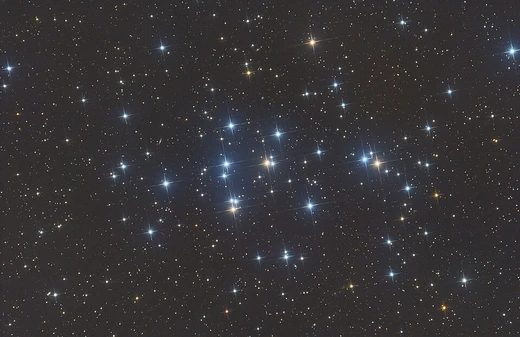
Globular cluster
Globular clusters are dense, ancient star groups found in galaxy halos.

A globular cluster is a roughly spherical group of stars held together by gravity, with stars packed more tightly near its center. It may contain anywhere from tens of thousands to millions of stars, all moving in a stable, compact orbit. This is different from open clusters, whose stars are loosely bound and easily scattered. Globular clusters look similar to dwarf spheroidal galaxies, and though they were long considered brighter than those galaxies, discoveries by the early 2000s made the line between them less clear. The name comes from the Latin word *globulus*, meaning "small sphere," and they are sometimes just called "globulars."
One globular cluster, Omega Centauri, was seen in ancient times and thought to be a star, but telescopes in the 1600s revealed their true nature. Early telescopic views showed them as fuzzy blobs, which led Charles Messier to list many in his catalog of objects that could be mistaken for comets. With larger telescopes, 18th-century astronomers saw that globular clusters are made of many individual stars. In the early 1900s, the way globular clusters are spread across the sky provided some of the first clues that the Sun is not near the center of the Milky Way.
Globular clusters exist in nearly every galaxy. In spiral galaxies such as the Milky Way, they are mostly found in the outer spherical region called the galactic halo. They are the biggest and most massive kind of star cluster, generally older, denser, and with fewer heavy elements than open clusters, which are usually in the disks of spiral galaxies. The Milky Way has more than 150 known globulars, and there may be more.
The origin of globular clusters and their role in galaxy evolution are not well understood. Some are among the oldest objects in their galaxies and even in the universe, helping to set limits on the universe's age. It was once thought that all stars in a globular cluster formed at the same time from a single nebula, but nearly all globular clusters contain stars that formed at different times or have different compositions. Some clusters may have had multiple rounds of star formation, and some may be leftovers of smaller galaxies that were captured by larger ones.
The first known globular cluster, now called M 22, was found in 1665 by German amateur astronomer Abraham Ihle.
- First discovered cluster
- M 22, discovered in 1665 by Abraham Ihle
- Known in milky way as of 2011
- 160
- Shapley sawyer concentration classes
- Class I (most concentrated) to Class XII (most diffuse)
- Typical distance overestimated by shaple
- 10–30 kiloparsecs (33,000–98,000 ly)
- Modern distance to galactic center
- roughly 8.5 kiloparsecs (28,000 ly)
- Largest known system
- M 87, with as many as 13,000 globular clusters
Lore & Background
The first known globular cluster, M 22, was discovered in 1665 by German amateur astronomer Abraham Ihle. Omega Centauri, visible to the naked eye, was known to ancient astronomers like Ptolemy as a star, reclassified as a nebula by Edmond Halley in 1677, and finally recognized as a globular cluster in the early 19th century by John Herschel. Early telescopic observations showed them as fuzzy blobs, leading Charles Messier to include many in his catalog of objects that could be mistaken for comets. William Herschel coined the term 'globular cluster' in 1789 after discovering 36 new ones and resolving virtually all into stars.
In 1914, Harlow Shapley began studies of globular clusters, using RR Lyrae variables to estimate distances, though he overestimated because those variables are fainter than Cepheid variables. In 1918, Shapley used the asymmetrical distribution of globular clusters to determine the Sun's position relative to the Galactic Center, correctly concluding the center is in Sagittarius. The count of known Milky Way globular clusters grew from 34 in 1782 to 160 by 2011, with two discovered that year by the VISTA infrared survey (VVV CL001 and VVV CL002). The Andromeda Galaxy may have as many as five hundred globulars, and giant elliptical galaxies like M 87 can have up to 13,000.
Globular clusters are classified by the Shapley–Sawyer Concentration Class, ranging from Class I (most concentrated) to Class XII (most diffuse). In 2015, astronomers from the Pontifical Catholic University of Chile proposed a new type: dark globular clusters. Their formation is poorly understood; while once thought to be simple single-age populations, nearly all globular clusters contain stars that formed at different times or with differing compositions. Some may have had multiple episodes of star formation, and some may be remnants of smaller galaxies captured by larger ones.
Reader's Guide
Globular clusters hold significant importance in astronomy as some of the oldest objects in their galaxies and the universe, constraining estimates of the universe's age. Their distribution in the sky provided early evidence that the Sun is far from the center of the Milky Way, a key insight into our galaxy's structure. The study of globular clusters has evolved from simple cataloging to complex analysis of multiple stellar populations, challenging earlier assumptions of uniform star formation. The discovery of outliers has blurred the distinction between globular clusters and dwarf spheroidal galaxies. Their role in galactic evolution remains unclear, but observations show a correlation between the mass of supermassive black holes in elliptical and lenticular galaxies and the extent of their globular cluster systems. No known globular clusters display active star formation, consistent with the hypothesis that they are typically old systems. The ongoing discovery of new clusters, even in the Milky Way, indicates that many remain hidden by gas and dust.
Did You Know?
- Omega Centauri was known to ancient astronomers like Ptolemy as a star before being reclassified as a nebula and later as a globular cluster.
- The Milky Way has over 150 known globular clusters, with 160 known as of 2011.
Physical Nature and Stellar Architecture
A globular cluster is a dense, roughly spherical collection of stars held together by mutual gravitational attraction, with stellar density peaking sharply toward the core. These systems house anywhere from tens of thousands to several millions of member stars, all locked into stable, compact orbits. Their name traces back to the Latin word globulus, meaning small sphere, and in casual astronomical parlance they are often shortened to simply "globulars." What sets them apart from open clusters is their tight gravitational binding; open clusters are loosely assembled and far more susceptible to disruption by passing objects or tidal forces. Globular clusters also resemble dwarf spheroidal galaxies in overall shape, and for a long time astronomers assumed globulars were the more luminous of the two categories. However, the discovery of exceptional outlier objects gradually eroded that clean distinction by the early 2000s, leaving the boundary between the two classes somewhat fuzzy. Globular clusters are the largest and most massive type of star cluster known, tending to be older, denser, and richer in low-abundance heavy elements compared to their open-cluster counterparts, which typically reside in the disks of spiral galaxies.
The Long Road to Recognition
The story of how humanity came to understand globular clusters spans millennia. The cluster now designated Omega Centauri was visible to the naked eye in the southern sky and was catalogued by ancient astronomers such as Ptolemy as nothing more than a star. It was not until Edmond Halley reclassified it as a nebula in 1677, and later John Herschel identified it as a globular cluster in the early 1800s, that its true nature was acknowledged. In the 17th century, the first known globular cluster, M 22, was spotted by German amateur astronomer Abraham Ihle in 1665. Early telescopic views rendered these objects as indistinct fuzzy smudges, which is why Charles Messier included many of them in his catalog of objects that might be confused with comets. It was not until 1764, when Messier resolved individual stars in M 4, that the low-resolution limitations of earlier instruments began to lift. William Herschel's ambitious sky survey starting in 1782, using much larger telescopes, allowed him to resolve virtually every known cluster into individual stars and to discover 36 additional ones. He also coined the very term "globular cluster" in his 1789 catalogue.
Mapping the Galaxy's Hidden Architecture
One of the most consequential uses of globular clusters in astronomy was their role in revealing the true structure of the Milky Way. Because these clusters are overwhelmingly concentrated in the outer spheroidal halo surrounding the galactic core rather than in the disk, their distribution on the sky carries a strong asymmetry. In 1918, Harlow Shapley exploited this lopsided pattern to estimate the overall dimensions of the galaxy and, crucially, the Sun's position relative to the galactic center. By assuming a roughly spherical arrangement of clusters around the center, he correctly concluded that the Milky Way's core lies toward the constellation Sagittarius, far from the Sun, rather than near Earth as earlier models had suggested. His distance estimates, based on RR Lyrae variable stars, overshot the modern value of about 8.5 kiloparsecs, placing typical clusters at 10 to 30 kiloparsecs. Nevertheless, the qualitative insight was revolutionary: ordinary stars appeared uniformly spread because they were confined to the dusty disk, while globular clusters, sitting well above and below that plane, could be seen across vast distances and thus betrayed the galaxy's true center.
Origins, Age, and Cosmic Significance
The origins of globular clusters and their precise role in galactic evolution remain unresolved puzzles. Some of these systems are among the oldest objects in their host galaxies and possibly in the entire universe, making them critical benchmarks for constraining estimates of cosmic age. For decades, the prevailing view held that every star within a given globular cluster formed simultaneously from a single star-forming nebula. Modern observations have complicated that picture considerably: nearly all known clusters contain stars that formed at different epochs or exhibit differing chemical compositions, suggesting multiple episodes of star formation within a single system. Some clusters may even be the surviving cores of smaller galaxies that were captured and stripped by larger hosts over billions of years. Globular clusters are found in virtually every galaxy of sufficient mass, from the Milky Way's roughly 160 known members to the Andromeda Galaxy, which may host as many as five hundred, and up to an astonishing 13,000 in giant elliptical galaxies like M 87 at the heart of a galaxy cluster. Their near-universal presence underscores how fundamental they are to galactic architecture, even as their exact birth stories continue to elude definitive explanation.
Frequently Asked Questions
Who is Globular cluster?
A globular cluster is a tightly packed, roughly spherical collection of stars held together by gravity, with stellar density rising toward the core. These ancient systems can hold anywhere from tens of thousands to millions of stars in a stable, compact configuration.
What are Globular cluster's powers/role?
Unlike loose open clusters that scatter easily, globular clusters maintain their dense structure over billions of years while orbiting within the halos of their host galaxies. Their Shapley-Sawyer concentration classes (I through XII) range from the most centrally packed to the most diffuse.
How was Globular cluster first discovered?
The first globular cluster identified was M 22, spotted by Abraham Ihle in 1665. By 2011, astronomers had catalogued roughly 160 such clusters in the Milky Way alone.
Why is Globular cluster important?
Globular clusters serve as key tracers of galactic structure and history, helping refine our understanding of the distance to the galactic center (now estimated at about 8.5 kiloparsecs). Early-2000s discoveries also blurred the traditional dividing line between globular clusters and dwarf spheroidal galaxies.
What is the largest known Globular cluster system?
The supermassive-black-hole host M 87 is the largest known system, harboring as many as 13,000 globular clusters. This dwarfs the Milky Way's own complement of roughly 160.
More in Star Clusters 1-24
Spotted an error? Know more?
Reader corrections go straight into our review queue. Suggest an edit · How this site is sourced