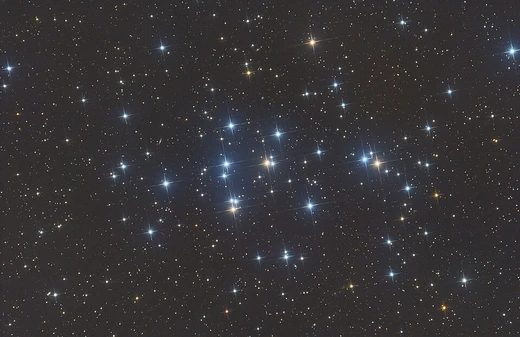
GCIRS 13E
A small cluster near the Galactic Center, possibly hosting an intermediate-mass black hole.

GCIRS 13E is an infrared and radio object near the Galactic Center, believed to be a cluster of hot massive stars. It is notable for possibly containing an intermediate-mass black hole (IMBH) at its center, though its true nature remains unknown.
- Type
- Infrared and radio object, star cluster
- Location
- Near the Galactic Center
- Number of identified objects
- 19
- Number of stars
- 4
- Star types
- WN8 and WC9 Wolf–Rayet stars; an OB supergiant; a K3 giant
- Proposed imbh mass
- about 1,300 M☉
- Migration distance
- from about 60 light-years further out
Lore & Background
GCIRS 13E was first identified as GCIRS 13, later resolved into two components: GCIRS 13E and W. Initially modeled as a single object, possibly a binary system, it was even classified as a Wolf–Rayet star (WR 101f) due to its strong emission line spectrum. Higher-resolution imaging then resolved it into seven Wolf–Rayet and class O stars. The highest-resolution infrared imaging and spectroscopy now identify 19 objects in GCIRS 13E, of which 15 are dense gaseous regions and four are stars: WN8 and WC9 Wolf–Rayet stars, an OB supergiant, and a K3 giant.
Reader's Guide
GCIRS 13E is significant because its members' motions indicate a much higher mass than can be accounted for by visible objects, leading to the proposal of an intermediate-mass black hole of about 1,300 M☉ at its center. However, there are a number of problems with this theory, and the true nature of the cluster remains unknown. The cluster is thought to have migrated inward toward the central supermassive black hole within the past 10 million years, probably from about 60 light-years further out, because massive stars cannot form so close to a supermassive black hole and have short lifespans. The stars may be the remains of a globular cluster where a middleweight black hole could develop through runaway star collisions. Alternatively, GCIRS 13E could be a dark star cluster that forms in the inner Galaxy if the evaporation rate of stars from the cluster is faster due to a strong tidal field than the depletion of the black hole content through ejections.
Did You Know?
- GCIRS 13E was initially classified as a Wolf–Rayet star and named WR 101f.
- The proposed intermediate-mass black hole at its center would have a mass of about 1,300 M☉.
- The cluster is thought to have migrated inward from about 60 light-years further out within the past 10 million years.
Discovery and the Long Road to Resolution
GCIRS 13E's identity has been a moving target for astronomers. What began as a single infrared and radio source near the Galactic Center was first catalogued simply as GCIRS 13. As observational tools improved, that single point of light was split into two distinct components, GCIRS13E and GCIRS13W. For a time, GCIRS 13E itself was modelled as one object, perhaps a binary pair. Its powerful emission-line spectrum led researchers to classify it as a Wolf–Rayet star, and it even received the designation WR 101f. That picture proved too simple. Higher-resolution work revealed seven Wolf–Rayet and class O stars packed into the region. Today, the sharpest infrared imaging and spectroscopy can distinguish nineteen separate objects within GCIRS 13E, though fifteen of those turn out to be dense gaseous regions rather than individual stars. Only four are confirmed stellar bodies. The journey from one fuzzy blob to a resolved cluster of hot, massive stars illustrates how dramatically our view of the Galactic Center has sharpened over the decades.
The Ghost Mass and the IMBH Question
The orbital motions of GCIRS 13E's member stars tell a story that the visible stars alone cannot explain. The cluster appears to contain far more mass than the handful of luminous objects we can actually see. This discrepancy has led to a bold proposal: an intermediate-mass black hole, weighing roughly 1,300 times the mass of the Sun, may lurk at the cluster's heart, invisible except for its gravitational pull. Such an object would sit in a mass range between stellar-mass black holes and the supermassive black hole at the Galactic Center, making it a tantalizing and rare class of compact object. Yet the hypothesis is not without difficulties. Several problems have been raised that complicate a straightforward IMBH interpretation, and the true nature of the unseen mass remains an open question. GCIRS 13E thus stands as one of the most debated potential IMBH candidates in the sky, a place where gravity's fingerprints are unmistakable but the source of that gravity is still hidden from direct observation.
A Cluster on the Move
The very presence of GCIRS 13E so close to the supermassive black hole at the Galactic Center raises a formation puzzle. Massive stars, the kind that dominate this cluster, are thought to be unable to form in the extreme environment that close to a supermassive black hole. Moreover, such stars burn through their fuel quickly, giving them lifespans measured in mere millions of years. Both facts point to the same conclusion: GCIRS 13E must have arrived at its current orbit relatively recently, within the last ten million years or so. The leading idea is that the cluster migrated inward from a position roughly sixty light-years farther out. One scenario envisions GCIRS 13E as the surviving core of a globular cluster that drifted into the inner Galaxy, where runaway collisions between stars could have produced a middleweight black hole. Another possibility is that it is a dark star cluster born in the inner Galaxy, where the strong tidal field strips stars away faster than the central black hole is ejected, leaving a compact remnant.
The Stellar Census
Despite the cluster's small size, the stars it does contain are extraordinary. The four confirmed stellar members include a WN8 Wolf–Rayet star and a WC9 Wolf–Rayet star, both representing late-stage, extremely hot, massive stars that have shed their outer hydrogen or helium layers. Alongside them sits an OB supergiant, a luminous star of the earliest spectral types, and a K3 giant, a cooler evolved star that provides a striking contrast to the blazing blue giants. The remaining fifteen objects identified in the highest-resolution observations are not stars at all but dense gaseous regions, likely clouds of ionized material shaped by the intense radiation and winds of the massive stars. Together, these components paint a picture of a compact, young stellar system dominated by a handful of the most massive and short-lived stars known. The coexistence of Wolf–Rayet stars, an OB supergiant, and a K3 giant in such a tight grouping makes GCIRS 13E a uniquely rich laboratory for studying the late evolutionary stages of massive stars in the harsh gravitational environment of the Galactic Center.
Frequently Asked Questions
What is GCIRS 13E?
GCIRS 13E is a compact infrared and radio-emitting object near the Galactic Center, generally interpreted as a small cluster of hot, massive stars. It contains roughly 19 identified objects, of which four stand out as particularly notable members.
What kinds of stars are in GCIRS 13E?
The cluster includes a WN8 Wolf–Rayet star, a WC9 Wolf–Rayet star, an OB supergiant, and a K3 giant. This mix of extremely evolved and very massive stars in such a tight grouping is unusual and makes the cluster a unique stellar laboratory.
Does GCIRS 13E host a black hole?
Researchers have proposed that an intermediate-mass black hole of roughly 1,300 solar masses sits at the cluster's center, but this has never been definitively confirmed. The true nature of whatever mass dominates the system remains an open question in astrophysics.
Where is GCIRS 13E located?
It resides in the immediate vicinity of the Galactic Center, the dense core region of the Milky Way. Its proximity to Sgr A* places it in one of the most extreme gravitational and radiation environments in our galaxy.
Why is GCIRS 13E important to the study of black holes?
If the suspected central mass is indeed an intermediate-mass black hole, GCIRS 13E would be one of the very few known IMBH candidates, bridging the gap between stellar-mass and supermassive black holes. Even if the IMBH hypothesis is wrong, the cluster's unusual stellar population in a tight configuration near the Galactic Center keeps it a high-priority target for follow-up observations.
More in Star Clusters 1-24
Spotted an error? Know more?
Reader corrections go straight into our review queue. Suggest an edit · How this site is sourced