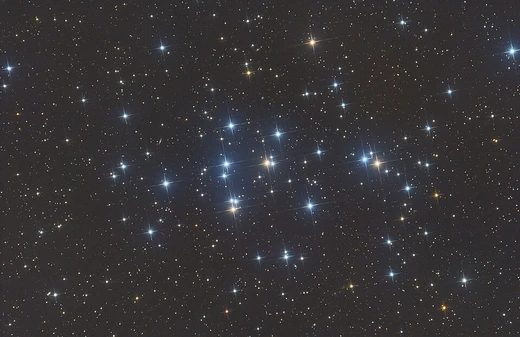
Open cluster remnant
Final evolutionary stage of an open star cluster.

An open cluster remnant (OCR) is the final evolutionary stage of an open star cluster. Theoretical work by Viktor Ambartsumian and Lyman Spitzer demonstrated that a star cluster cannot fully evaporate. Spitzer proposed two possible endpoints: either evaporation triggers physical collisions between stars, or it continues until a stable binary or higher-order multiple system remains.
Observational searches for OCRs in the Milky Way have been conducted using objective-prism plates. These studies assumed that remnant stars share similar luminosity and spectral type. About 30% of the objects examined could be classified as possible cluster remnants, each with at least 15 member stars. These systems typically have ages around 150 million years, ranging from 50 to 200 million years. They show a high density of binaries, including many optical binaries. The stars tend to be massive and early-type (A to F), though this is partly due to a selection effect: bright early-type spectra are easier to detect than fainter, later-type ones. Almost no stars later than type F appear in these samples.
However, these results are not fully conclusive. Some sky regions contain many stars of the same spectral type but lack matching proper motions or radial velocities. A notable example is Upgren 1, a small group of seven F stars originally thought to be an old cluster remnant. Later work showed it is a chance alignment of stars from two dynamically distinct groups passing close together. One of those groups includes five stars, among them a long-period binary and an unusual triple system.
Numerical simulations of systems with 25 to 250 stars suggest that the final outcome is one or more tightly bound binaries, or even a hierarchical triple system. Several observational candidates have been proposed, including σ Ori, ADS 12696, ρ Oph, 1 Cas, 8 Lac, 67 Oph, and the Ursa Major moving group (Collinder 285).
- Theorists
- Viktor Ambartsumian (1938), Lyman Spitzer (1940)
- Observational work
- Lodén (1987, 1988, 1993)
- Typical age
- about 150 Myr (range 50-200 Myr)
- Membership threshold
- ≥ 15
- Spectral types
- early-type (A-F), almost none later than F
- Simulation contributors
- von Hoerner (1960, 1963), Aarseth (1968), van Albada (1968)
- Observational candidates
- σ Ori, ADS 12696, ρ Oph, 1 Cas, 8 Lac, 67 Oph, Ursa Major moving group (Collinder 285)
Lore & Background
The theoretical foundation for open cluster remnants was laid by Viktor Ambartsumian in 1938 and Lyman Spitzer in 1940, who demonstrated that a star cluster cannot evaporate entirely. Spitzer proposed two possible outcomes: evaporation leading to physical collisions between stars, or evaporation proceeding until a stable binary or higher multiplicity system remains.
Observational searches for OCRs were conducted by Lodén using objective-prism plates, under the assumption that remnant stars should have similar luminosity and spectral type. About 30% of his sample were possible OCRs, with membership of at least 15 stars, typical ages around 150 Myr, and a high density of binaries. The stars tended to be massive, early-type (A-F), though this included a selection effect favoring bright early-type spectra.
Lodén's results were not fully conclusive; some groupings like Upgren 1—initially thought to be an old cluster remnant—were later shown to be chance alignments. Numerical simulations by von Hoerner, Aarseth, and van Albada suggested that the final outcome for clusters of 25–250 stars is one or more tightly bound binaries or hierarchical triples. Van Albada listed several observational candidates, and Wielen added the Ursa Major moving group.
Reader's Guide
The concept of open cluster remnants is significant because it addresses the ultimate fate of open star clusters, a common type of stellar grouping. The theoretical work of Ambartsumian and Spitzer established that clusters cannot vanish completely, leading to the prediction of bound remnants. Lodén's observational surveys provided the first systematic search for such objects, finding that roughly 30% of his sample could be OCRs, though selection effects and ambiguous cases like Upgren 1 highlighted the difficulty of confirmation. Numerical simulations reinforced the idea that the end state is typically a binary or triple system. The legacy of this research lies in its integration of theory, observation, and simulation to define a distinct class of stellar system. The candidates proposed by van Albada and Wielen remain reference points for further study, and the ongoing refinement of observational techniques continues to test the predictions. The work underscores the dynamic evolution of star clusters and the importance of binary systems in stellar astronomy.
Did You Know?
- Viktor Ambartsumian and Lyman Spitzer independently showed that a star cluster cannot evaporate completely.
- Lodén found that about 30% of his sample could be possible open cluster remnants.
- The typical age of observed OCR candidates is about 150 Myr, with a range of 50–200 Myr.
Formation and Dissolution
Open clusters originate when a giant molecular cloud collapses and a fraction of its mass—typically around one-tenth—condenses into stars while the remainder is expelled by radiation pressure from the newly formed group. In their youth, these clusters can still be embedded within their parent cloud, their combined light ionizing the surrounding gas to produce a glowing H II region. However, the gravitational bond holding tens to a few thousand stars together is relatively weak. As the cluster orbits the Galactic Center, close encounters with other star groups and dense gas clouds gradually strip away members through internal interactions and tidal effects. Most open clusters therefore dissolve into the general stellar population of the Milky Way within a few hundred million years, though the most massive examples can persist for several billion years. More than 1,100 such clusters have been catalogued in our galaxy, with many additional ones still undiscovered.
A Window into Stellar Evolution
Because every member of an open cluster condensed from the same parent cloud at essentially the same time, the stars share a common age and chemical makeup. This uniformity makes it far simpler to measure properties like distance, metallicity, extinction, and space velocity than it is for a random field star, whose history is obscured by individual circumstances. For that reason, open clusters serve as natural laboratories for tracing how stars of different masses evolve over time. Their presence is also a diagnostic of galactic environment: they have been identified only in spiral and irregular galaxies, precisely the types where active star formation is ongoing. The fact that they are absent from elliptical galaxies, where star formation has long ceased, reinforces the link between cluster birth and the presence of fuel-rich molecular gas.
From Fuzzy Patches to Resolved Star Groups
For centuries, open clusters appeared to the unaided eye or through early instruments as soft, nebulous smudges. Ptolemy listed several in his Almagest, and the Persian observer Al-Sufi described the Omicron Velorum group, yet none could be broken into individual stars. That changed in 1609 when Galileo Galilei pointed a telescope at these patches and revealed them as dense gatherings of suns—nearly fifty in the Pleiades alone, compared to the six or seven visible without aid. Inspired by his findings, the Sicilian astronomer Giovanni Hodierna went on to identify several previously unknown clusters in 1654. By 1767, Reverend John Michell had shown statistically that the Pleiades could not be a random line-of-sight alignment, cementing the idea of physical association. Messier's 1774–1781 catalogue added twenty-six more, and William Herschel in the 1790s proposed that gravity itself drew scattered stars into clusters, laying the conceptual groundwork for modern cluster astronomy.
Observing and Measuring Cluster Members
Several open clusters are bright enough to be seen without any optical aid: the Pleiades, the Hyades, and the Alpha Persei Cluster all form recognizable star groups in the night sky. The Double Cluster in Perseus sits at the threshold of naked-eye perception, while the Wild Duck Cluster (M11) and many others require binoculars or a small telescope. Proving that the stars in these groups are truly gravitationally bound took precise astrometry. Micrometer position measurements by E. Schönfeld in 1877 and later by E. E. Barnard failed to detect any motion. It was not until 1918 that Adriaan van Maanen, comparing photographic plates of the Pleiades taken years apart, measured a shared proper motion. Subsequent spectroscopic work confirmed common radial velocities, demonstrating that cluster stars move together through space as a coherent system rather than as a chance projection.
Frequently Asked Questions
What exactly is an open cluster remnant?
An open cluster remnant is the last surviving phase of an open star cluster after the vast majority of its original members have been lost to the surrounding interstellar medium. It represents the endpoint of cluster evolution rather than a new type of object.
Who first theorized that open clusters leave behind remnants?
Viktor Ambartsumian (1938) and Lyman Spitzer (1940) independently showed that a cluster cannot simply evaporate away entirely. Spitzer outlined two possible fates: either physical stellar collisions are triggered, or a tight binary or higher-order multiple system endures.
What do open cluster remnants look like in observational surveys?
Lodén's searches in the late 1980s and early 1990s used objective-prism plates and assumed the surviving members share similar luminosity and spectral type. The remnants are dominated by early-type stars in the A-to-F range, with almost no members later than F.
How old are open cluster remnants, and how many stars do they contain?
They typically sit around 150 million years old, with estimates spanning roughly 50 to 200 million years. A group generally needs at least about 15 members to be classified as a remnant rather than a chance alignment.
Why are open cluster remnants important to astrophysicists?
They offer a natural window into how stellar systems disperse and how tight multiple systems form over hundreds of millions of years. Early N-body simulations by von Hoerner, Aarseth, and van Albada in the 1960s provided the dynamical framework for understanding these final stages.
More in Star Clusters 1-24
Spotted an error? Know more?
Reader corrections go straight into our review queue. Suggest an edit · How this site is sourced