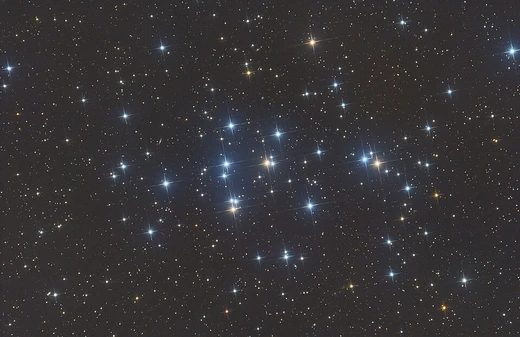
Nuclear star cluster
Dense, luminous star clusters at galactic centers, often coexisting with supermassive black holes.

A nuclear star cluster (NSC), also called a compact stellar nucleus or, occasionally, a young stellar nucleus, is a dense, bright cluster of stars located near the gravitational center of many galaxies, including our own Milky Way. In fainter, lower-mass galaxies, NSCs serve as the central massive objects, often coexisting with supermassive black holes (SMBHs) or existing where no such black hole is present. The most massive galaxies, however, lack NSCs entirely. Some galaxies, the Milky Way among them, host both an NSC and an SMBH of roughly similar mass.
The relationship between massive black holes and dense nuclear star clusters was quantitatively established in 2009. A subsequent discovery in 2016 revealed a scaling relation linking the mass of a central supermassive black hole to the mass of its surrounding nuclear star cluster. This connection is crucial for understanding how these central objects evolve together and for predicting the rates of extreme mass-ratio inspirals (EMRIs), which future space-based gravitational wave observatories like LISA could detect.
**Properties**
Nuclear star clusters are present in most galaxies that can be resolved in enough detail: at least 50% of early spiral galaxies (types Sa–Sc), at least 75% of late spiral galaxies (types Scd–Sm), and at least 70% of spheroidal galaxies (types S0 and E). They are the densest known star clusters in the universe. With infrared apparent magnitudes between -14 and -10, they are, on average, about 40 times brighter than globular clusters, yet their effective radii are no larger than 2 to 5 parsecs. Their dynamical masses range from 10⁶ to 10⁸ solar masses, placing them at the upper end of what globular clusters can reach. Most nuclear star clusters contain a mix of old stellar populations (at least one billion years old) and young ones, with signs of star formation occurring within the last 100 million years.
- Apparent magnitude range
- -14 to -10 mag in the infrared
- Average brightness relative to globular
- 40 times brighter
- Effective radius range
- 2 to 5 parsecs
- Dynamic mass range
- 10^6 to 10^8 solar masses
- Occurrence in early spiral galaxies
- at least 50%
- Occurrence in late spiral galaxies
- at least 75%
- Occurrence in spheroidal galaxies
- at least 70%
Lore & Background
Nuclear star clusters are the densest known star clusters in the Universe. With apparent magnitudes between -14 and -10 mag in the infrared, they are on average 40 times brighter than globular clusters, although their effective radii are not larger than 2 to 5 parsecs. With a dynamic mass of 10^6 to 10^8 solar masses, they are at the upper end of the values reached by globular clusters. The majority of nuclear star clusters contain a mix of old (at least one billion years old) and young stellar populations and show signs of star formation within the last 100 million years.
The co-existence of massive black holes and dense nuclear star clusters was quantified in 2009. Following this, a scaling relation between the mass of the central supermassive black hole and the mass of the nuclear star cluster was discovered in 2016. This relation is important for understanding the co-evolution of these central massive objects and for predicting rates of extreme mass-ratio inspirals (EMRIs) detectable by future space-based gravitational wave observatories such as LISA.
Although the mechanisms behind their formation are not entirely known, hypotheses provide four possibilities: nuclear star clusters originate somewhere else and are captured by a central black hole; they are due to an incidence of gas at some distance from the center of the galaxy; a combination of the above possibilities whereby the gravitational potential of a trapped object, such as the nucleus of a dwarf galaxy, triggers new star formation by incident gas near the galactic center; or they are created by merging star clusters with subsequent migration to the galactic center due to dynamical friction with background stars.
Reader's Guide
Nuclear star clusters are notable as the central massive objects of fainter, low-mass galaxies, where supermassive black holes often co-exist or are not present. In the most massive galaxies, NSCs are entirely absent. Some galaxies, including the Milky Way, are known to contain both a NSC and a SMBH of comparable mass. The quantification of their co-existence in 2009 and the discovery of a scaling relation between their masses in 2016 are significant for understanding the co-evolution of these central massive objects. This scaling relation also helps predict rates of extreme mass-ratio inspirals (EMRIs) detectable by future space-based gravitational wave observatories such as LISA. Because nuclear star clusters occur in most galaxy species, they should still be present in the halo of the resulting galaxy after the fusion of galaxies, forming a hypothesis for the origin of globular clusters. Alternatively, nuclear star clusters could be the result of a fusion of globular clusters captured by a supermassive black hole and dynamically destroyed. Their high density and luminosity, combined with their presence in a majority of resolved galaxies, make them key objects for studying galactic centers and the interplay between star clusters and black holes.
From Fuzzy Blobs to Resolved Stars: The Long Road to Recognition
Globular clusters have a remarkably long observational history that stretches back to antiquity. The cluster now designated M 22 was first catalogued in 1665 by the German amateur astronomer Abraham Ihle, while the brilliant Omega Centauri had been recorded by Ptolemy and other ancient observers as nothing more than a bright star. It was not until Edmond Halley reclassified it as a nebula in 1677, and later John Herschel confirmed its true nature in the early nineteenth century, that its identity shifted. For much of the eighteenth century, these objects appeared through modest telescopes as indistinct smudges, which is why Charles Messier dutifully listed many of them alongside comets in his catalog. Abbé Lacaille added several more entries in his 1751–1752 survey. The breakthrough came when Messier managed to resolve individual stars in M 4 in 1764, a feat made possible by improved optics. William Herschel then launched a sweeping survey in 1782, adding thirty-six new clusters and becoming the first observer to break virtually every known globular into its constituent stars. In his 1789 catalogue he formally introduced the term "globular cluster," a name drawn from the Latin word for small sphere that has endured to this day.
Shapley's Revolution: Mapping the Sun's True Position
In 1914 Harlow Shapley embarked on an ambitious programme of globular cluster research that would span roughly forty published papers. His method centred on RR Lyrae variable stars, which he initially mistook for Cepheids, using their brightness and pulsation periods to gauge how far each cluster lay from Earth. Because RR Lyrae stars are actually fainter than Cepheids, his distance estimates ran too high, placing typical clusters at ten to thirty kiloparsecs rather than the roughly eight-and-a-half kiloparsecs we now accept for the Galactic Centre. Despite that miscalibration, Shapley's 1918 analysis of the clusters' strongly lopsided sky distribution delivered a far more important result: the Milky Way's true centre lies toward the constellation Sagittarius, not anywhere near the Sun. This finding overturned the earlier assumption, drawn from the apparently even spread of ordinary stars, that we occupied a central position. The key insight was that most ordinary stars reside in the galactic disk, where interstellar gas and dust block their light, whereas globular clusters orbit well outside that disk and remain visible across enormous distances. Shapley's work thus repositioned humanity within the galaxy for the first time.
Structure, Distribution, and Galactic Context
A globular cluster is a tightly packed, roughly spherical assembly of stars held together by mutual gravity, with stellar density peaking sharply toward the core. Individual clusters can house anywhere from tens of thousands to many millions of members, all tracing stable orbits within a compact volume. This architecture sets them apart from open clusters, whose stars are only loosely gravitationally bound and are far more vulnerable to disruption by passing molecular clouds or tidal forces. Globular clusters also resemble dwarf spheroidal galaxies in overall shape, and although they were long considered the more luminous of the two categories, the discovery of extreme outliers has blurred that boundary by the early twenty-first century. In spiral galaxies such as our own, these clusters predominantly inhabit the outer spheroidal halo rather than the flat disk. They represent the largest and most massive class of star cluster, tending to be older, denser, and poorer in heavy elements than their open-cluster counterparts. The Milky Way alone is home to over one hundred and fifty known globulars, the Andromeda Galaxy may harbour as many as five hundred, and giant ellipticals like M 87 can possess up to thirteen thousand. Every sufficiently massive galaxy in the Local Group appears to host its own population.
Ancient Origins and the Puzzle of Formation
Despite their ubiquity, the birth and evolutionary role of globular clusters remain genuinely unresolved. Many are among the oldest objects known in their host galaxies and perhaps in the entire universe, making them invaluable anchors for constraining the age of the cosmos. For decades the prevailing picture held that every star in a given cluster condensed simultaneously from a single star-forming nebula. Modern observations have shattered that simplicity: nearly all globular clusters now contain stars that formed at different epochs or display distinct chemical compositions, pointing to multiple rounds of star formation within a single system. Some researchers even propose that certain clusters are the surviving cores of smaller galaxies that were swallowed by larger ones during cosmic assembly. The ongoing discovery of new members underscores how much remains hidden. The Milky Way count climbed from eighty-three in 1915 to one hundred and sixty by 2011, when the VISTA infrared survey revealed VVV CL001 and VVV CL002. Many more are believed to lurk in the crowded galactic bulge or behind veils of interstellar dust, as was the case with the Palomar Globular Clusters, most of which were not identified until the 1950s.
Frequently Asked Questions
Who is Nuclear star cluster?
A nuclear star cluster (NSC) is an ultra-dense, brilliant knot of stars parked right at the gravitational heart of a galaxy. It shows up in a wide variety of galaxies, including our own Milky Way, and is sometimes nicknamed a compact or young stellar nucleus.
What are Nuclear star cluster's powers/role?
In lower-mass galaxies the NSC acts as the dominant central mass, either sharing that role with a supermassive black hole or filling the void where no black hole exists at all. In the Milky Way it coexists with the central SMBH, and the two happen to have roughly comparable masses.
Why is Nuclear star cluster important?
NSCs are a critical clue in the puzzle of how galactic centers form, because their mass range overlaps with that of supermassive black holes. They are detected in at least 50 % of early-type spirals and 75 % of late-type spirals, making them a defining feature of a large fraction of the universe.
How bright and massive is Nuclear star cluster compared to other clusters?
An NSC shines about 40 times brighter than a typical globular cluster while fitting inside an effective radius of only 2–5 parsecs, with a dynamic mass between 10⁶ and 10⁸ solar masses. In the infrared its apparent magnitude falls roughly in the –14 to –10 range.
More in Star Clusters 1-24
Spotted an error? Know more?
Reader corrections go straight into our review queue. Suggest an edit · How this site is sourced