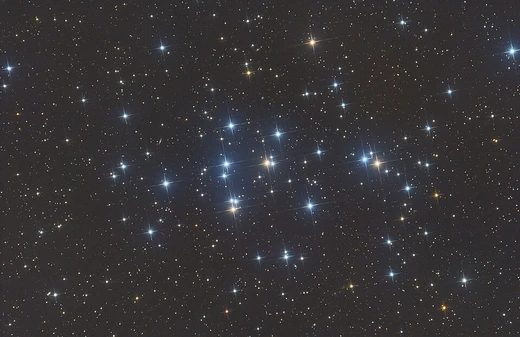
OB association
Loose, unbound groups of young, massive O and B stars.

An OB association is a loose, young grouping of massive stars, mostly of spectral types O and B. These stars are hot, blue, and extremely bright, with masses ranging from 10 to 90 times that of the Sun. An association typically includes 10 to 100 or more such massive stars, along with many smaller ones, all moving together and sharing similar ages and chemical makeup—evidence they formed from the same material. Unlike star clusters, OB associations are not held together by gravity and will gradually drift apart over a few million years.
The concept of stellar associations was introduced by Armenian astronomer Victor Ambartsumian in 1947. He separated them from bound clusters, defining OB associations for O and B stars and T associations for cooler, variable T Tauri stars. Since then, OB associations have been found not only in the Milky Way but also in other galaxies, helping astronomers study how stars form.
OB associations arise inside giant molecular clouds, where dense pockets of gas and dust collapse into stars. The massive O and B stars form close together, but their intense radiation, stellar winds, and eventual supernovae blow away the surrounding gas. This reduces gravitational pull and causes the group to expand as an unbound system, resulting in a lower star formation efficiency than in bound clusters. These associations are sparse, often spanning 700 to 1,500 light-years across, and look quite different from compact clusters. They are very young—typically only a few million years old—because O-type stars burn through their fuel in 1 to 15 million years, and B-type stars last only a bit longer. OB associations are commonly found in the spiral arms of galaxies like the Milky Way, often near open star clusters. Their massive stars can shine up to 100,000 times brighter than the Sun and usually end their lives as supernovae.
Notable examples include the Scorpius-Centaurus association, the closest to Earth at about 400 light-years away, which contains bright stars in Scorpius, Centaurus, Lupus, and Crux, including the nearby red supergiant Antares. Another is the Orion OB1 association, linked to the Orion Nebula and the active star-forming region of the Orion Molecular Cloud Complex.
- Introduced by
- Victor Ambartsumian
- Year introduced
- 1947
- Typical diameter
- 700 to 1,500 light-years
- Typical age
- a few million years
- Mass range of massive stars
- 10 to 90 times that of the Sun
- Luminosity of massive stars
- up to 100,000 times brighter than the Sun
- Closest example
- Scorpius-Centaurus association, approximately 400 light-years away
Lore & Background
The concept of stellar associations, including OB associations, was introduced by Armenian astronomer Victor Ambartsumian in 1947. He distinguished them from bound clusters, categorizing them into OB associations (for O and B-type stars) and T associations (for cooler, variable T Tauri stars). Since their identification, OB associations have been observed not only in the Milky Way but also in nearby galaxies, contributing significantly to studies of galactic star formation.
OB associations form within giant molecular clouds, where dense regions of gas and dust collapse under gravity to produce stars. The massive O and B stars form in a relatively small volume, but stellar winds, radiation pressure, and supernovae from these stars expel surrounding gas, reducing gravitational cohesion and causing the group to expand as an unbound system. This process results in lower star formation efficiency compared to bound clusters, contributing to their dispersed nature.
OB associations are notably sparse, often spanning 700 to 1,500 light-years in diameter, and are visually distinct from compact clusters. They are typically very young, with ages of a few million years, as O-type stars have lifespans of 1 to 15 million years, while B-type stars last somewhat longer due to their rapid nuclear fuel consumption. These associations are often found in the spiral arms of galaxies like the Milky Way and are associated with nearby open star clusters.
Reader's Guide
OB associations are significant for their role in studies of galactic star formation, as they represent a common mode of star birth in giant molecular clouds. Their unbound nature, caused by stellar winds, radiation pressure, and supernovae from massive stars, results in lower star formation efficiency compared to bound clusters. The massive stars within them, with masses between 10 and 90 times that of the Sun and luminosities up to 100,000 times brighter than the Sun, frequently end their lives as supernovae. The closest example, the Scorpius-Centaurus association, is located approximately 400 light-years away and contains bright stars including Antares, one of the nearest red supergiants to Earth. Another prominent example is the Orion OB1 association, linked with the Orion Nebula and the active star-forming region of the Orion Molecular Cloud Complex. Since their identification in 1947, OB associations have been observed in nearby galaxies, contributing to the understanding of star formation beyond the Milky Way.
Did You Know?
- OB associations typically span 700 to 1,500 light-years in diameter.
- The closest OB association to Earth is the Scorpius-Centaurus association, about 400 light-years away.
- Massive stars in OB associations can be up to 100,000 times brighter than the Sun.
Defining Characteristics and Structure
OB associations are gravitationally unbound collections of young, massive stars—primarily of O and B spectral types—that share common motion vectors, ages, and chemical compositions, all pointing to a single shared birthplace. These stars are extraordinarily hot, blue, and luminous, with individual masses stretching from 10 to 90 times that of the Sun. A typical association contains anywhere from 10 to 100 or more of these massive members, embedded among a far larger population of lower-mass companion stars. What distinguishes them from denser star clusters is their lack of sufficient gravitational binding; they are sparse, sprawling systems that can span 700 to 1,500 light-years in diameter. The most massive members can blaze up to 100,000 times brighter than the Sun, and many will ultimately end their lives in supernova explosions. Their unbound, diffuse architecture means they are inherently transient structures, destined to disperse over millions of years rather than endure as a coherent stellar group.
Formation and Ephemeral Nature
OB associations are born within giant molecular clouds, where dense pockets of gas and dust collapse under gravity to ignite new stars. The massive O and B stars form in a relatively compact region, but their own fierce stellar winds, intense radiation pressure, and eventual supernova explosions rapidly blow away the surrounding gas. This expulsion strips the group of the gravitational cohesion that would otherwise hold it together, causing the stars to drift apart as an unbound, expanding system. The result is a lower star-formation efficiency compared to tightly bound clusters, reinforcing the dispersed character of the association. These structures are extremely young—typically only a few million years old—because O-type stars burn through their nuclear fuel in just 1 to 15 million years, while B-type stars survive somewhat longer due to their rapid fuel consumption. Their brief existence makes them valuable tracers of recent and ongoing star formation across galaxies.
Discovery and Broader Significance
The very concept of stellar associations was proposed in 1947 by Armenian astronomer Victor Ambartsumian, who recognized that some groups of stars were fundamentally different from the gravitationally bound clusters astronomers had long studied. He classified them into OB associations, dominated by hot O and B-type stars, and T associations, which contain cooler, variable T Tauri stars. Since that foundational identification, OB associations have been catalogued not only throughout the Milky Way but also in nearby galaxies, making them a crucial tool for understanding how stars form across the universe. Their presence in the spiral arms of galaxies like our own, often in proximity to open star clusters and active molecular cloud complexes, has deepened our understanding of galactic star-formation cycles and the interplay between massive stars and their gaseous environments.
Notable Examples in Our Sky
Two OB associations stand out for their proximity and visibility. The Scorpius-Centaurus association, at roughly 400 light-years from Earth, is the nearest known OB association and scatters bright stars across the constellations of Scorpius, Centaurus, Lupus, and Crux. It even hosts Antares, one of the closest red supergiants to our solar system. The Orion OB1 association, set within the constellation of Orion, is intimately linked to the famous Orion Nebula and the active star-forming region known as the Orion Molecular Cloud Complex, making it a natural laboratory for studying how massive stars emerge from dense gas. Both examples illustrate how OB associations serve as the broader, looser context in which the more compact, well-known star clusters and nebulae are embedded, revealing that the most dramatic stellar nurseries are part of vast, diffuse, and short-lived stellar families.
Frequently Asked Questions
What is an OB association?
An OB association is a loose, unbound collection of young, massive stars—mostly O and B spectral types—whose masses range from 10 to 90 solar masses and whose combined output can reach 100,000 times the Sun's luminosity. They share similar ages and chemical signatures, pointing to a common birth environment.
How big and how old are OB associations typically?
They generally stretch across 700 to 1,500 light-years and are only a few million years old, making them some of the youngest visible groupings of stars in the galaxy.
What's the real difference between an OB association and a star cluster?
The critical distinction is gravitational binding: a star cluster is held together by mutual gravity, whereas an OB association is not, so its members are free to drift apart rather than orbit a common center of mass.
Who coined the idea of stellar associations and when?
Victor Ambartsumian introduced the concept in 1947, recognizing that these loose groupings of hot, blue stars shared common motion and composition even though they lacked the gravitational cohesion of a true cluster.
More in Star Clusters 1-24
Spotted an error? Know more?
Reader corrections go straight into our review queue. Suggest an edit · How this site is sourced