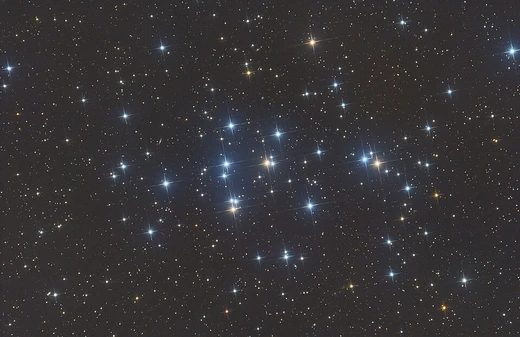
Mayall II
Brightest globular cluster in the Local Group, orbiting Andromeda.

Mayall II—also cataloged as NGC-224-G1, SKHB 1, GSC 2788:2139, HBK 0-1, M31GC J003247+393440, and Andromeda's Cluster—is a globular cluster that orbits the Andromeda Galaxy (M31). Situated about 130,000 light-years (40 kiloparsecs) from Andromeda’s core, it is the Local Group’s most luminous globular cluster in absolute terms, with an absolute visual magnitude of −10.94 and a brightness equivalent to 2 million Suns. Its apparent magnitude in the V band is 13.81. Mayall II is roughly twice as massive as Omega Centauri and may harbor a central intermediate-mass black hole of around 20,000 solar masses.
American astronomers Nicholas Mayall and Olin J. Eggen first identified it as a possible globular cluster in 1953, using a Palomar 48-inch (1.2-meter) Schmidt plate exposed in 1948. Because its stars show a wide spread in metallicity—evidence of multiple generations of stars and a prolonged period of star formation—many astronomers argue that Mayall II is not a true globular cluster but rather the stripped core of a dwarf galaxy that was consumed by Andromeda.
The cluster’s names reflect its discoverers: Mayall II honors Nicholas U. Mayall, who co-discovered it with Eggen in 1953. SKHB 1 stands for Sargent, Kowal, Hartwick, and van den Bergh, who named it G1 in 1977. HBK 0-1 comes from Huchra, Brodie, and Kent in 1991.
- Absolute visual magnitude
- −10.94
- Luminosity
- 2 million Suns
- Apparent magnitude v band
- 13.81
- Distance from andromeda core
- 130,000 light-years (40 kpc)
- Mass comparison
- twice the mass of Omega Centauri
- Central black hole mass
- ~2×10^4 M☉ (intermediate-mass, may contain)
- Discovery year
- 1953
- Discoverers
- Nicholas Mayall and Olin J. Eggen
Lore & Background
Mayall II was first identified as a possible globular cluster by American astronomers Nicholas Mayall and Olin J. Eggen in 1953 using a Palomar 48-inch (1.2 m) Schmidt plate exposed in 1948. It is located 130,000 light-years from the Andromeda Galaxy's galactic core and is the brightest globular cluster in the Local Group, with an absolute visual magnitude of −10.94 and the luminosity of 2 million Suns. It has an apparent magnitude of 13.81 in V band and is considered to have twice the mass of Omega Centauri, and may contain a central, intermediate-mass black hole of about 2×10^4 solar masses.
Because of the widespread distribution of metallicity, indicating multiple star generations and a large stellar creation period, many contend that it is not a true globular cluster, but is actually the galactic core that remains of a dwarf galaxy consumed by Andromeda. The cluster is also known by several other names: SKHB 1 (named for Sargent, Kowal, Hartwick, and van den Bergh in 1977) and HBK 0-1 (named for Huchra, Brodie, and Kent in 1991).
Reader's Guide
Mayall II holds significance as the brightest globular cluster in the Local Group, with an absolute visual magnitude of −10.94 and a luminosity of 2 million Suns. Its mass is twice that of Omega Centauri, and it may host a central intermediate-mass black hole of about 2×10^4 solar masses. The cluster's widespread metallicity distribution suggests multiple generations of stars and a prolonged star formation period, leading many to argue that it is not a true globular cluster but rather the remnant core of a dwarf galaxy that was consumed by the Andromeda Galaxy. Discovered in 1953 by Nicholas Mayall and Olin J. Eggen using a Palomar 48-inch Schmidt plate from 1948, it has been cataloged under multiple designations, including SKHB 1 (1977) and HBK 0-1 (1991). Its legacy lies in challenging the definition of globular clusters and providing insight into galaxy merger processes.
Did You Know?
- Mayall II is the brightest globular cluster in the Local Group by absolute magnitude, with a luminosity of 2 million Suns.
- Many contend it is not a true globular cluster but the core of a dwarf galaxy consumed by Andromeda.
More in Star Clusters 1-24
Spotted an error? Know more?
Reader corrections go straight into our review queue. Suggest an edit · How this site is sourced