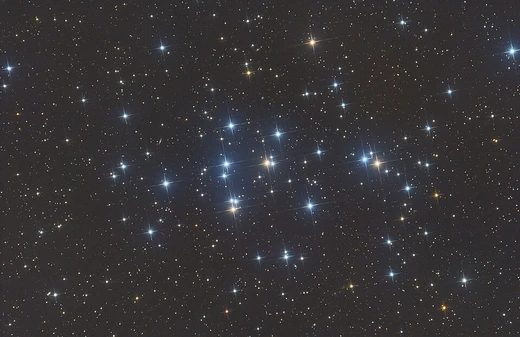
Laevens 1
The most distant Milky Way globular cluster known.

Laevens 1, also cataloged as Crater, the Crater cluster, or PSO J174.0675-10.8774, is a faint globular cluster discovered in 2014 within the constellation Crater. It holds the distinction of being the most remote globular cluster associated with the Milky Way, residing in the galaxy’s halo roughly 145 kiloparsecs (470,000 light-years) away. With an estimated age of 7.5 billion years, it likely joined our galaxy well after the Milky Way formed, probably during an encounter with the Small Magellanic Cloud.
Early studies mistakenly classified Laevens 1 as a satellite galaxy, based on a handful of blue loop stars and a sparse red clump. The presence of such stars would suggest star formation within the last 400 million years—highly unusual for a globular cluster. However, later work indicated that some of these stars were incorrectly attributed to the cluster, skewing the analysis. After removing them, researchers concluded Laevens 1 is instead a faint, intermediate-age globular cluster.
This cluster orbits the Milky Way at roughly the same distance as the ultrafaint dwarf galaxies Leo IV and Leo V, suggesting that all three objects may have once been closely linked before falling together into the Milky Way’s halo.
- Discovery year
- 2014
- Constellation
- Crater
- Distance
- 145 kiloparsecs (470 kly)
- Age
- 7.5 Gyr
- Alternate names
- Crater, the Crater cluster, PSO J174.0675-10.8774
Lore & Background
Laevens 1 was discovered in 2014 and is also known as Crater, the Crater cluster, and PSO J174.0675-10.8774. At a distance of 145 kiloparsecs (470 kly), it is the most distant Milky Way globular cluster yet known, residing in the galactic halo. With an age of only 7.5 Gyr, it is likely to have been incorporated into our galaxy long after the formation of the Milky Way, probably during an interaction with the Small Magellanic Cloud.
Some analyses initially categorized it as a satellite galaxy due to the presence of a handful of blue loop stars and a sparsely populated red clump, which would imply relatively recent star formation (within 400 Myr). Such recent formation would be very atypical for a globular cluster. More recent work suggests that some of these stars were erroneously assigned membership of the cluster, distorting the overall result. After removing these, the subsequent reanalysis concluded that Laevens 1 is a faint, intermediate-age globular cluster.
Laevens 1 is orbiting the galaxy at approximately the same distance as the ultrafaint dwarf galaxies Leo IV and Leo V. This hints that all three satellites may once have been closely associated before falling together into the Milky Way halo.
Reader's Guide
Laevens 1 holds significance as the most distant Milky Way globular cluster known, offering insights into the outer reaches of the galactic halo. Its intermediate age of 7.5 Gyr suggests it was not formed with the Milky Way but was later incorporated, likely during an interaction with the Small Magellanic Cloud. The initial misclassification as a satellite galaxy, due to stars that were later found to be erroneously assigned, highlights the challenges in studying faint, distant clusters. Its similar orbital distance to the ultrafaint dwarf galaxies Leo IV and Leo V hints at a possible common origin, suggesting these satellites may have fallen into the Milky Way together. This cluster thus provides a window into the accretion history of our galaxy and the nature of its outer stellar populations.
Did You Know?
- Laevens 1 is the most distant Milky Way globular cluster known, at 145 kiloparsecs (470 kly).
- It was initially misclassified as a satellite galaxy due to blue loop stars and a red clump.
- The cluster is likely to have been incorporated into the Milky Way during an interaction with the Small Magellanic Cloud.
More in Star Clusters 1-24
Spotted an error? Know more?
Reader corrections go straight into our review queue. Suggest an edit · How this site is sourced