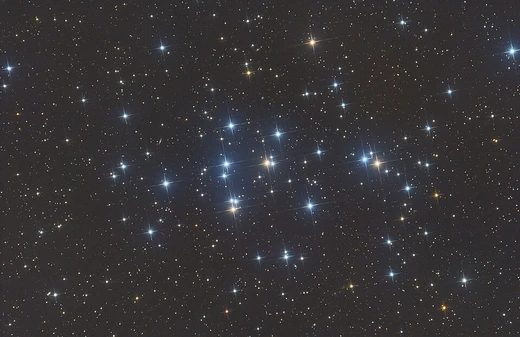
FSR 1758
A large, obscured globular cluster possibly from an accreted dwarf galaxy.

FSR 1758, also called the Sequoia Cluster, is a globular cluster in the Milky Way that is both large and bright, though heavily obscured. It lies about 11.5 kpc from the Sun and roughly 3.7 kpc from the galactic center, hidden behind the galactic bulge by foreground stars and dust. First spotted in 2007 in 2MASS data, it was initially thought to be an open cluster until 2018, when Gaia mission data confirmed it as a globular cluster. Its size and brightness may rival or surpass those of Omega Centauri, which is widely considered the remnant core of a dwarf galaxy that merged with the Milky Way. This has led to speculation that FSR 1758 could itself be the nucleus of a dwarf galaxy, tentatively named the Scorpius Dwarf. It may also resemble Messier 54, known as the core of the Sagittarius Dwarf Spheroidal Galaxy. The term "Sequoia" was first used by Barbá et al. to describe the cluster’s size. Myeong et al. later adopted the name in a different sense, proposing that FSR 1758 was one of five globular clusters originally belonging to a dwarf galaxy they re-name as the Sequoia dwarf. This dwarf was accreted into the Milky Way during what they call the Sequoia Event, and its members follow a retrograde galactic orbit. Several other research groups have since taken up this terminology. In 2025, a study using the Very Large Telescope examined the metal-poor star BPM 3066, a candidate member of either the Sequoia galaxy or the accreted Thamnos galaxy. The star, which has a retrograde orbit, showed unusually high levels of lithium and beryllium in its spectrum. One hypothesis is that it was once near a hypernova; some chemical abundances support this idea, while others do not. An alternative explanation is that the star engulfed a rocky planet rich in lithium and beryllium.
- Distance from sun
- about 11.5 kpc
- Distance from galactic center
- about 3.7 kpc
- First noticed
- 2007 in 2MASS data
- Reclassified as globular cluster
- 2018 via Gaia mission data
- Alternative name
- Sequoia Cluster
Lore & Background
FSR 1758 was first noticed in 2007 in 2MASS data and initially believed to be an open cluster, until data from the Gaia mission revealed in 2018 that it is a globular cluster. It lies behind the galactic bulge, heavily obscured by foreground stars and dust. Its size and brightness may be comparable to or exceed that of Omega Centauri, which is widely believed to be the nucleus of a dwarf galaxy that merged into the Milky Way in the past. Therefore, FSR 1758 may be the nucleus of a dwarf galaxy tentatively named the Scorpius Dwarf galaxy. It may also be similar to another globular cluster, Messier 54, which is known to be the nucleus of the Sagittarius Dwarf Spheroidal Galaxy. After Barbá et al. used the term Sequoia to describe the size of FSR 1758, Myeong et al. used the term in a slightly different way. They believe that FSR 1758 was one of five globular clusters that populated a dwarf galaxy that Myeong et al. re-name as the Sequoia dwarf galaxy. This dwarf was accreted into the Milky Way in the Sequoia Event. The members of Sequoia have a retrograde galactic orbit. This term has been adopted by several other groups.
Reader's Guide
FSR 1758's significance lies in its potential as the remnant nucleus of an accreted dwarf galaxy, the Scorpius Dwarf galaxy, and its role in the Sequoia Event, a proposed accretion event in which a dwarf galaxy merged with the Milky Way. The cluster's size and brightness may rival Omega Centauri, a known dwarf galaxy nucleus, suggesting a similar origin. The term 'Sequoia' was first used by Barbá et al. to describe its size, then repurposed by Myeong et al. to name a dwarf galaxy that included FSR 1758 among its five globular clusters. This dwarf galaxy was accreted in the Sequoia Event, and its members have retrograde galactic orbits. The term has been adopted by several other groups. A 2025 study using the Very Large Telescope observed the metal-poor star BPM 3066, a candidate member of either the Sequoia galaxy or the accreted Thamnos galaxy. The star, in a retrograde orbit, showed unusual high amounts of lithium and beryllium. One suggestion is that it was close to a hypernova in the past, though some chemical abundances support this hypothesis while others speak against it. An alternative explanation is that the star engulfed a rocky planet rich in lithium and beryllium.
Did You Know?
- It was reclassified as a globular cluster in 2018 using data from the Gaia mission.
- The star BPM 3066, a candidate member of the Sequoia galaxy, showed unusual high amounts of lithium and beryllium in its spectrum.
More in Star Clusters 1-24
Spotted an error? Know more?
Reader corrections go straight into our review queue. Suggest an edit · How this site is sourced